
Key Highlights
- Discovery:Astronomers confirm an atmosphere on LHS 1140 b, a rocky exoplanet.
- Location:The planet is located 48 light-years from Earth, within its star's habitable zone.
- Significance:This finding strengthens the case for studying potentially habitable worlds.
Astronomers have made a significant breakthrough in the search for extraterrestrial life by confirming the presence of an atmosphere on LHS 1140 b, a rocky exoplanet located approximately 48 light-years from Earth. This discovery is pivotal as it sheds light on one of humanity's oldest questions: could there be other worlds capable of supporting life? While the answer remains elusive, the evidence gathered brings the search into sharper focus.
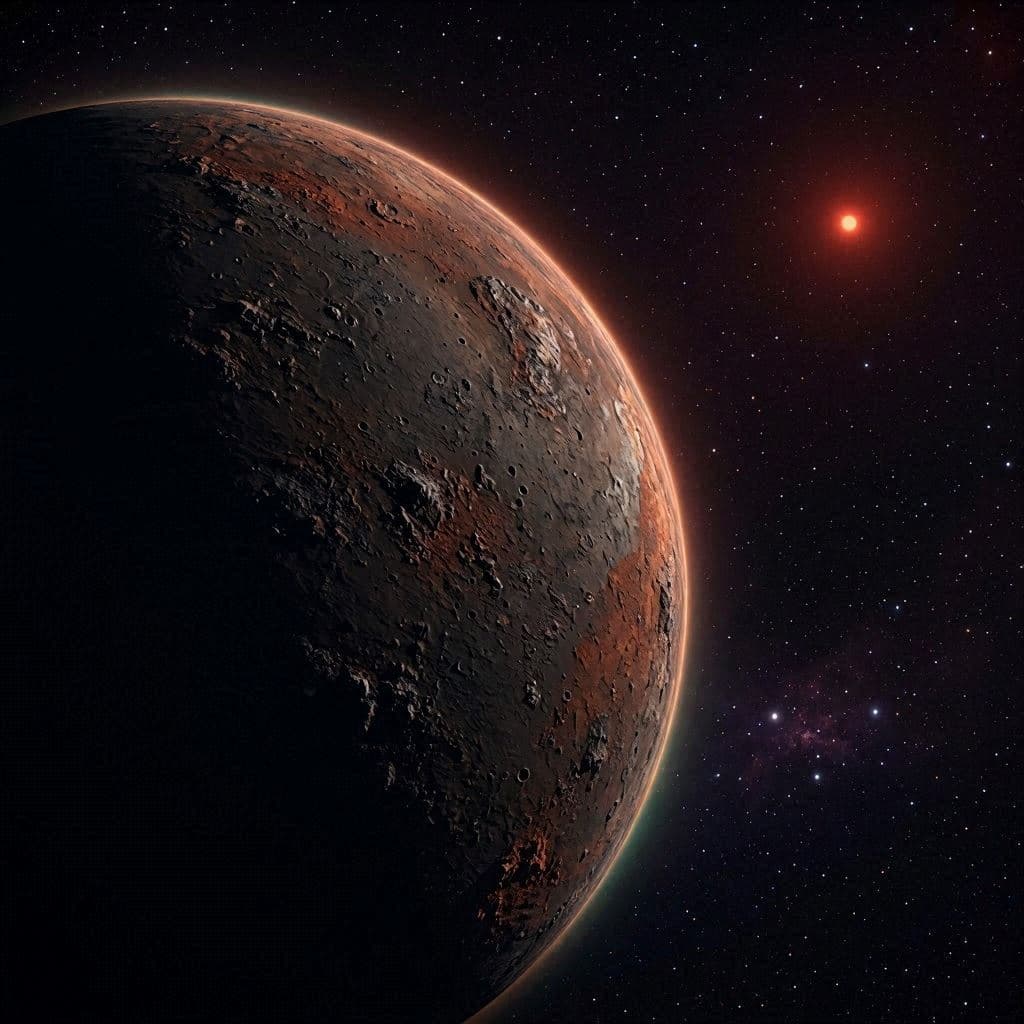
LHS 1140 b is classified as a "super-Earth," orbiting a relatively quiet red dwarf star within its habitable zone. This zone is crucial because it is where conditions may allow for the existence of liquid water, a key ingredient for life as we know it. For years, astronomers have regarded LHS 1140 b as a prime candidate for further investigation, but confirming the presence of an atmosphere has proven to be a formidable challenge.
Recent observations from the Magellan Clay Telescope in Chile, combined with data from the WINERED spectrograph, have revealed helium escaping from the planet's upper atmosphere. While helium itself does not indicate the presence of life, it serves as compelling evidence that LHS 1140 b has retained an atmosphere. This marks the first confirmed atmospheric detection for a rocky planet located within the habitable zone of another star, a milestone in exoplanet research.
An atmosphere is essential for habitability as it regulates surface temperatures, protects the planet from harmful radiation, and helps preserve liquid water. Without such a protective layer, many planets, despite being in favorable positions, can become barren. Therefore, this discovery strengthens the scientific case for further studies of LHS 1140 b, although researchers caution against interpreting these findings as evidence of extraterrestrial life.
The observations reveal helium in the planet's upper atmosphere, but do not yet identify other critical molecules such as water vapor, oxygen, or methane that could provide deeper insights into the planet's environment. Future observations, particularly with NASA's James Webb Space Telescope, are expected to delve into the atmosphere's lower layers and determine its chemical composition, which could provide more clues about the planet's potential for supporting life.
This study also underscores the advancements in modern observational astronomy. Detecting the atmosphere of a relatively small rocky planet is significantly more challenging than studying the thick gaseous envelopes surrounding giant planets. Improved spectroscopic techniques now enable astronomers to distinguish subtle signals embedded within starlight, paving the way for examining increasingly Earth-like worlds.
Beyond LHS 1140 b, this discovery establishes an important benchmark for future exoplanet research. It demonstrates that rocky planets orbiting small stars can retain atmospheres over extended periods, encouraging astronomers to explore similar systems throughout the Milky Way. Each new observation contributes to a growing understanding of how common potentially habitable worlds may be.
While this discovery does not answer the question of whether life exists beyond Earth, it provides the strongest evidence yet that one nearby rocky world possesses a crucial ingredient for habitability. As more powerful telescopes continue their observations, LHS 1140 b will remain a focal point in the ongoing quest to uncover life beyond our solar system.
AI Image Disclaimer: The accompanying visuals are AI-generated artistic interpretations intended to illustrate the scientific concepts discussed and are not actual telescope images.
Published by Banx Network. This article is part of the Banx decentralized media programme, powered by the BXE token on the XRP Ledger.



