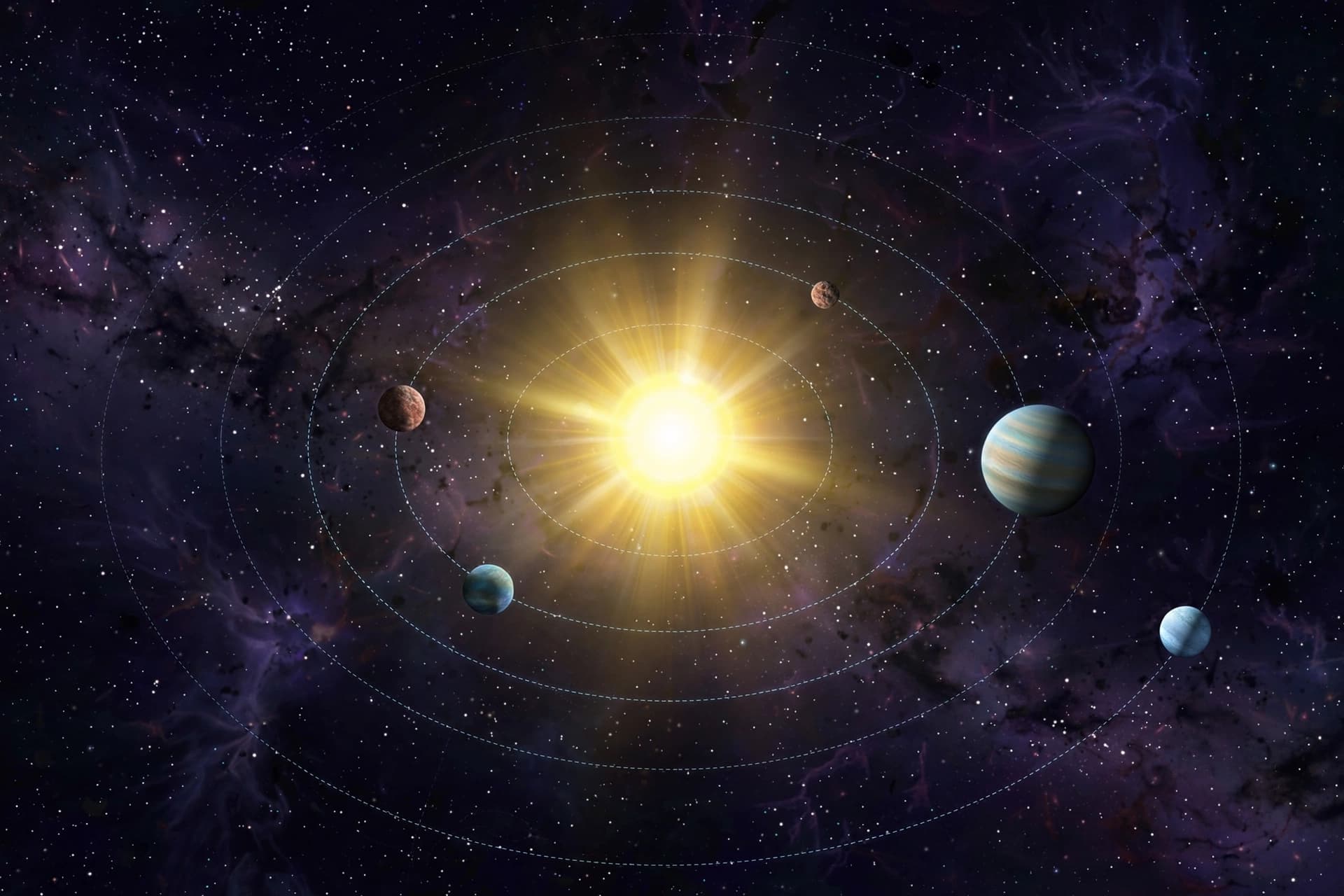
There is a kind of poetry in the cosmos — a quiet music we think we understand, until a curious chord causes us to pause. In the familiar rhythm of our own solar family, the inner planets are terrestrial, made of rock and metal, and the outer realms are home to giants wreathed in gases. Yet sometimes the universe composes a phrase that sounds unfamiliar, and that is precisely the feeling stirred by the recent discovery of an exoplanetary system that does not read like the textbooks.
Around the gentle glow of a small red dwarf star known as LHS 1903, about 117 light‑years away, astronomers have observed four planets — two rocky worlds and two gaseous mini‑Neptunes — arranged in a sequence that appears, at first glance, backwards. The first and nearest planet clings to the star with the kind of bare, dense solidity we expect. The next two, by contrast, are composed mostly of gas, substantial and swathed in lighter elements. Then comes another world of stone, farther out, where the cool darkness should favor gas giants instead.
This pattern, a kind of cosmic inside‑out, is more than an odd configuration; it is a gentle nudge to the scientific imagination. Standard theories of planetary formation — grounded in decades of observation and models based largely on our own solar neighborhood — suggest that rocky planets should nestle close to their star, where stellar heat strips away most light gases, and that giant gaseous planets should grow in cooler zones, where hydrogen and helium linger long enough to be drawn into massive envelopes. But here, that neat division blurs.
Scientists propose a thoughtful explanation rooted in cosmic patience: perhaps the outer rocky planet simply formed later, after the primordial disk of gas had thinned, leaving mostly dust and rock to coalesce. In that scenario, the building blocks of a gas giant were no longer abundant, and a solid world emerged in their stead. Observations from ESA’s CHEOPS telescope and others suggest this sequential, "inside‑out" formation could be a real pathway for planetary systems, especially around stars that differ from our Sun.
Such discoveries remind us, gently but persuasively, that our place in the cosmos is a singular reference point — not a universal rulebook. As more exoplanets are cataloged by instruments like NASA’s TESS and the James Webb Space Telescope, astronomers expect to encounter greater diversity in planetary architectures, each offering new insights into the processes that shape worlds.
In the end, science thrives on surprises that deepen our understanding rather than undermine it. The planets of LHS 1903 do not insult the laws of physics; they broaden them, inviting us to see planetary formation as a tapestry with more patterns than we once imagined. With future observations and refined theories, the narrative of how planets come to be will continue to unfold, written in the subtle language of rings, orbits, and starlight.
In this way, a distant solar system, quietly circling its star, has offered a fresh page in astronomy’s ongoing story — an elegant testament to the universe’s capacity to surprise.
AI Image Disclaimer (Rotated Wording) Visuals are created with AI tools and are not real photographs.
Source Check (5 major media names):
Reuters (science news) Space.com LiveScience Agencia EFE (reported via multiple outlets) Various science news summaries reinterpreting the finding (e.g., TheObjective)
Published by Banx Network. This article is part of the Banx decentralized media programme, powered by the BXE token on the XRP Ledger.