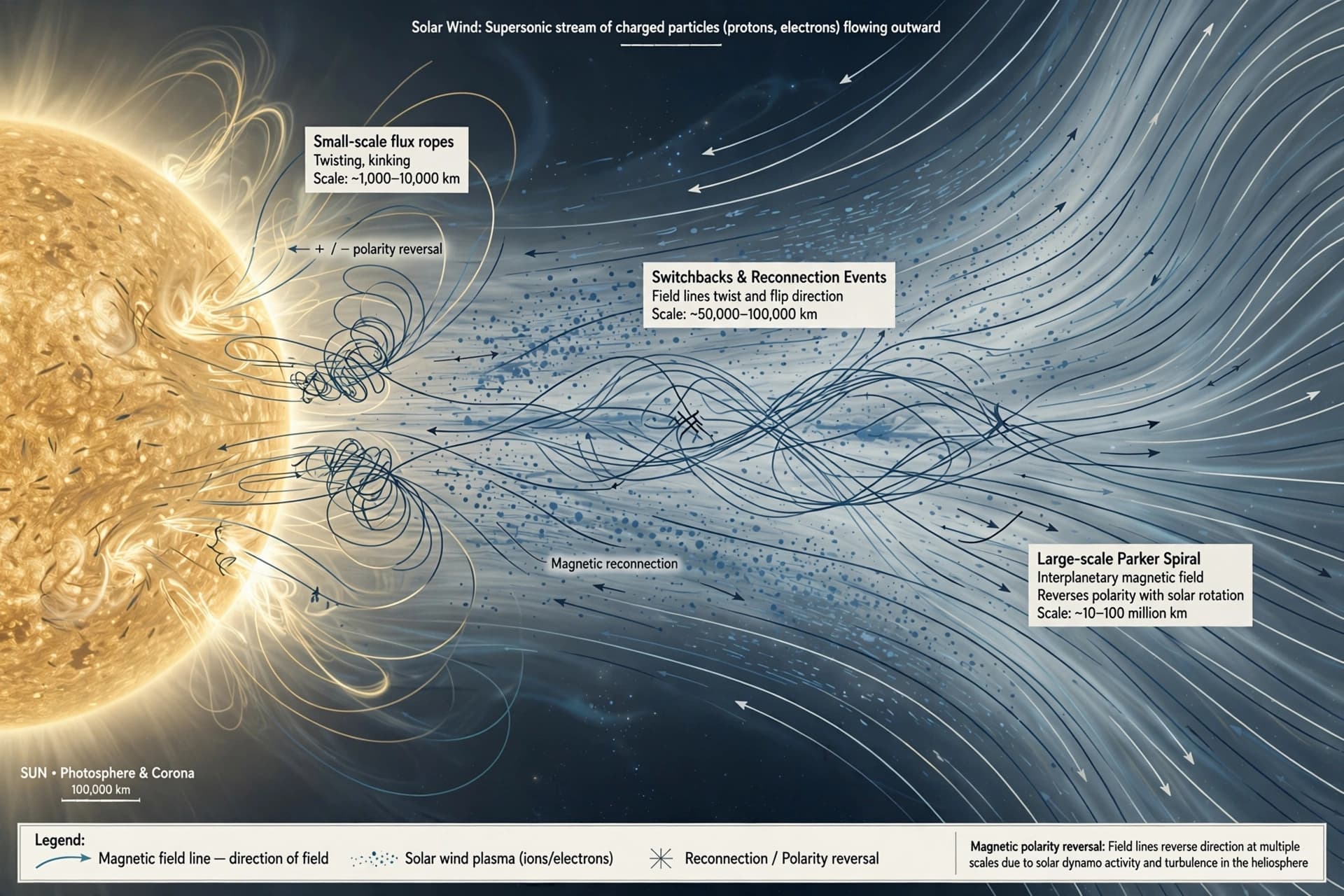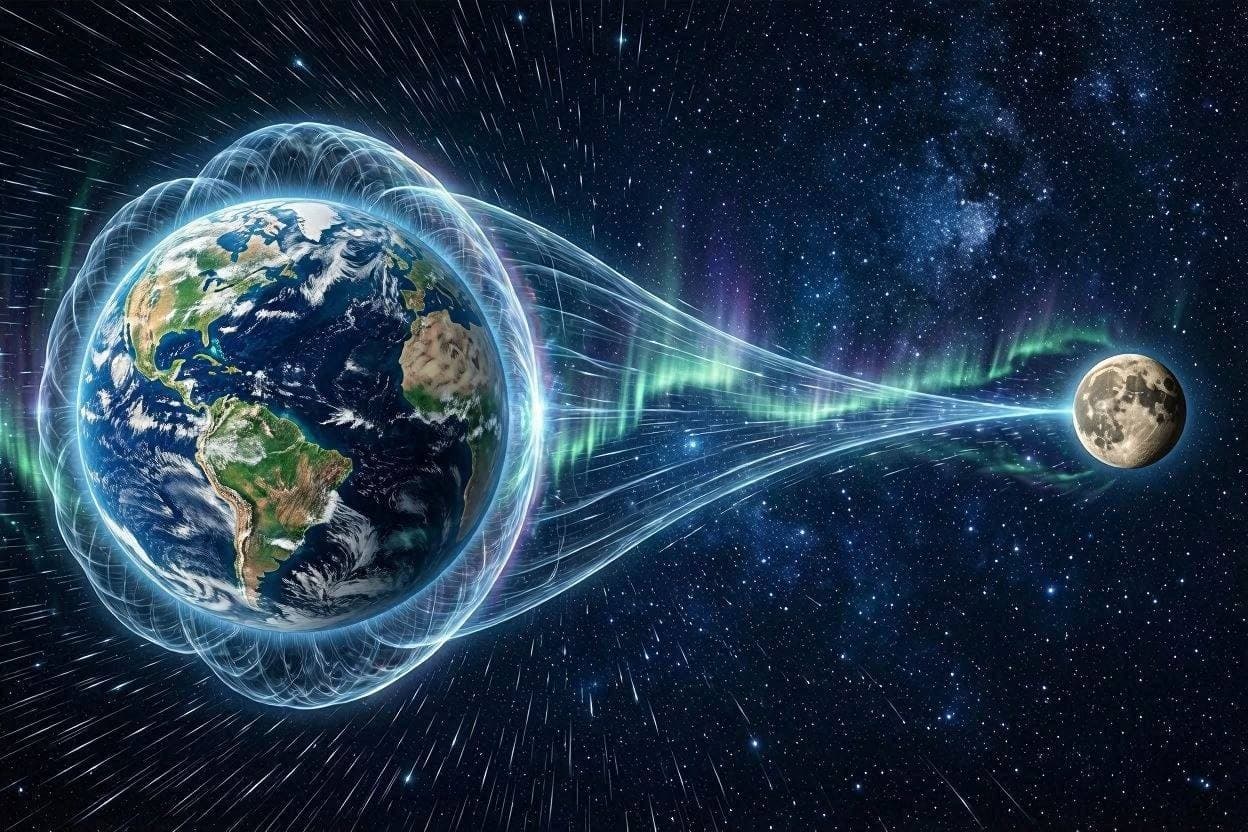
Opening: Space is often perceived as a vacuum, empty and silent, yet it is filled with dynamic forces that shape our celestial neighborhood. One such force is the solar wind, a stream of charged particles flowing constantly from the Sun. Recently, scientists have observed that Earth’s magnetic field does more than protect our own planet; it extends its influence far into space, acting as a shield that slows the solar wind before it reaches the Moon. This discovery offers a new perspective on the interconnectedness of our planetary system and the protective embrace of our magnetic bubble.
Body: The Earth’s magnetosphere, a region dominated by our planet’s magnetic field, stretches thousands of kilometers into space. When the solar wind encounters this barrier, it is deflected and slowed, creating a turbulent wake behind Earth. Data from NASA’s ARTEMIS mission has revealed that this wake extends all the way to the Moon’s orbit. During certain phases of the lunar cycle, the Moon passes through this protected zone, experiencing a significant reduction in the intensity of the solar wind.
This interaction is crucial for understanding the lunar environment. The solar wind plays a key role in weathering the lunar surface, altering the chemical composition of the soil, or regolith. By slowing the wind, Earth’s magnetic shield may preserve certain areas of the Moon from these effects, creating variations in surface properties that scientists are only beginning to map. This knowledge is vital for future lunar exploration and resource utilization.
The phenomenon also provides insights into plasma physics, the study of charged gases that make up most of the visible universe. Observing how the solar wind interacts with Earth’s magnetosphere helps researchers model similar processes around other planets and stars. The Moon serves as a natural detector, allowing scientists to measure changes in the solar wind’s speed and density as it passes through Earth’s shadow.
For astronauts planning long-duration stays on the Moon, understanding these magnetic dynamics is essential for safety. The solar wind carries radiation that can be harmful to human health. Knowing when the Moon is within Earth’s protective wake could help in scheduling outdoor activities to minimize exposure. This natural shielding offers a passive layer of defense that complements technological solutions.
The discovery highlights the delicate balance of forces in space. While the solar wind is a constant presence, its impact varies depending on planetary alignments and magnetic activity. Earth’s role as a protector extends beyond its atmosphere, influencing the space environment of its nearest neighbor. This interconnectedness reminds us that no planet exists in isolation.
As we prepare for a renewed era of lunar exploration, such findings inform mission planning and scientific objectives. Understanding the lunar surface’s history and current state requires a detailed knowledge of these space weather interactions. The data collected by missions like ARTEMIS continues to refine our models, ensuring safer and more effective exploration.
Closing: Earth’s magnetic shield extends its protection to the Moon, slowing the solar wind and altering the lunar environment. This discovery enhances our understanding of space weather and its implications for future exploration. As we look to the Moon, we see not just a destination, but a partner in our cosmic dance.
AI Image Disclaimer: Visuals in this piece are artificially generated and should be viewed as artistic interpretations rather than factual documentation.
Sources: NASA Space.com Scientific American Phys.org
Published by Banx Network. This article is part of the Banx decentralized media programme, powered by the BXE token on the XRP Ledger.