Space has long been imagined as sterile — a vast, airless expanse where life cannot easily follow. Rockets rise in pillars of flame, astronauts float in sealed capsules, and the void beyond Earth seems too harsh to harbor anything fragile. Yet wherever humans travel, invisible companions travel with them. Microbes, ancient and adaptable, cross thresholds without ceremony. As we look toward the Moon, Mars, and beyond, it may be time to rethink not only propulsion systems and habitats, but the microbial future of space travel itself.
Inside every spacecraft, a hidden ecosystem forms. Astronauts carry trillions of microorganisms in and on their bodies — bacteria essential to digestion, immunity, and overall health. Studies conducted aboard the International Space Station have shown that microgravity can alter microbial behavior. Some bacteria grow differently; others express genes in unexpected ways. Research published in Nature has explored how spaceflight conditions influence microbial virulence and resistance, raising important questions about crew safety on long-duration missions.
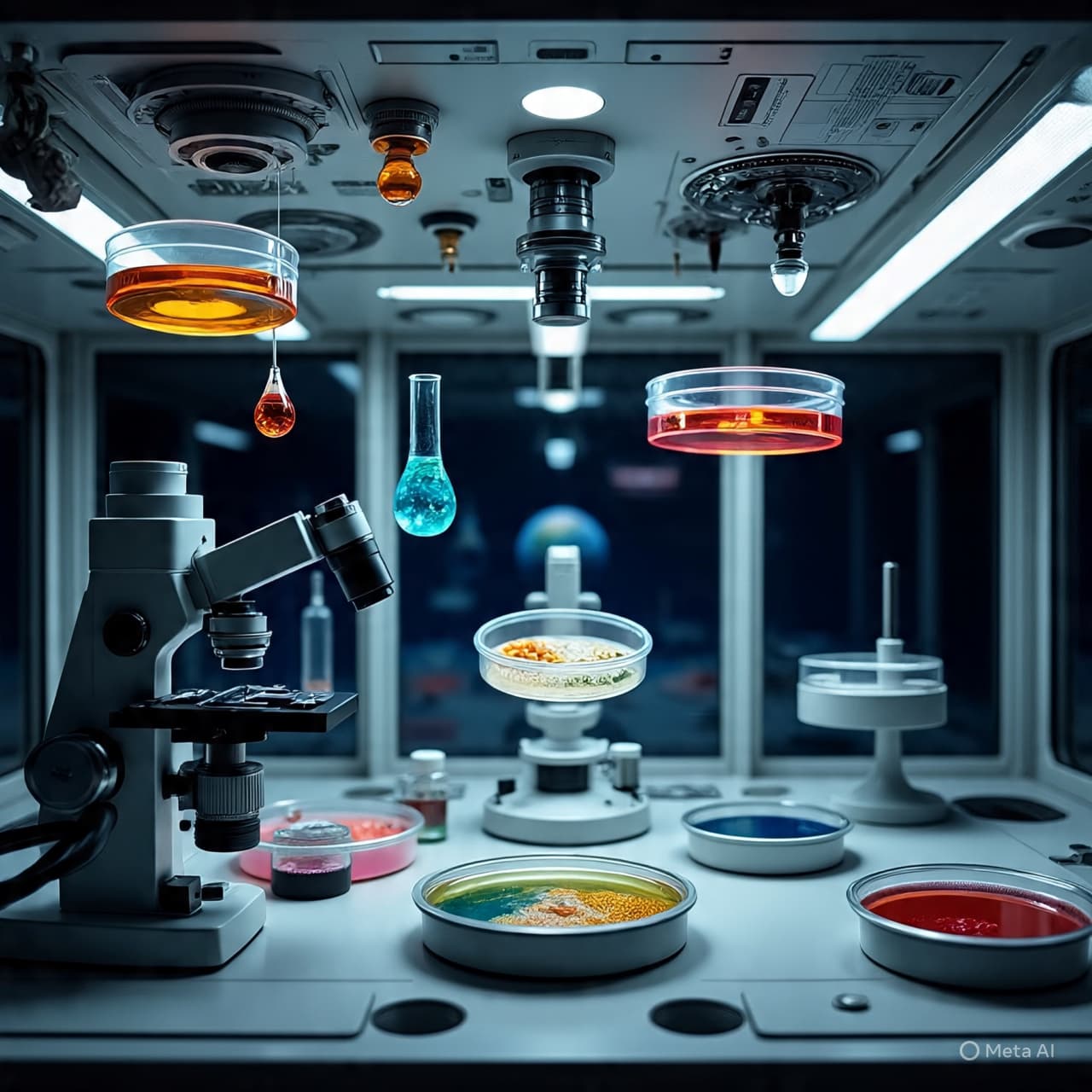
Meanwhile, agencies such as NASA carefully monitor microbial populations aboard spacecraft. Swabs of surfaces, air filters, and water systems reveal communities that evolve over time. The closed environment of orbit — controlled, recycled, and compact — becomes a laboratory for understanding how microbes adapt beyond Earth. Some strains appear to become more resilient under radiation and microgravity, though findings remain nuanced and subject to ongoing study.
The question extends beyond astronaut health. It touches planetary protection — the principle that exploration should avoid contaminating other worlds with terrestrial life. If microbes survive the journey, what happens when they encounter Martian soil or the icy plumes of Europa? International guidelines aim to minimize forward contamination, yet complete sterility is nearly impossible. The microbial future of space travel therefore carries ethical dimensions as well as scientific ones.
There is, however, another side to the story — one less about threat and more about partnership. Scientists are increasingly investigating how microbes might support human survival beyond Earth. Engineered bacteria could help recycle waste, produce oxygen, or even manufacture materials from local resources. Research discussed in outlets like Scientific American has highlighted experiments exploring microbial biomanufacturing in microgravity. In this vision, microbes are not stowaways but collaborators.
Long missions to Mars will demand closed-loop life support systems. Water must be purified and reused. Air must be scrubbed and regenerated. Food may need to be grown in controlled habitats. On Earth, microbes quietly power such cycles in soils, oceans, and our own bodies. Translating those processes into space habitats requires careful engineering — and careful humility. Microbial ecosystems are complex; they do not always behave predictably when removed from their native contexts.
The human microbiome itself may shift during prolonged spaceflight. Limited diets, radiation exposure, stress, and altered circadian rhythms could reshape gut communities. Scientists are studying whether these changes influence immunity or mood during missions. The idea that mental and physical resilience in space might depend partly on microscopic partners reframes exploration as a biological journey as much as a technological one.
As nations and private companies accelerate plans for lunar bases and Martian expeditions, the microbial dimension grows more relevant. Spacecraft design increasingly considers antimicrobial materials and filtration systems. At the same time, researchers explore probiotic strategies and synthetic biology tools that could harness microbes safely and effectively. The frontier is not only external; it is internal.
The story unfolding is neither cautionary nor celebratory alone. It is layered. Microbes have survived on Earth for billions of years, adapting to extremes of heat, cold, pressure, and radiation. It would be surprising if they did not adapt to space as well. The challenge lies in understanding how to guide that adaptation — to protect astronauts, preserve extraterrestrial environments, and perhaps use microbial ingenuity to sustain life far from home.
For now, space agencies continue to conduct controlled experiments aboard orbiting laboratories and simulation habitats. Findings are gradually shaping policy and design. The microbial future of space travel remains a developing field of research, grounded in both promise and precaution. As humanity prepares to extend its reach into the solar system, it does so accompanied by life too small to see — yet too significant to ignore.
AI Image Disclaimer
Visuals are created with AI tools and are not real photographs.
---
Sources
NASA Nature Scientific American The Guardian Space.com
Published by Banx Network. This article is part of the Banx decentralized media programme, powered by the BXE token on the XRP Ledger.