There are stories that begin not with footsteps on solid ground, but with questions that stretch out into the dark between stars — questions about home, time, and what it would mean to carry humanity beyond its cradle forever. In that spirit, a bold starship concept has captured the imagination of space thinkers and dreamers alike: a generation vessel so vast and self‑contained that it would not merely transport people, but nurture entire societies in the silence of interstellar space.
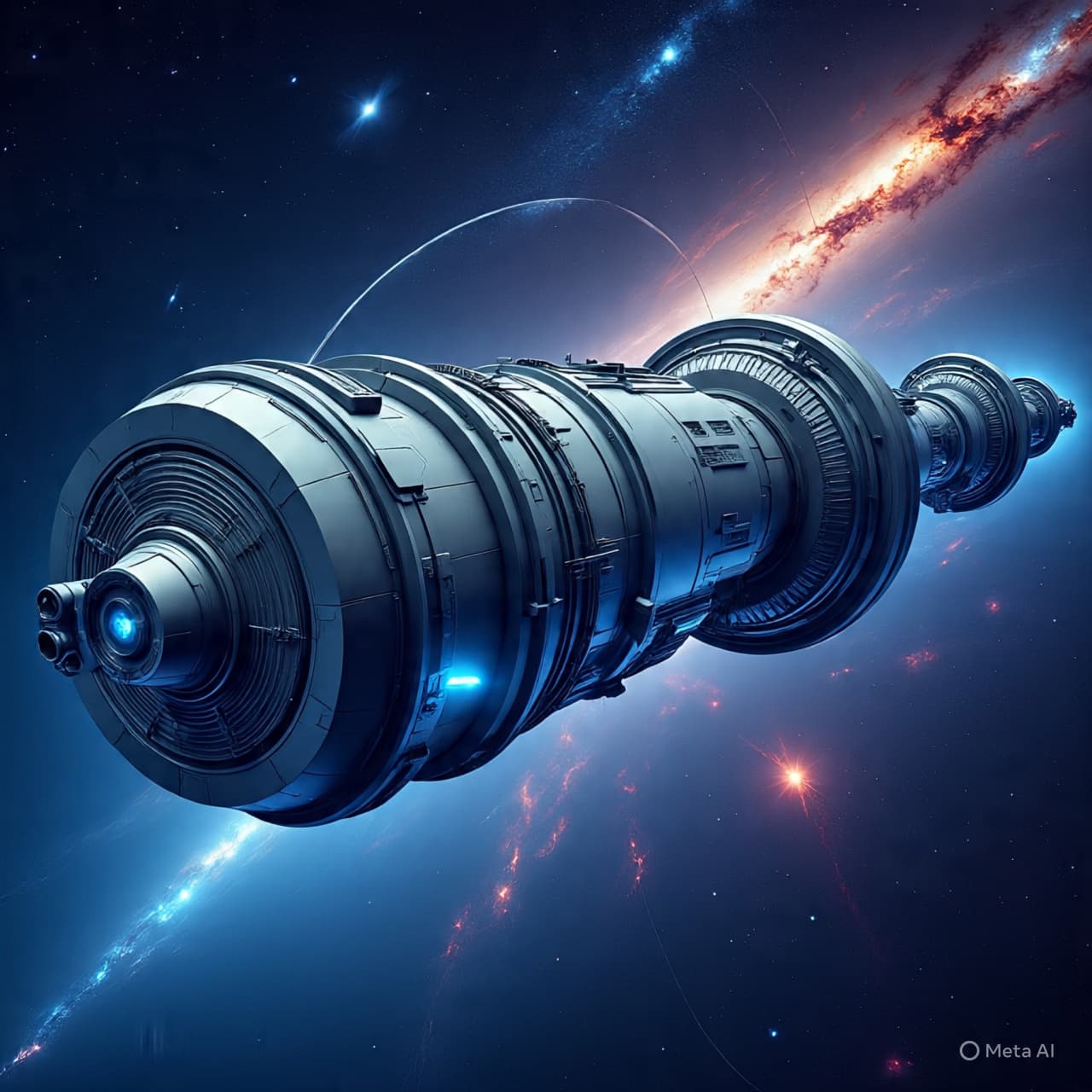
This concept design, known as Chrysalis, emerged from an international design competition aimed at probing what it would take to send humans on a one‑way journey between the stars. At roughly 36 miles (58 kilometers) end‑to‑end, Chrysalis is not a conventional spacecraft in the way familiar rockets are; instead, it resembles a mobile world, engineered to sustain life, culture, and community across multiple generations as it travels over hundreds of years toward a distant destination such as Proxima Centauri b. The proposal envisions a vessel that hosts up to 1,000 people, none of whom would return to Earth once they depart.
In the realm of interstellar concepts, Chrysalis represents an extreme form of what aerospace theorists call a generation ship — a self‑sustaining habitat in which the original crew ages and passes away, with their descendants continuing the voyage over centuries. Building such a ship assumes systems far beyond today’s technology, including life support capable of recycling air, water, and nutrients indefinitely, food production integrated into closed‑loop ecological systems, and artificial gravity generated by slow rotation to support human health.
The design documents developed by the Chrysalis team — winners of the Project Hyperion competition sponsored by the Initiative for Interstellar Studies — approach these challenges with remarkable depth. Instead of simple speculation, the proposal lays out physical architecture, mass budgets, agricultural modules, social governance models, and systems integration that treat closed‑loop living as a continuous process rather than a temporary experiment. Artificial gravity would be produced by concentric rotating cylinders sized to minimize physiological stress, while fusion power — still theoretical for spacecraft application — is proposed to drive propulsion and onboard energy needs.
Yet even as the vision stretches human ingenuity, it also underscores how much remains unknown. Fusion reactors adequate for space travel have not been built, and adequate radiation shielding for centuries in deep space exceeds current material capabilities. Closed ecological systems have been tested only in limited, short‑term environments far smaller than what Chrysalis would require. Moreover, the psychological and social dynamics of populations living in isolation for centuries — long beyond any human experience — remain purely theoretical domains.
The Chrysalis concept, therefore, serves as much as a thought experiment as a blueprint — inviting questions about identity, purpose, and survival in a universe far larger than any single life. What does it mean to be born into a journey with no return? How does community hold together when Earth becomes a memory? The answers lie not just in engineering manuals but in the human stories that we carry with us wherever we go.
In practical terms, Chrysalis remains a distant vision. Projects like the 100 Year Starship initiative have aimed to frame research pathways for sustained human interstellar travel, but concrete technology enabling such voyages is still beyond reach. Despite this, concepts like Chrysalis continue to stimulate discussion about long‑duration space missions, population sustainability in isolated environments, and the physical and ethical challenges of colonizing distant worlds.
For now, Chrysalis reminds us that the future of space exploration may not only be about going far, but about imagining what it would be like to stay far — to build communities under alien stars, sustained not by distance from Earth, but by the enduring spirit that first drove humans to look upward in wonder.
AI Image Disclaimer Visuals are AI‑generated illustrations, intended for conceptual depiction rather than actual representation.
Sources Daily Galaxy Indian Defence Review IFLScience (aggregated science reporting) Project Hyperion design competition context from generation ship studies
Published by Banx Network. This article is part of the Banx decentralized media programme, powered by the BXE token on the XRP Ledger.