

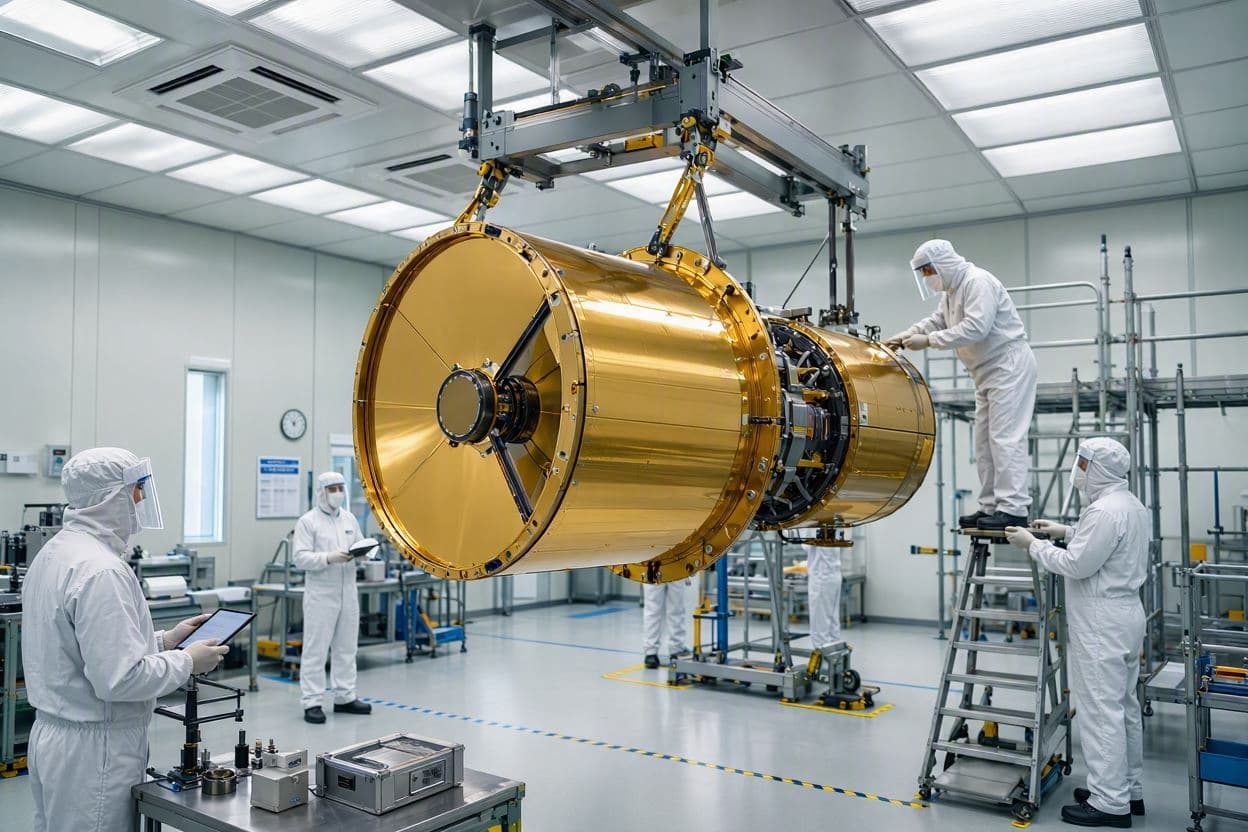
Scientific progress often moves to a rhythm that transcends political cycles. While administrations may change and budgets may fluctuate, the momentum of discovery can be difficult to halt. The Nancy Grace Roman Space Telescope, once facing uncertainty amid proposed budget cuts, has now reached the final stages of preparation for launch. Its journey from potential cancellation to imminent deployment serves as a reminder of the resilience of scientific institutions and the enduring value of long-term exploration.
During his presidency, Donald Trump’s administration proposed eliminating funding for the Roman Space Telescope in the federal budget request, citing cost concerns and shifting priorities. However, Congress repeatedly rejected these proposals, recognizing the telescope’s scientific potential and the significant investment already made in its development. This legislative support ensured that the project continued, albeit with some delays and adjustments.
Now, with construction complete and testing underway, the Roman Telescope is poised to revolutionize our understanding of the universe. Designed to study dark energy, exoplanets, and infrared astrophysics, it will complement the James Webb Space Telescope by surveying vast areas of the sky with high precision. Its wide field of view allows it to capture data on thousands of galaxies simultaneously, offering a broader perspective than previous missions.
The telescope’s ability to detect exoplanets through microlensing is particularly promising. This method can reveal planets that are far from their stars or even free-floating in interstellar space, populations that are difficult to detect with other techniques. By mapping these distant worlds, Roman will help astronomers understand the diversity of planetary systems in our galaxy.
Furthermore, Roman will investigate the mysterious force known as dark energy, which is driving the accelerated expansion of the universe. By measuring the distribution of galaxies and the effects of gravity on light, it aims to constrain the properties of dark energy and test competing cosmological models. This research could fundamentally alter our understanding of the universe’s fate.
The survival of the Roman Telescope highlights the importance of bipartisan support for science. Despite political disagreements, many lawmakers recognize that space exploration yields technological benefits, inspires future generations, and expands human knowledge. The collaboration between NASA, industry partners, and Congress demonstrates how complex projects can endure through changing political landscapes.
As the launch date approaches, excitement builds within the astronomical community. Scientists are eager to begin analyzing the data, knowing that every image could contain a new discovery. The telescope represents not just a machine, but a collective aspiration to understand the cosmos.
NASA has confirmed that the Roman Space Telescope is on track for launch in the mid-2020s. The agency continues to engage with the public and scientific community, preparing for a mission that promises to reshape our view of the universe.
AI Image Disclaimer: The images associated with this piece are AI-generated visualizations intended to represent the themes of space technology, political process, and astronomical discovery.
Published by Banx Network. This article is part of the Banx decentralized media programme, powered by the BXE token on the XRP Ledger.




