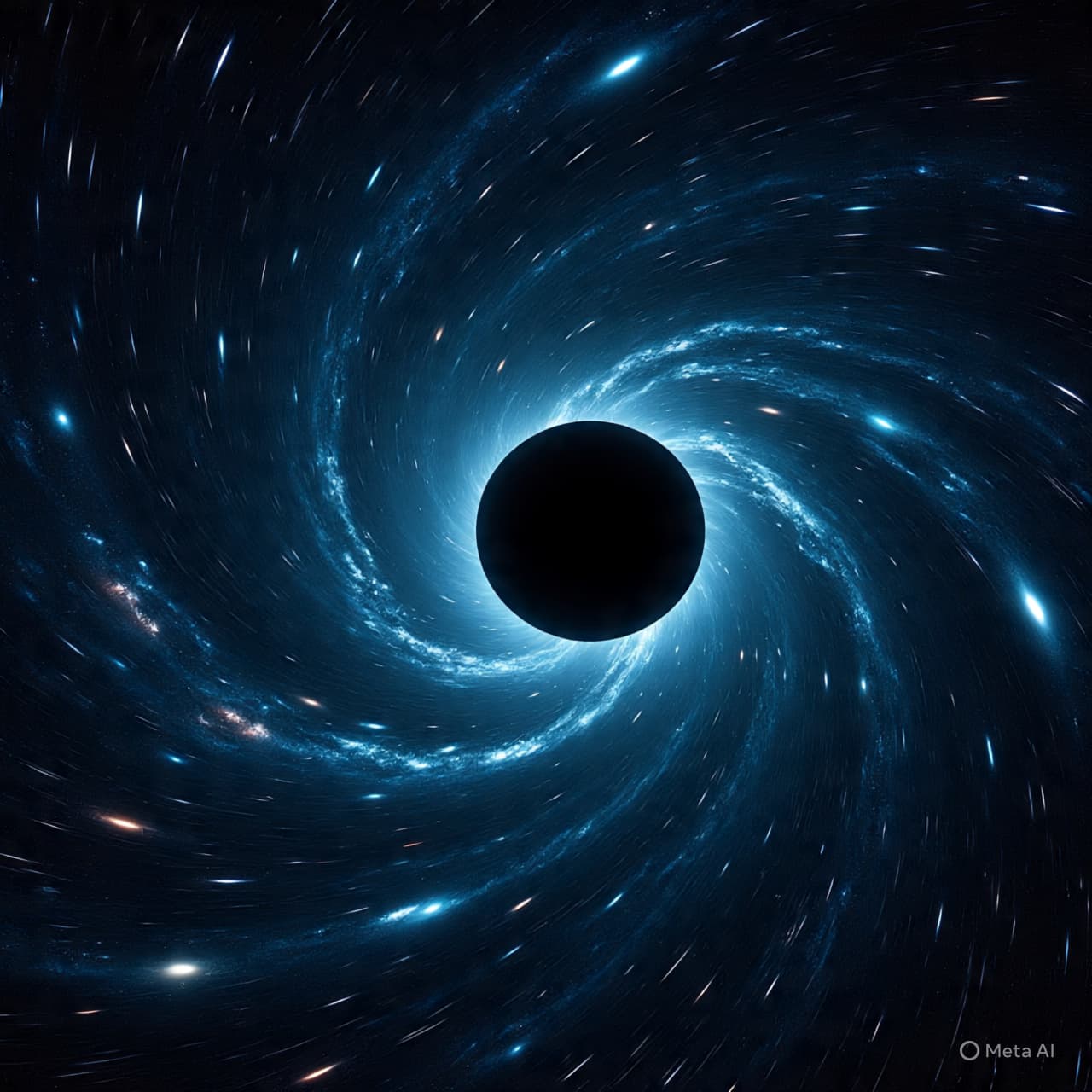
There are moments when the universe seems to whisper a story so sublime that even our greatest myths seem like gentle echoes beside it. In the vast theater of space, where light travels across millions of years to meet our gaze, a distant black hole — known by its scientific designation AT2018hyz and affectionately nicknamed “Jetty McJetface” — is telling such a tale. This is not a story of swords or lasers born in fiction, but of an extraordinary cosmic force whose energy outpouring has grown over years into something that humbles even our most dramatic imaginings.
In 2018, astronomers first noticed this black hole’s tidal disruption event, a phenomenon that occurs when a star wanders too close and is torn apart by unbeaten gravity. As the star’s remains are devoured, streams of matter fall inward and complex interactions among gas, magnetic fields, and gravity can launch powerful jets of energetic particles outward. With delicate persistence, researchers led by astrophysicist Yvette Cendes of the University of Oregon have tracked the increasing emission from this event — and what they found was unexpected.
Rather than fading after the star’s death, the black hole’s jet has grown brighter and more intense over time, now emitting energy many times greater than what it displayed upon first detection. It continues to intensify as observations span years — a rare and unusual evolution that has captured the attention of astronomers. Comparing its output to familiar cultural touchstones, scientists have calculated that the energy radiated by this black hole could be between one trillion and as much as 100 trillion times more powerful than the fictional Death Star’s energy output. In this poetic measure, what is imagined as destructive in story becomes an inviting lens through which to appreciate how much more immense and enduring cosmic phenomena can be compared with human creations, even those born in fiction.
The radio emissions detected from this distant jet — traveling near the speed of light — are a testament not only to the violence of a star’s end but also to the continuing complexity of cosmic processes long after the initial encounter. Rather than a single burst of energy, this black hole seems to sustain its brightness for years, much like a river that keeps flowing long after rain has stopped. This ongoing luminosity may peak around 2027 as the jet evolves further, offering scientists a rare window into the physics of black holes and how they interact with the remnants of stars they consume.
As we reflect on this discovery, we are reminded that the universe often has lessons that exceed even the bounds of our imagination. In comparing this powerful jet to the Death Star’s legendary beam, scientists invite us to see beyond the familiar and to recognize the scale and persistence of nature’s own energetic forces. And yet, for all its might, this phenomenon remains a deeply instructive subject — a teacher that draws us closer, whisper by whisper, into the heart of cosmic mystery.
In straightforward scientific terms, the tidal disruption event AT2018hyz — caused by a supermassive black hole consuming a star about 665 million light‑years away — has produced a jet of radiation that continues to rise in intensity years after the initial encounter. Researchers report this sustained energy output could be up to 100 trillion times greater than the energy of a hypothetical Death Star laser, and plan continued observations as the emission is expected to peak in 2027.
AI Image Disclaimer Graphics are AI‑generated and intended for representation, not reality.
Sources Space15 / ScienceAlert Euronews Space.com The Debrief Times of India – Science
Published by Banx Network. This article is part of the Banx decentralized media programme, powered by the BXE token on the XRP Ledger.