There are moments when the vastness of space quietly reminds humanity that cooperation can travel farther than borders. As a spacecraft rises beyond the atmosphere, it carries more than its crew—it also carries decades of scientific partnership built through shared exploration. The latest Soyuz mission continues that tradition, transporting one American astronaut and two Russian cosmonauts to the International Space Station, where research and international collaboration remain central to everyday life in orbit.
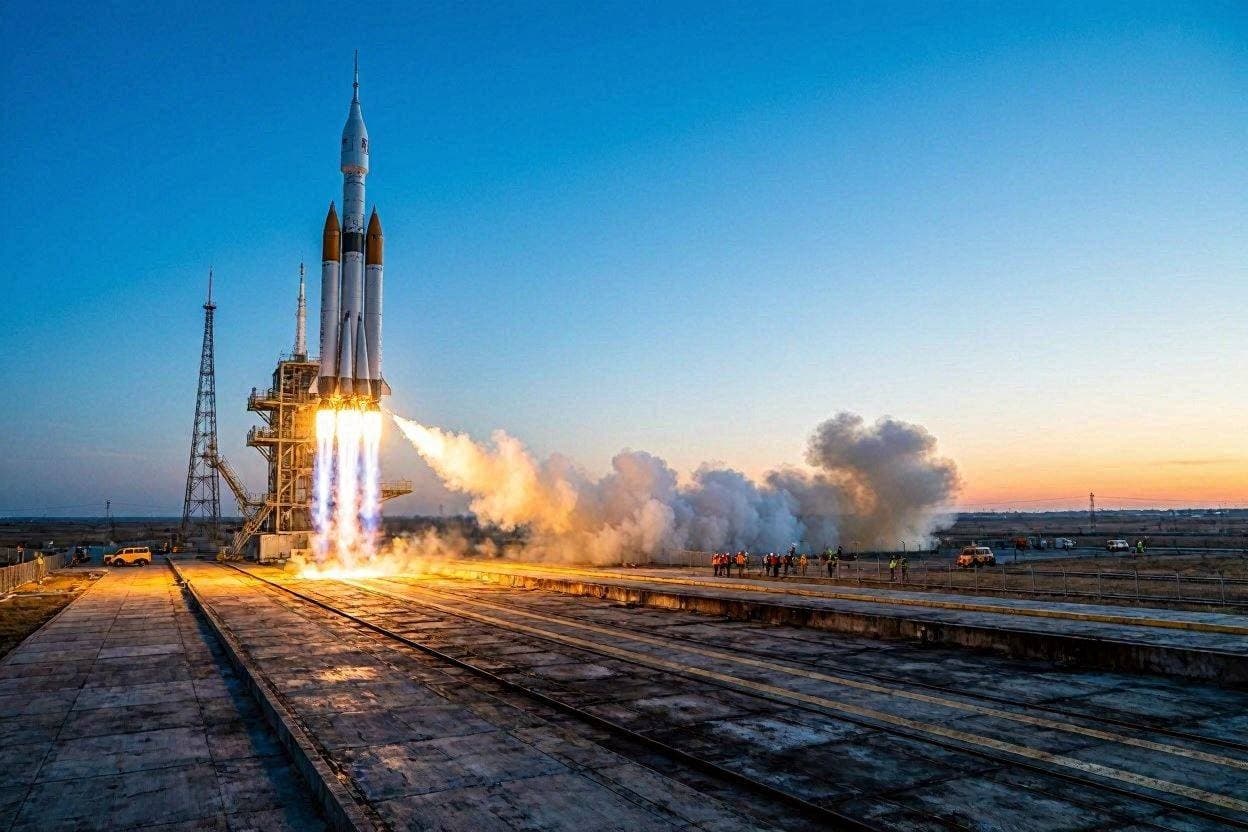
The Soyuz spacecraft launched successfully from the Baikonur Cosmodrome in Kazakhstan, beginning a carefully planned journey to the International Space Station. On board were one NASA astronaut and two Roscosmos cosmonauts, all scheduled to join the station's existing crew for a long-duration scientific expedition. Mission controllers monitored each stage of the launch and orbital insertion before confirming that the spacecraft was following its planned trajectory.
The International Space Station has served as a continuously occupied research laboratory for more than two decades. Orbiting Earth approximately every 90 minutes, the station provides a unique environment where scientists can conduct experiments that are difficult or impossible to perform under Earth's gravity. Research carried out aboard the ISS contributes to advances in medicine, biology, materials science, physics, and future deep-space exploration.
Following launch, the Soyuz spacecraft performed a series of precisely timed orbital maneuvers designed to align its path with that of the ISS. Once the required orbital conditions were achieved, the spacecraft approached the station for an automated docking procedure. Engineers continuously monitored spacecraft systems throughout the rendezvous to ensure a safe arrival.
The incoming crew is expected to participate in a wide range of scientific investigations during their mission. Experiments aboard the ISS often examine how microgravity influences living organisms, fluid behavior, advanced manufacturing techniques, and the long-term effects of spaceflight on the human body. These studies help researchers prepare for future missions beyond low Earth orbit while also producing knowledge applicable to life on Earth.
The mission also reflects the continuing cooperation between NASA and Roscosmos through the international crew exchange program. Under these arrangements, astronauts and cosmonauts fly aboard each other's spacecraft to maintain a balanced multinational presence aboard the ISS. This approach enhances operational flexibility and supports uninterrupted scientific activities regardless of the launch vehicle used.
Space agencies emphasize that international collaboration remains one of the defining characteristics of the ISS program. Scientists, engineers, and mission specialists from numerous countries contribute to experiments, station maintenance, and technology development. The station continues to demonstrate how scientific goals can unite partners from different nations in pursuit of shared knowledge.
Following successful docking, the new crew will undergo safety briefings and begin integrating into the station's daily operations. Their mission is expected to include scientific research, maintenance activities, and technology demonstrations over the coming months. As another Soyuz mission reaches orbit, the International Space Station continues its role as a symbol of sustained cooperation and scientific discovery above Earth.
AI Image Disclaimer: The accompanying images are AI-generated visual representations inspired by the mission and are intended solely to illustrate the reported event rather than depict actual mission photography.
Sources: NASA; Roscosmos; Reuters; Associated Press; Space.com
Published by Banx Network. This article is part of the Banx decentralized media programme, powered by the BXE token on the XRP Ledger.