At the southern edge of the Moon, sunlight and darkness exist almost side by side. Some crater interiors have remained untouched by direct sunlight for billions of years, preserving temperatures cold enough to hold ancient water in frozen form. It is toward this strange boundary that China is now sending another spacecraft.
China is preparing to launch Chang’e-7, an uncrewed lunar mission designed to search for water ice near the Moon's south pole. Reuters describes it as China's most technologically complex lunar mission to date.
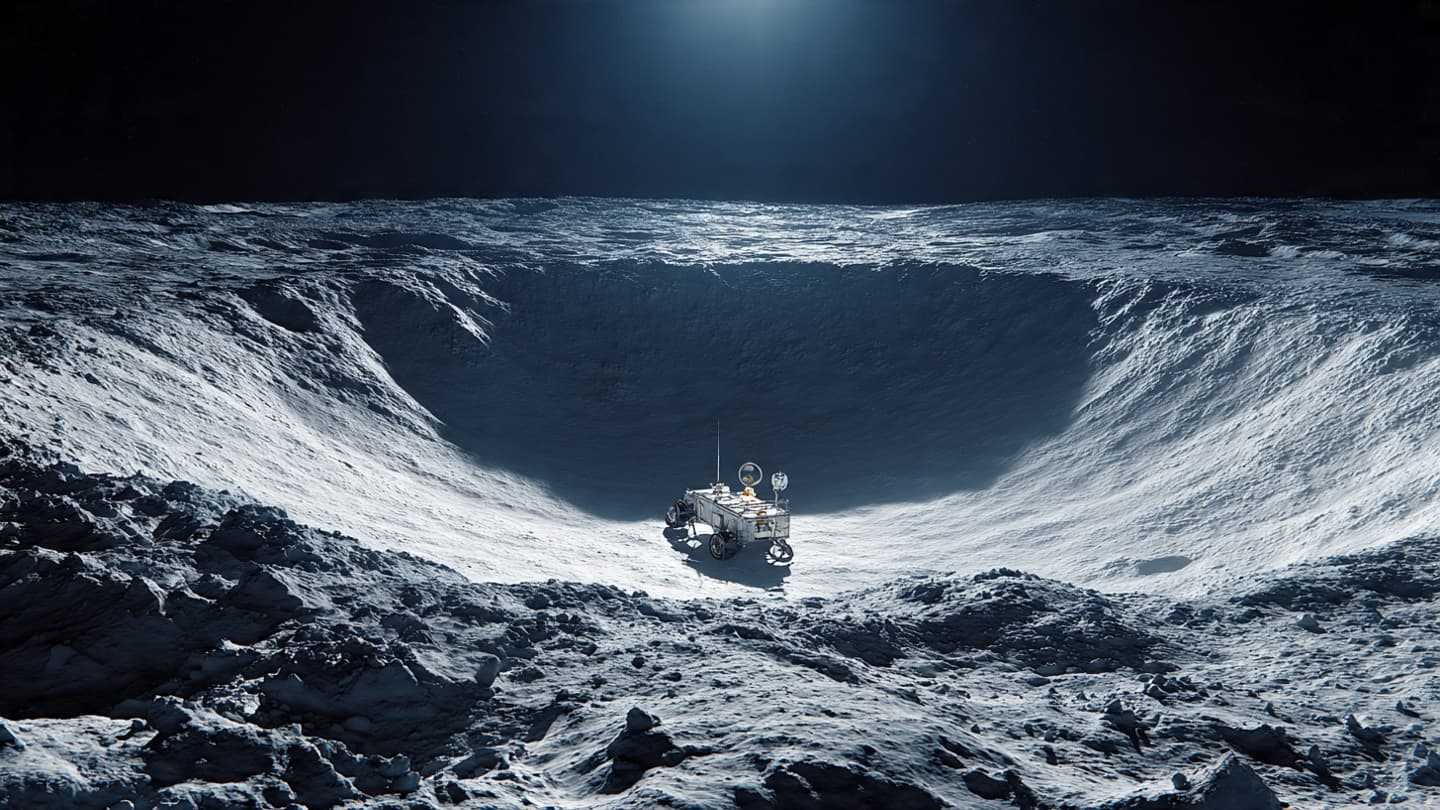
The mission will include a robotic lander, rover, and a hopping probe designed to explore permanently shadowed terrain. Once the spacecraft reaches lunar orbit, it will examine potential landing locations before attempting to place equipment on the surface.
One possible landing area is near Shackleton crater. Its rim receives almost continuous sunlight, while the crater's interior remains deeply shadowed. That unusual geography creates an environment where scientists believe ancient water and other volatile materials may have survived for extremely long periods.
The temperatures inside some permanently shadowed regions can fall to about minus 203 degrees Celsius. Such extreme cold is one reason scientists consider these locations natural repositories capable of preserving material that may have disappeared from warmer parts of the Moon.
Water would be particularly valuable for future exploration. It can potentially be used not only for scientific research but also as a source of hydrogen and oxygen, components that could support future spacecraft and human activity beyond Earth. The search therefore reaches beyond the question of whether ice exists.
The mission also demonstrates how lunar exploration has changed. Earlier missions often focused on reaching the surface and returning scientific measurements. Newer projects are increasingly concerned with specific resources, difficult terrain, long-term operations, and technologies that could eventually support a sustained human presence.
China has said it is working toward a crewed lunar landing before 2030. It also has plans for a joint lunar research station with Russia by 2035, making the search for accessible resources an important part of its longer-term exploration strategy.
Other countries are studying the same region. The United States, India, Russia, Japan, and Europe have all developed or announced lunar projects involving the Moon's south pole. India's Chandrayaan-3 successfully landed near the region in 2023, while future missions from NASA, the European Space Agency, and the Japan-India LUPEX program are expected to investigate lunar water and terrain.
Chang’e-7 therefore arrives at a Moon increasingly viewed not simply as a distant destination, but as a place whose geography may contain resources relevant to future exploration. Beneath the permanent shadows of its southern craters, the search continues for something remarkably familiar: water, preserved in darkness for ages and waiting for instruments from Earth to find it.
AI Image Disclaimer
The accompanying illustrations were generated with AI to visualize the lunar mission and are not actual photographs from the Moon.
Sources
Reuters — China hunts for lunar ice in one of solar system’s coldest places — August 21, 2026.
NASA — Research and mission information concerning permanently shadowed lunar regions.
European Space Agency — Lunar south-pole exploration information.
Published by Banx Network. This article is part of the Banx decentralized media programme, powered by the BXE token on the XRP Ledger.