
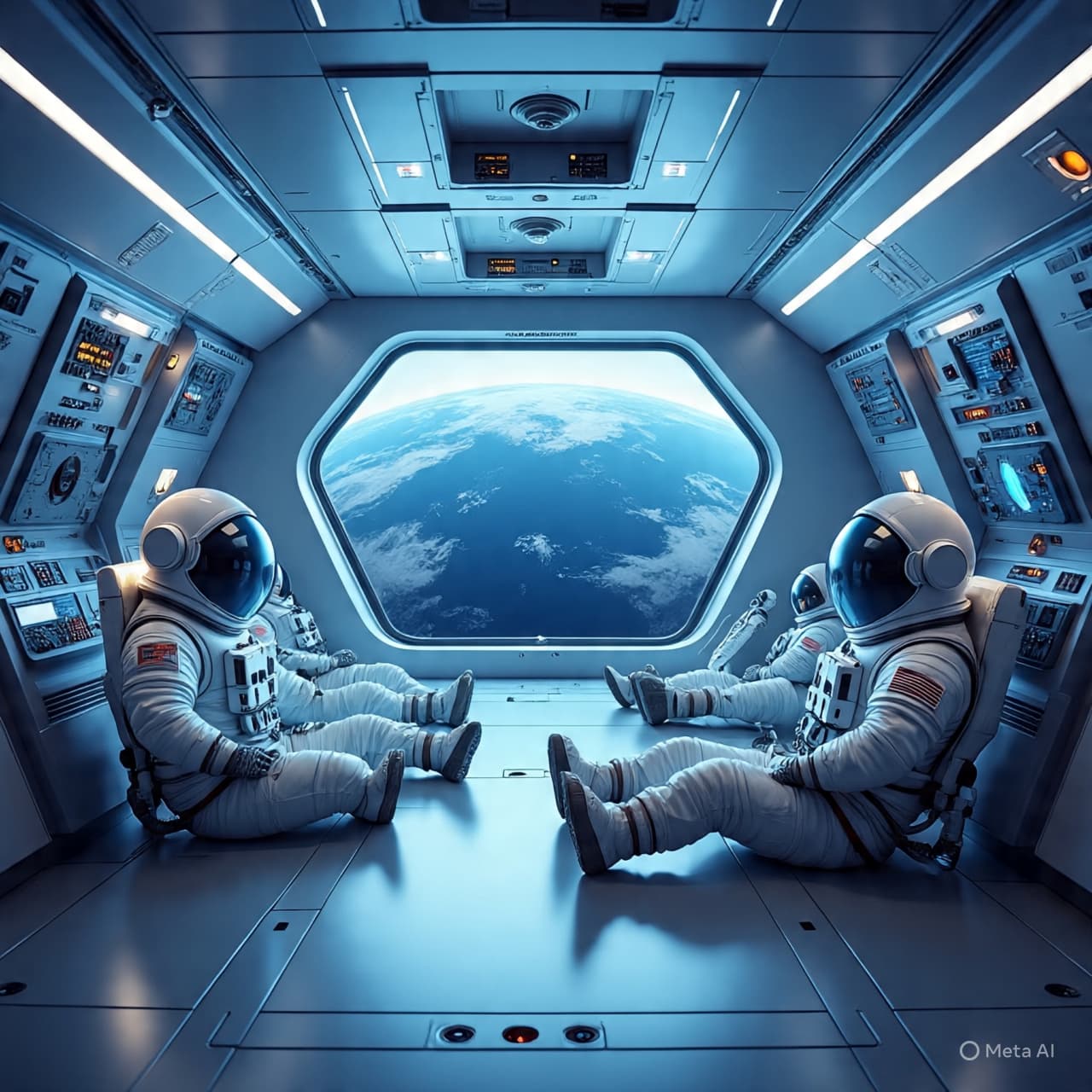
There are frontiers that expand outward, measured in distance, velocity, and the reach of human technology. And then there are those that turn inward, toward questions more delicate, more difficult to approach. Among them is a question that has remained largely untested—not for lack of curiosity, but for the complexity it carries.
What would happen if human life were to begin beyond Earth?
In the controlled environments of orbit, aboard places like the International Space Station, the study of life has progressed steadily. Plants have been grown, microorganisms observed, and the human body itself studied under conditions of microgravity. Bones respond differently, muscles adapt, fluids shift. The body, even in its established form, reveals how closely it is tied to the gravity of its home planet.
Yet the earliest stages of life—conception, development, gestation—remain largely uncharted in this environment.
Recent discussions within space medicine and related fields acknowledge this gap with unusual clarity. Scientists openly note that there is no complete understanding of how human reproduction would proceed in space. The question is not only about possibility, but about process: how cells divide, how tissues form, how an organism develops when the fundamental force of gravity is absent or altered.
Studies involving animals provide partial insight. Experiments with rodents, fish, and other organisms have shown that reproduction and early development can be affected by microgravity, sometimes in subtle ways, sometimes more significantly. Fertilization may occur, but development can diverge from typical patterns. Orientation, cell signaling, and structural formation all depend, in part, on forces that behave differently in orbit.
Radiation adds another layer of uncertainty. Beyond the protective envelope of Earth’s atmosphere, exposure to cosmic radiation increases, introducing potential risks to genetic material. For developing embryos, which rely on precise and stable processes, such exposure raises questions that remain only partially answered.
Despite these unknowns, there is a growing recognition that the question may eventually need to be addressed more directly. As plans for long-duration missions and potential habitation beyond Earth continue to develop, the ability to sustain human life across generations becomes part of a broader consideration. Not immediate, perhaps, but not indefinitely distant.
The discussion, however, remains measured. Ethical considerations, safety concerns, and the limits of current knowledge all shape how such research is approached. It is not a question to be answered quickly, nor without careful preparation. The absence of certainty is acknowledged, not as a failure, but as a boundary—one that science approaches gradually.
There is, in this, a shift in perspective. Space exploration has often been framed in terms of movement outward—how far, how fast, how long. But questions like this suggest a different dimension, one that asks not only where humans can go, but how life itself adapts when it arrives.
Scientists state that there is currently no definitive understanding of how human reproduction would occur in space. Existing studies, largely based on animal models, indicate potential challenges related to microgravity and radiation. Researchers emphasize that further study is important for understanding long-term human presence beyond Earth.
AI Image Disclaimer
Illustrations were created using AI tools and are not real photographs.
Sources
NASA Nature Science New Scientist Scientific American
Published by Banx Network. This article is part of the Banx decentralized media programme, powered by the BXE token on the XRP Ledger.



