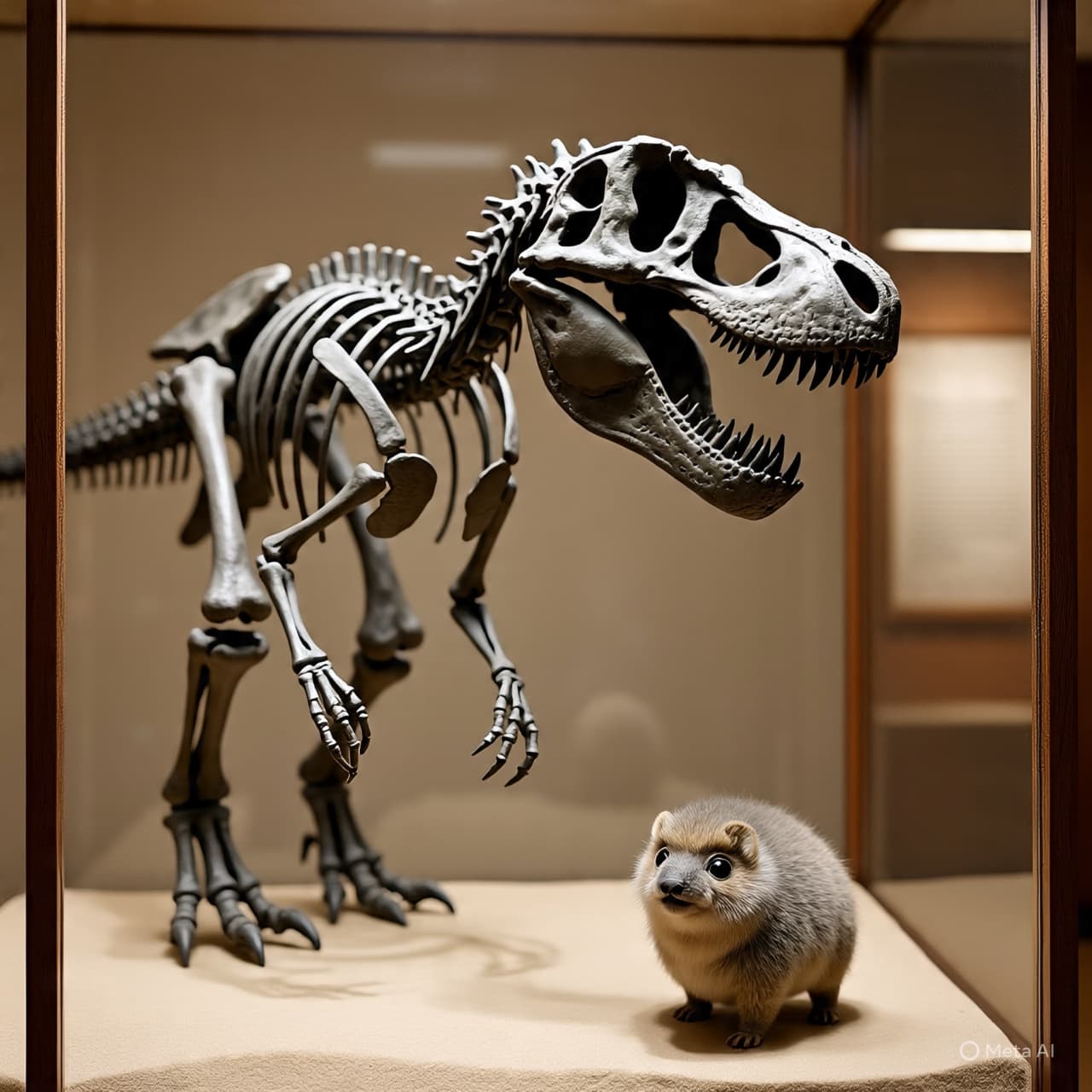
There was a time when the world belonged to giants, when the rhythm of life beat beneath scaled skin and thunderous footsteps. For decades, scientists compared those giants—dinosaurs—with the mammals that followed, measuring bones, estimating speed, debating intelligence. It was a conversation about size, about strength, about who ruled and who endured. Yet sometimes, in the careful business of comparison, the most delicate distinctions can remain hidden in plain sight.
For years, the debate centered on metabolism. Were dinosaurs cold-blooded like modern reptiles, or warm-blooded like mammals? Studies of bone growth rings and isotopic signatures suggested that many dinosaurs possessed high metabolic rates, narrowing what once seemed a vast biological divide. Later, discoveries of feathered theropods and evidence of active lifestyles further blurred the line. The ancient world appeared less foreign, more dynamic.
But in focusing so intently on metabolism and posture, researchers may have overlooked something quieter yet equally profound: reproductive strategy and early-life development. Mammals, by and large, invest heavily in fewer offspring, nurturing them through extended parental care. Dinosaurs, though diverse, generally laid clutches of eggs, often in significant numbers, relying on different survival strategies shaped by their ecosystems.
Recent fossil analyses, including preserved nesting grounds and embryonic remains, reveal a pattern that reshapes earlier assumptions. While some dinosaur species likely exhibited parental care, their growth rates were extraordinary. Many hatchlings appear to have grown rapidly, reaching substantial size in relatively short periods. Mammals, in contrast, evolved slower developmental arcs tied to complex brain growth and prolonged learning phases.
This difference is not merely biological—it is ecological. Rapid growth allows a species to fill niches quickly and withstand predation pressures in one way; extended development fosters adaptability, social learning, and behavioral flexibility in another. Over millions of years, such strategies shape evolutionary pathways as surely as claws or teeth.
Brain structure has also entered the conversation. Advanced imaging of fossil skull cavities suggests that some dinosaurs possessed sophisticated sensory systems. Yet mammals developed a neocortex capable of expanded cognitive processing, emotional complexity, and social coordination. The distinction lies not in intelligence alone, but in neurological architecture and developmental investment.
In retrospect, the comparison between dinosaurs and mammals may have been framed too narrowly. It was never simply about which group was “more advanced.” Evolution does not work in hierarchies; it works in adaptations. Dinosaurs thrived for over 160 million years—an astonishing tenure by any measure. Mammals, once small and largely nocturnal, gradually diversified after the mass extinction event 66 million years ago, expanding into ecological spaces newly opened.
The key difference that scientists increasingly recognize is not a single trait but a constellation of life-history strategies—how energy is allocated, how young are raised, how brains develop, how flexibility emerges. These subtleties influence resilience over deep time.
Today, paleontologists continue to reexamine fossil evidence with refined tools: microstructural bone analysis, CT scanning, and isotopic chemistry. Each discovery adds nuance rather than finality. The story is not about correcting a grand mistake, but about refining understanding—allowing complexity to replace oversimplification.
In gentle, steady terms, researchers now suggest that the long-standing dinosaur–mammal comparison may have underestimated the importance of developmental biology and reproductive strategy. Ongoing studies aim to clarify how these differences influenced survival and adaptation across changing climates and catastrophic events. The conversation continues, measured and open, shaped by evidence rather than assumption.
AI Image Disclaimer Graphics are AI-generated and intended for representation, not reality.
Source Check (Credible Media Coverage Identified): BBC Science National Geographic Scientific American Smithsonian Magazine Nature
Published by Banx Network. This article is part of the Banx decentralized media programme, powered by the BXE token on the XRP Ledger.