
Key Highlights
- Discovery:ANU physicists observe helium atoms existing in two locations simultaneously.
- Significance:This marks a breakthrough in understanding quantum mechanics and gravity.
- Publication:Findings published in Nature Communications.
Researchers at the Australian National University (ANU) have made a groundbreaking discovery in the field of quantum physics, observing pairs of helium atoms that exhibit a remarkable phenomenon: they can exist in two spatially separate locations at once. This finding, published in the prestigious journal Nature Communications, extends the understanding of quantum mechanics from light particles to massive matter, providing a new perspective on the relationship between quantum behavior and gravity.
The experiment was conducted under extreme conditions, cooling helium atoms to just above absolute zero. At this temperature, the behavior of particles transitions from classical to quantum, allowing them to exhibit wave-like properties. When two clouds of these ultracold helium atoms collided, they produced pairs of atoms that flew apart in opposite directions while remaining entangled in their quantum states. This entanglement means that the atoms share a quantum state that spans two distinct locations simultaneously, a concept that challenges traditional notions of matter and space.
The researchers utilized a Bell-style interference measurement to verify their findings, a method that serves as a gold standard for testing nonlocal quantum behavior. This approach demonstrated that the helium atoms were not merely observed in two places at once; rather, their shared quantum state allowed them to occupy both locations simultaneously until a measurement was made. This discovery is significant because it involves massive particles, which respond to gravitational forces, unlike previous studies that focused primarily on photons.
The implications of this research extend beyond the laboratory. For decades, physicists have grappled with the challenge of reconciling the probabilistic nature of quantum mechanics with the smooth, deterministic fabric of spacetime described by Einstein's theory of gravity. By demonstrating that massive atoms can exhibit nonlocal superposition and interference, the ANU team has opened new avenues for exploring how gravity interacts with quantum phenomena. This could lead to a deeper understanding of the fundamental principles governing the universe.
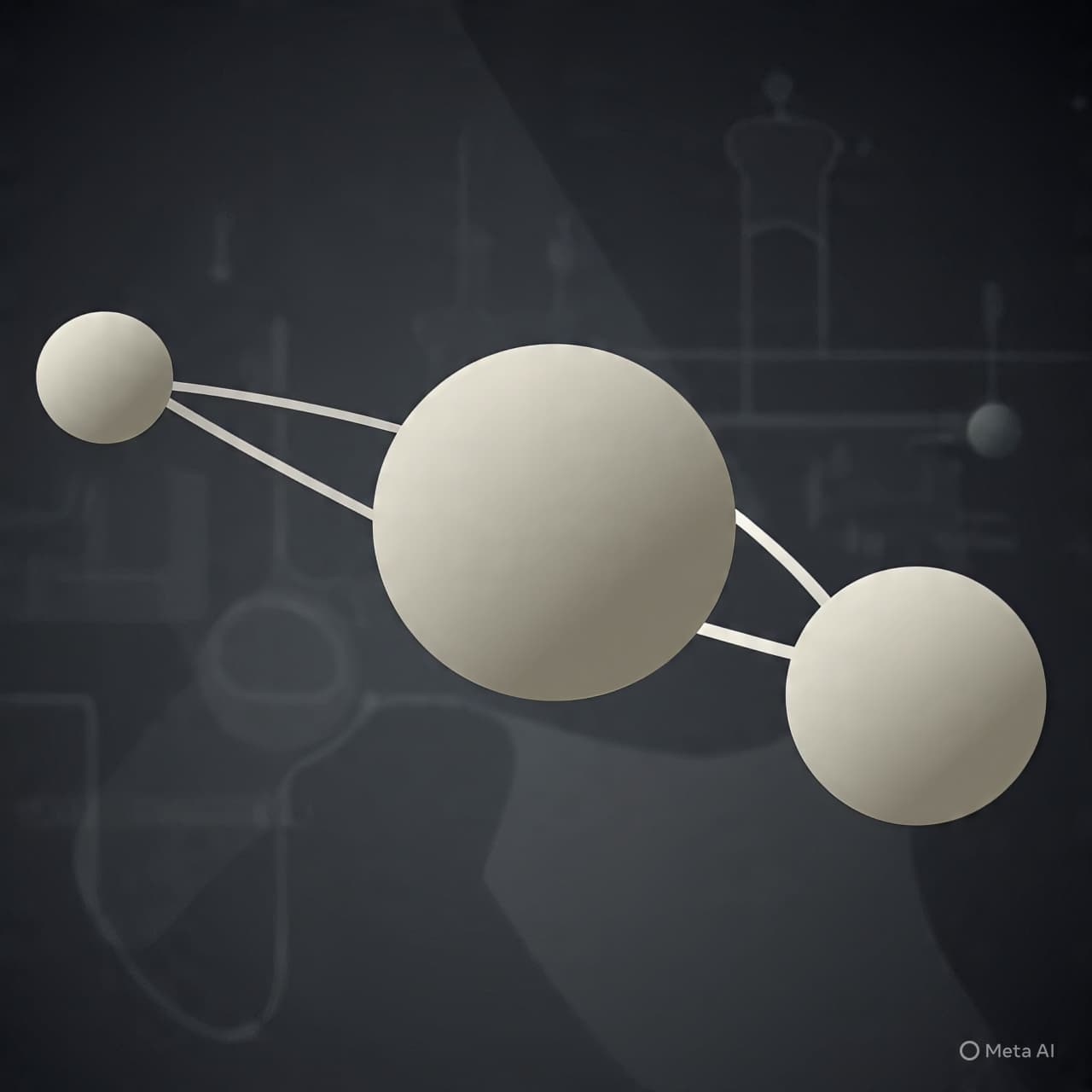
The visual representation of this experiment, while AI-generated, captures the essence of the findings. It illustrates the concept of two helium atoms, born from a collision, moving apart yet remaining connected through their shared quantum state. This imagery evokes a sense of the profound interconnectedness of particles, challenging our conventional understanding of distance and separation in the quantum realm.
As researchers continue to explore the boundaries between quantum mechanics and gravity, the findings from ANU represent a significant step forward. The ability to observe massive particles like helium atoms in a shared quantum state not only enhances our understanding of quantum behavior but also paves the way for future experiments that could further illuminate the mysteries of the universe.
Published by Banx Network. This article is part of the Banx decentralized media programme, powered by the BXE token on the XRP Ledger.



