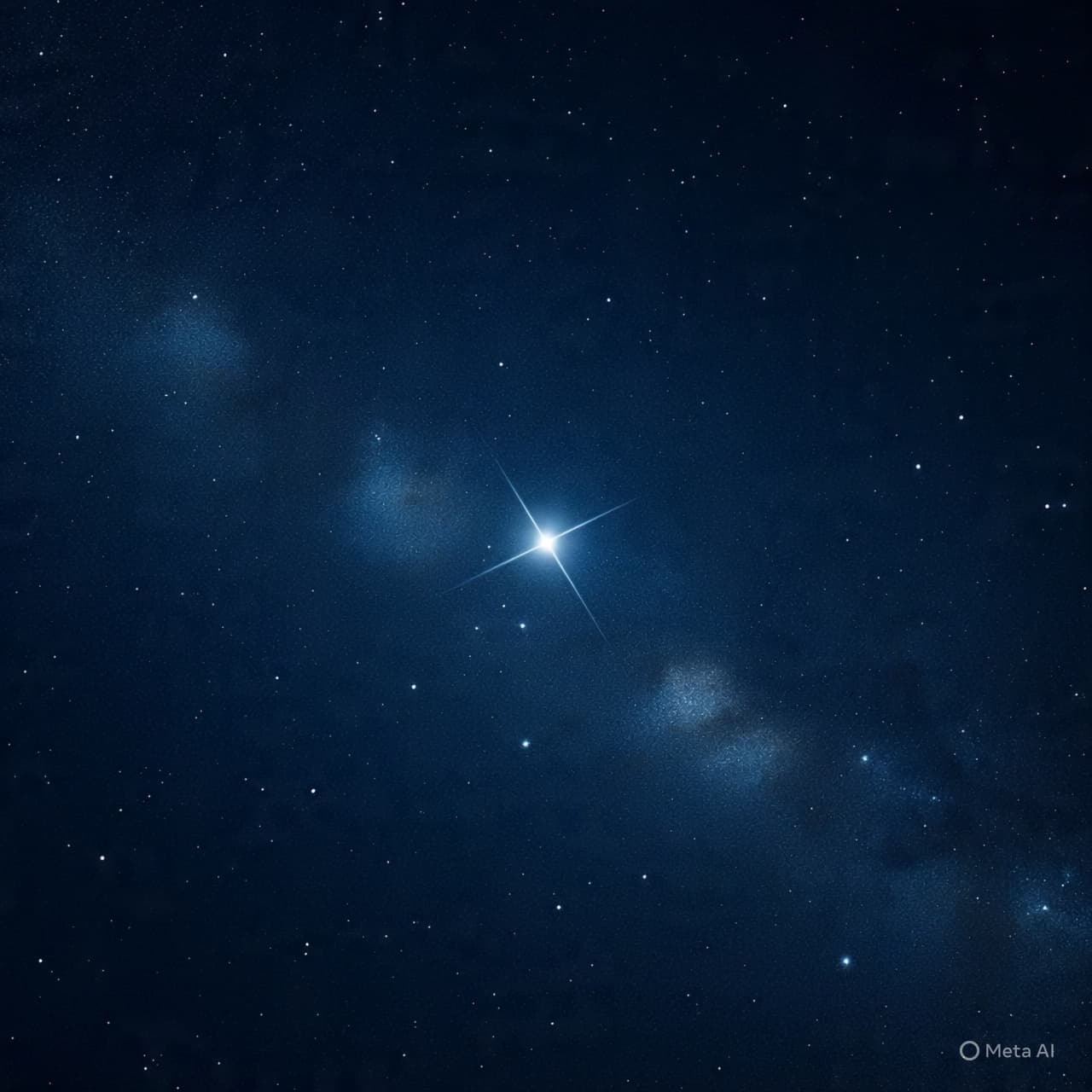
There is a moment after sunset when the sky does not yet belong to night, but no longer to day. The light lingers, stretched thin across the horizon, and the first stars appear not all at once, but carefully—one, then another, then a pattern that only reveals itself if one waits.
It is in this gradual unfolding that certain constellations come into their own. Not the brightest, nor the most immediate, but those that require a slower kind of attention. Among them is Corvus, a small grouping of stars that finds its place in the southern sky during the spring months.
Corvus does not announce itself with brilliance. Its stars are modest, arranged in a compact quadrilateral that can be easy to overlook in brighter skies. Yet once seen, it holds its shape with quiet clarity—a tilted box, a simple geometry that contrasts with the more elaborate figures around it.
Its position is guided by proximity. To find it, observers often look first to Crater and then to Hydra, whose long, winding form stretches across much of the sky. Corvus rests just above Hydra, as if perched along its length, a smaller presence anchored by its larger neighbor.
This time of year offers a particular advantage. By late evening, Corvus climbs higher above the horizon, clearing the distortions of lower altitude. Its stars become steadier, easier to trace, less affected by atmospheric haze. In darker locations, the constellation stands out more distinctly, though even in suburban skies its outline can be found with patience.
There is a rhythm to such observation. One does not rush to locate Corvus; one allows the eye to adjust, to move slowly from brighter landmarks toward subtler forms. The constellation reveals itself not through intensity, but through coherence—its stars holding together just enough to suggest a figure without insisting upon it.
In ancient traditions, Corvus was imagined as a crow, its story tied to myth and movement, though the details vary across cultures. Today, its significance is quieter. It marks a season, a position, a moment in the turning of the sky. It is less about narrative and more about presence.
And perhaps that is its appeal. In a sky often dominated by brighter constellations, Corvus offers something smaller, more contained—a reminder that not all patterns demand attention. Some simply wait for it.
On Saturday, March 28, Corvus is visible in the evening sky, best observed in the southern hemisphere skies after sunset and into the late evening. It can be located near the constellations Crater and Hydra, appearing as a small quadrilateral of stars. Clear skies and low light pollution will improve visibility.
AI Image Disclaimer
These visuals are AI-generated representations for illustrative purposes only.
Sources
Astronomy Magazine Sky & Telescope NASA EarthSky Space.com
Published by Banx Network. This article is part of the Banx decentralized media programme, powered by the BXE token on the XRP Ledger.