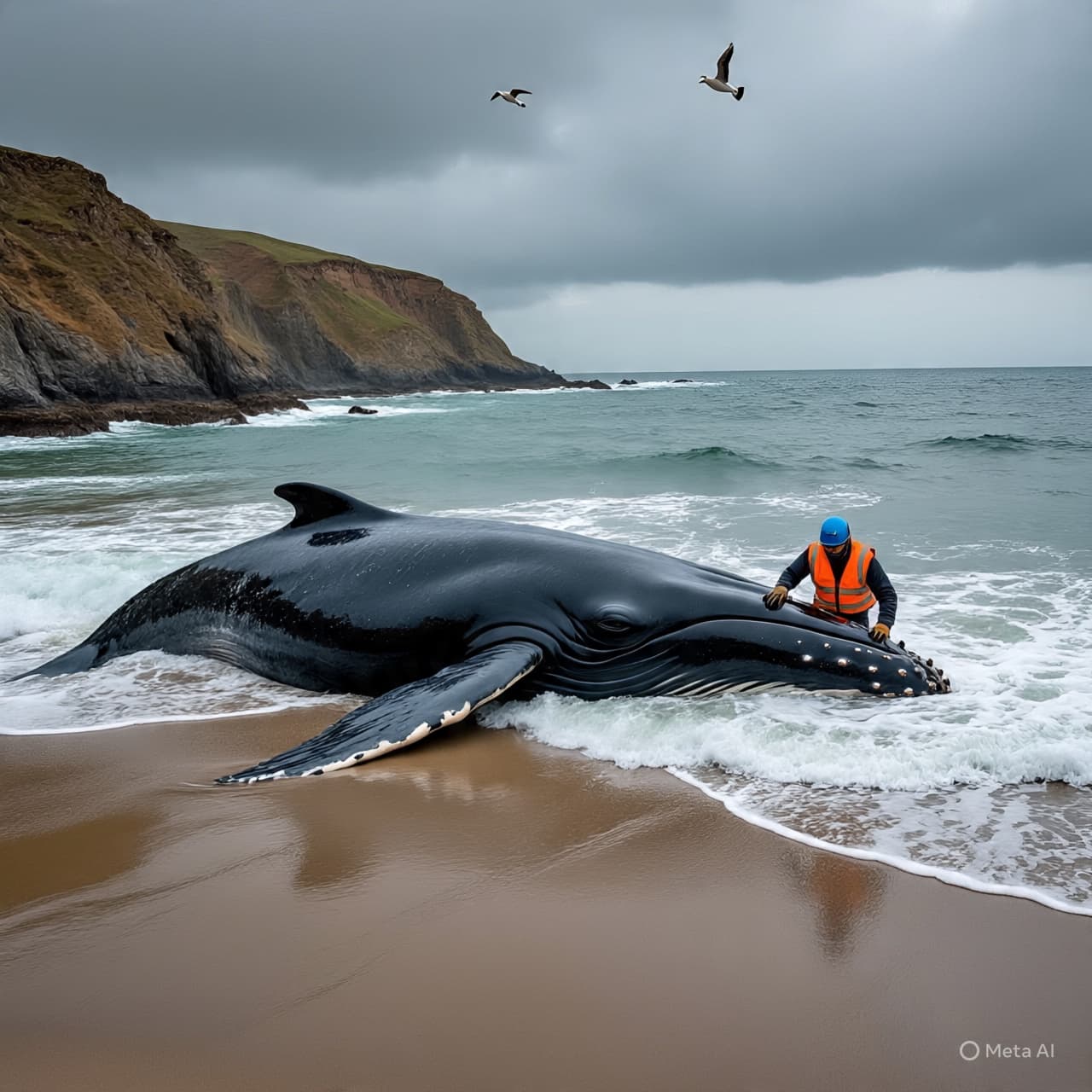
The sea along the northern coast carries a different rhythm in early light. It moves in long, patient breaths, brushing against sandbanks and tidal flats that shift almost imperceptibly with each passing hour. In these shallow waters off northern Germany, where the horizon often blurs into a pale sky, something vast and out of place has come to rest.
A humpback whale, far from the deep routes it would ordinarily follow, has become stranded near the German coastline, prompting a careful and urgent response from rescue teams. The animal, typically accustomed to the open expanses of the Atlantic, now lies within waters that grow increasingly shallow with the tide—an environment that offers little room for movement and even less margin for recovery.
Marine experts and rescuers have gathered at the site, working within the narrow windows allowed by shifting tides. Their efforts are deliberate, shaped by both experience and uncertainty. Humpback whales, despite their size and strength, are vulnerable when stranded; their own weight becomes a burden outside deeper water, placing pressure on internal organs and limiting their ability to breathe comfortably over time.
Initial attempts have focused on stabilizing the whale—keeping it cool, ensuring its skin remains hydrated, and monitoring its condition while plans for refloating are assessed. In such operations, timing is everything. A rising tide can offer a chance to guide the animal back toward deeper water, but success depends on coordination, weather conditions, and the whale’s own strength.
The presence of a humpback whale in these waters is itself unusual. These animals are known for long migrations, often traveling thousands of miles between feeding and breeding grounds. Stranding events can occur for a variety of reasons, including navigational errors, illness, or disorientation caused by environmental factors. In some cases, the exact cause remains unknown, leaving only the immediate task of response.
Local authorities and marine organizations have urged the public to keep a distance, allowing rescuers the space needed to work without additional stress on the animal. The scene, while drawing attention, is being managed with a sense of quiet focus rather than spectacle—a recognition that the outcome remains uncertain.
For those involved, the effort is as much about care as it is about intervention. Each action—whether adjusting the whale’s position or preparing for a possible refloat—is taken with an understanding of both the fragility and resilience of the animal. Even under the best conditions, not all rescues succeed, and the balance between hope and realism is carefully held.
As the tide continues its steady cycle, the window for action opens and closes in measured intervals. The whale remains, for now, suspended between sea and shore, its presence a reminder of how easily the boundaries of habitat can shift.
In the coming hours, the outcome will depend on a convergence of factors—timing, coordination, and the strength of a creature far from its intended path. Whether the sea reclaims it or not, the effort itself speaks to a broader instinct: to respond, to assist, to meet the unexpected with care.
And along the quiet coast, where the water keeps its slow rhythm, the story continues—held in the space between tide and time.
Published by Banx Network. This article is part of the Banx decentralized media programme, powered by the BXE token on the XRP Ledger.