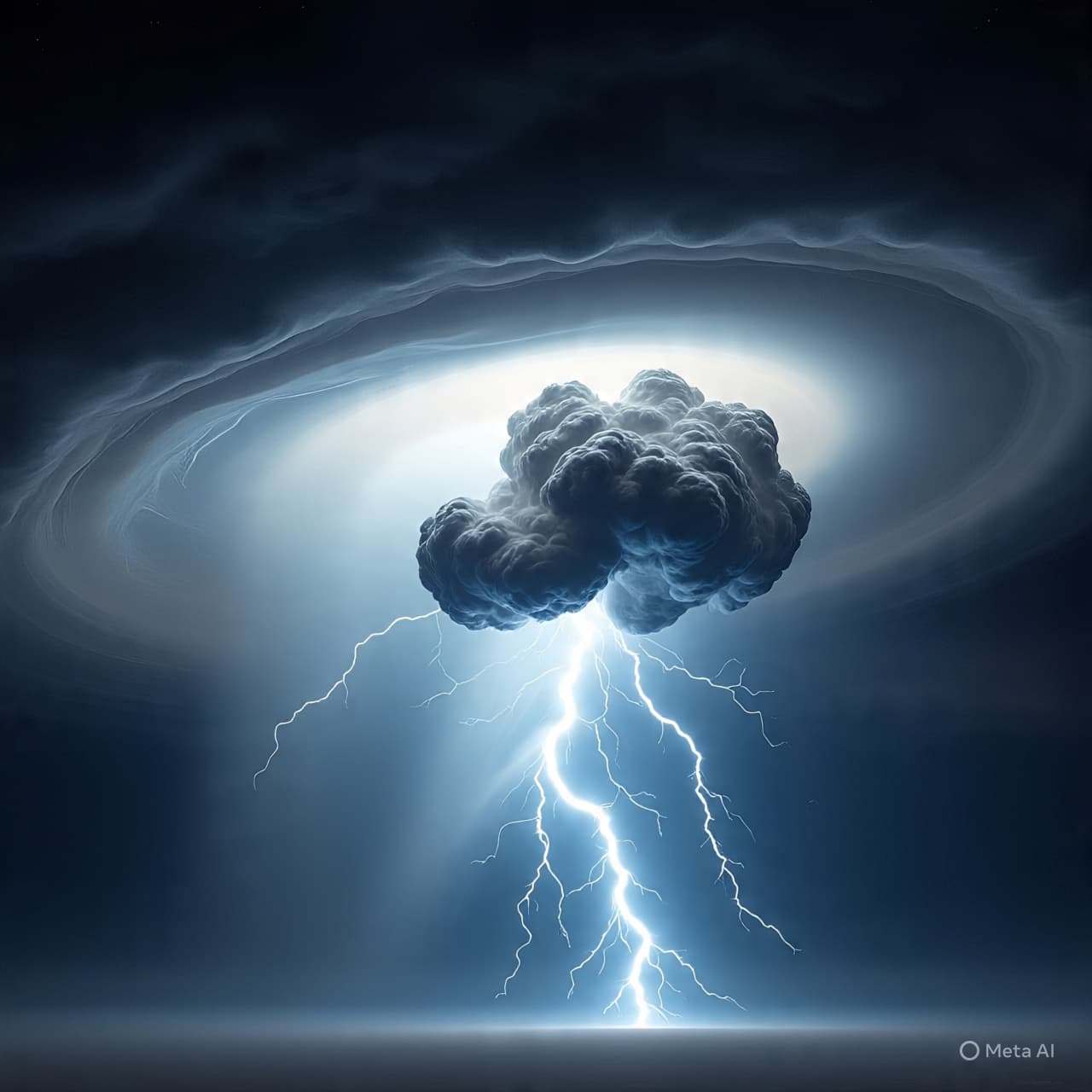
There are storms we know by sound and sight—the sudden crack of thunder, the brief illumination of a sky split open by light. On Earth, lightning feels immediate, almost intimate, a reminder of the atmosphere’s restless energy. Yet beyond our horizon, in places where clouds stretch deeper and forces gather on a scale difficult to imagine, lightning may exist in forms that quietly exceed our expectations.
On the giant world of Jupiter, scientists have been studying electrical storms that bear a resemblance to those on Earth, yet unfold under vastly different conditions. Data collected by missions such as Juno suggest that lightning on Jupiter may be significantly more powerful—potentially reaching intensities up to a million times greater than typical lightning strikes observed on our own planet.
This difference is shaped by environment. Jupiter’s atmosphere is composed primarily of hydrogen and helium, layered with dense clouds of ammonia and water. These clouds extend far deeper than those on Earth, creating conditions where electrical charges can build over larger volumes and longer durations. When they discharge, the resulting lightning carries a magnitude that reflects this immense scale.
Unlike Earth, where lightning is often associated with localized storms, Jupiter’s storms can span vast regions, forming complex systems that persist over extended periods. The planet’s rapid rotation and internal heat contribute to dynamic atmospheric movements, allowing energy to accumulate and circulate in ways that are still being studied. Within these systems, lightning becomes not just a feature, but a fundamental expression of atmospheric activity.
Observations from Juno have provided new insights into how these lightning events occur. Instruments capable of detecting radio waves and optical flashes have captured signals that indicate both frequency and intensity. Interestingly, some of Jupiter’s lightning appears to originate in regions where water clouds are present, suggesting parallels with Earth’s storm processes, even within a vastly different atmospheric composition.
There is also a quiet complexity in how such comparisons are made. Measuring lightning across planets involves translating signals—radio emissions, light intensity, and energy estimates—into a common framework. The idea that Jupiter’s lightning could be “a million times stronger” reflects these interpretations, offering a sense of scale rather than a direct equivalence. It is a way of understanding difference through proportion, rather than exact replication.
What emerges from this research is not only a clearer picture of Jupiter, but a broader understanding of planetary atmospheres. By studying how storms behave under different conditions, scientists gain insight into the fundamental processes that govern weather and energy distribution across the Solar System. Each planet becomes a variation on a theme, revealing how similar forces can produce different outcomes.
There is, too, a certain perspective gained from looking outward. Earth’s storms, powerful as they may seem, are part of a larger spectrum of atmospheric behavior. To consider lightning on Jupiter is to place our own experiences within a wider context, where familiar phenomena take on new dimensions.
In ongoing research, scientists continue to analyze data from Juno and other observations, refining estimates of lightning intensity and distribution on Jupiter. While much has been learned, further study is expected to deepen understanding of these powerful storms and their role within the planet’s atmosphere.
AI Image Disclaimer Images in this article are AI-generated illustrations, meant for concept only.
Source Check (Credible Media & Journals): NASA Nature Astronomy Science Space.com Scientific American
Published by Banx Network. This article is part of the Banx decentralized media programme, powered by the BXE token on the XRP Ledger.