There is a particular gravity to a warning issued from an embassy, a document that reads like bureaucracy but carries the weight of a decision made in Washington about how dangerous the world has become. When the United States tells its citizens in a region to reconsider travel, to leave while commercial options remain, to prepare for the possibility that the airport may close without notice, it is not speaking in abstractions. It is drawing on intelligence, on the trajectory of a conflict, and on the knowledge that the next strike may not be the last.
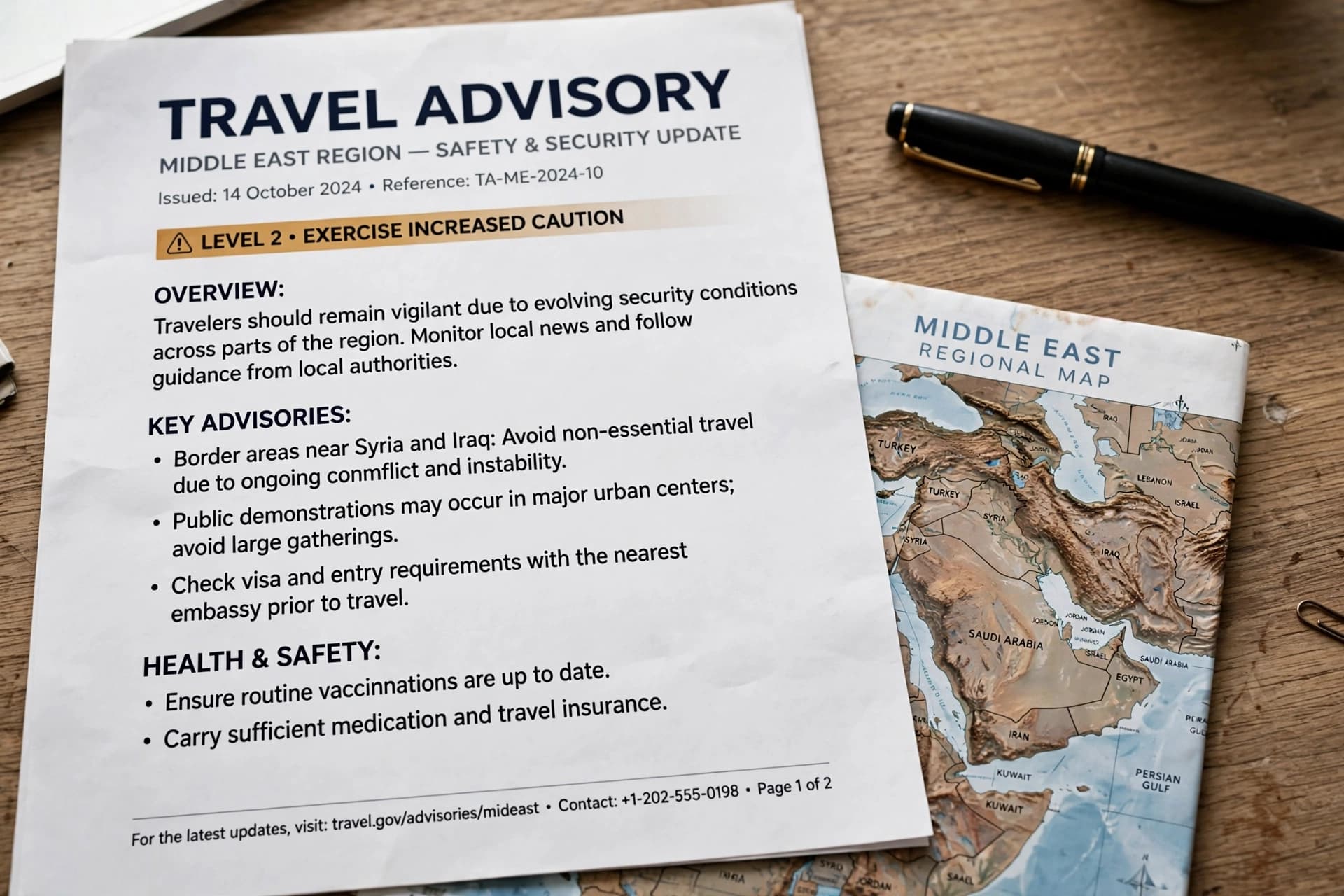
The State Department has raised its travel advisory for Yemen to Level 4—Do Not Travel—after a Houthi missile strike on a training camp in Shabwa killed at least seventy-three people and wounded more than two hundred . The attack, which targeted new recruits aged eighteen to twenty, was the deadliest single incident since fighting escalated three months ago . The advisory warns of "risk of unpredictable violence and armed conflict" and notes that the U.S. government's ability to provide emergency services to citizens in Yemen is "very limited" .
The warnings extend beyond Yemen's borders. American citizens in neighboring countries have been urged to remain vigilant, to avoid large gatherings, and to monitor local media for updates. The Houthis have demonstrated a willingness to strike beyond Yemen's territory, launching missiles toward Saudi Arabia and threatening shipping lanes in the Red Sea. The conflict, which began as a civil war, has become a regional confrontation with multiple fronts.
The immediate context is the collapse of a ceasefire that had largely held since 2022. Airstrikes on Sanaa International Airport in July shattered the truce, and since then, the Houthis have escalated their campaign. They have besieged Taiz, Yemen's third-largest city, cutting supply routes and placing civilians at grave risk. They have launched attacks on Saudi infrastructure. And they have shown that their missile arsenal can reach training camps and population centers with devastating accuracy.
For American citizens in the region, the warnings carry a practical dimension. Commercial flights may be suspended. Land borders may close. Medical facilities may be overwhelmed. The embassy's ability to assist may be constrained by security conditions. These are not hypotheticals but the standard language of advisories issued when a situation is deteriorating and the window for safe departure is narrowing.
There is a geopolitical dimension that extends beyond the immediate conflict. The United States has been drawn into the region's tensions, supporting Saudi Arabia and its coalition partners while seeking to contain Iran's influence. The Houthis, backed by Iran, have framed their campaign as resistance against foreign intervention. Each strike, each warning, each escalation adds a layer to a conflict that has already killed more than 150,000 people and created what the United Nations calls one of the world's worst humanitarian disasters.
For now, the warnings stand. The embassy continues to operate, though with reduced staffing. The airports remain open, though with uncertainty. And the citizens who remain in the region must weigh the risks against the reasons they are there—work, family, obligation—and decide whether the calculus has shifted. The State Department has done what it can do: it has told them the truth as it understands it. What they do with that truth is their own decision.
---
AI Image Disclaimer: The visuals in this article are AI-generated and are intended for illustrative purposes only.
Sources: State Department travel advisories (via cited reports), Associated Press, Reuters, CBC News
Published by Banx Network. This article is part of the Banx decentralized media programme, powered by the BXE token on the XRP Ledger.