
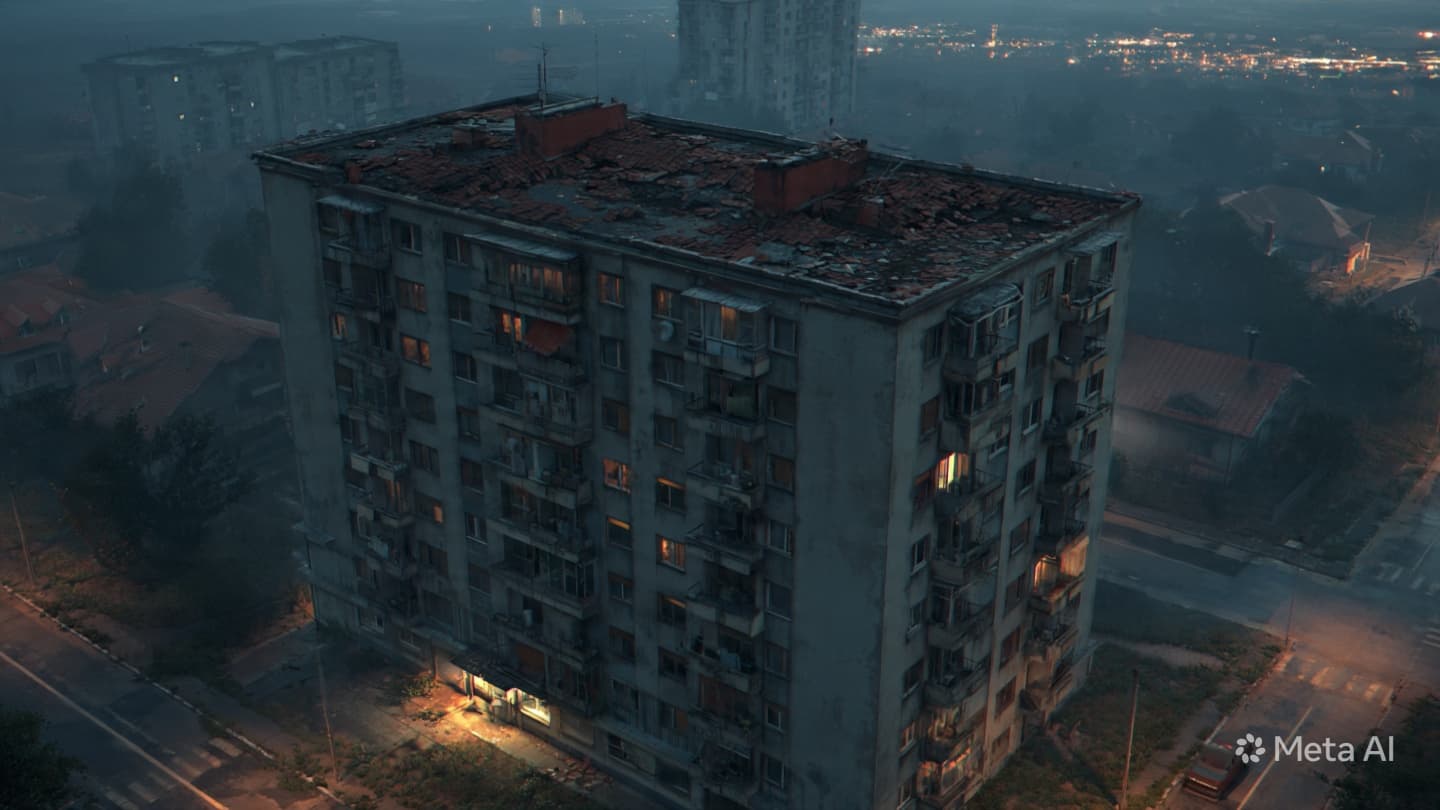
The city of Galați, situated quietly along the banks of the Danube, has long been defined by the steady, industrial rhythm of the river and the predictable patterns of its residents. It is a landscape of brick and concrete, where the skyline is broken by the familiar, sturdy shapes of mid-rise apartment blocks. However, in the early hours of May 29, 2026, this sense of continuity was abruptly severed. An aerial object, identified later as a Russian-origin drone, veered from its intended path over the border and found its terminus on the roof of a ten-story residential building, an event that shifted the city’s perception of safety in a single, kinetic moment.
The strike was not merely a mechanical failure; it was a profound rupture in the peace of the early morning. As the drone detonated on impact, the resulting fire turned the top-floor flat into a beacon of urgency against the predawn sky. The sound—a sharp, concussive event—pierced the silence of the neighborhood, drawing the community into a state of sudden, unwanted attention. For those living within the block, the experience was one of visceral displacement, as the familiar sanctity of their homes was momentarily compromised by the external, violent reality of the ongoing war nearby.
Emergency crews responded with the practiced, somber efficiency that such crises demand. In the darkness, the flash of fire and the wail of sirens painted a picture of a city forced to confront the spillover of a distant conflict. Responders navigated the stairwells of the building, securing the site and evacuating residents who, only moments before, had been caught in the fragile lull of sleep. The presence of the Romanian authorities—police, firefighters, and medical teams—served as a grounding force, attempting to restore order to a space that had suddenly become unrecognizable.
The human cost, while fortunately contained, was real. Two individuals, reported to be a woman and a child, suffered injuries that required immediate hospital care. Their experience serves as a sobering reminder that the repercussions of geopolitical violence do not always respect the boundaries we draw upon maps. As the fire was brought under control and the extent of the structural damage began to be assessed, the focus turned from the raw shock of the event to the necessity of care and the long, slow process of recovering a sense of security.
In the hours that followed, the atmosphere in the city shifted from crisis to a guarded, contemplative unease. The event triggered an immediate and firm diplomatic response, with officials in Bucharest summoning the Russian ambassador and convening the Supreme Council of National Defense. The rhetoric from the national leadership was one of resolute gravity, emphasizing that the security of Romanian citizens is an absolute, non-negotiable priority. Yet, beneath the formal diplomatic exchanges, the city itself felt the weight of its proximity to the frontline.
The incident has sparked a broader, more existential conversation about the vulnerabilities of a modern, interconnected nation. The technical reality of the strike—the four minutes the drone spent in Romanian airspace, the inability of air defenses to engage without risking civilian safety—has forced a public examination of the country’s protective capacities. It is an editorial observation of a difficult truth: that in an era of cheap, pervasive aerial technology, even the most peaceful of residential spaces can find itself unexpectedly positioned on the front line of an international conflict.
As the smoke cleared from the roof of the Galați apartment block, it left behind more than just charred brickwork. It left a landscape forever marked by the memory of the impact. The recovery, both of the physical structure and the residents' peace of mind, will be a lengthy endeavor. It is a process of cleaning up the debris and attempting to weave the ordinary threads of life back together, while living in the persistent knowledge that the sky above can no longer be viewed with the same, unthinking trust.
The incident is currently being treated with the highest level of national concern. While forensic teams continue to document the remnants of the drone to confirm the technical details of the strike, the Romanian government has moved to strengthen its defensive posture, requesting additional support from allied air-defense capabilities. The city of Galați, though shaken, has returned to its daily rhythm, yet the presence of the investigators on the roof of the apartment block remains a permanent, sobering fixture in the city’s recent history.
Published by Banx Network. This article is part of the Banx decentralized media programme, powered by the BXE token on the XRP Ledger.

.jpg&w=3840&q=75 "US Declares Drought Disaster for Parts of Puerto Rico as Dry Conditions Persist")
