In the gentle wash of twilight, when day’s warmth begins to soften and the horizon exhales into dusk, an extraordinary alignment draws closer each evening. There is a quiet poetry in skies that age, in that brief moment after the sun dips below sight when stars and planets awaken one by one. Soon, observers across parts of North America — including those watching from California’s broad western skies — will witness a rare spectacle woven into that calm transition: six planets appearing together in a celestial procession.
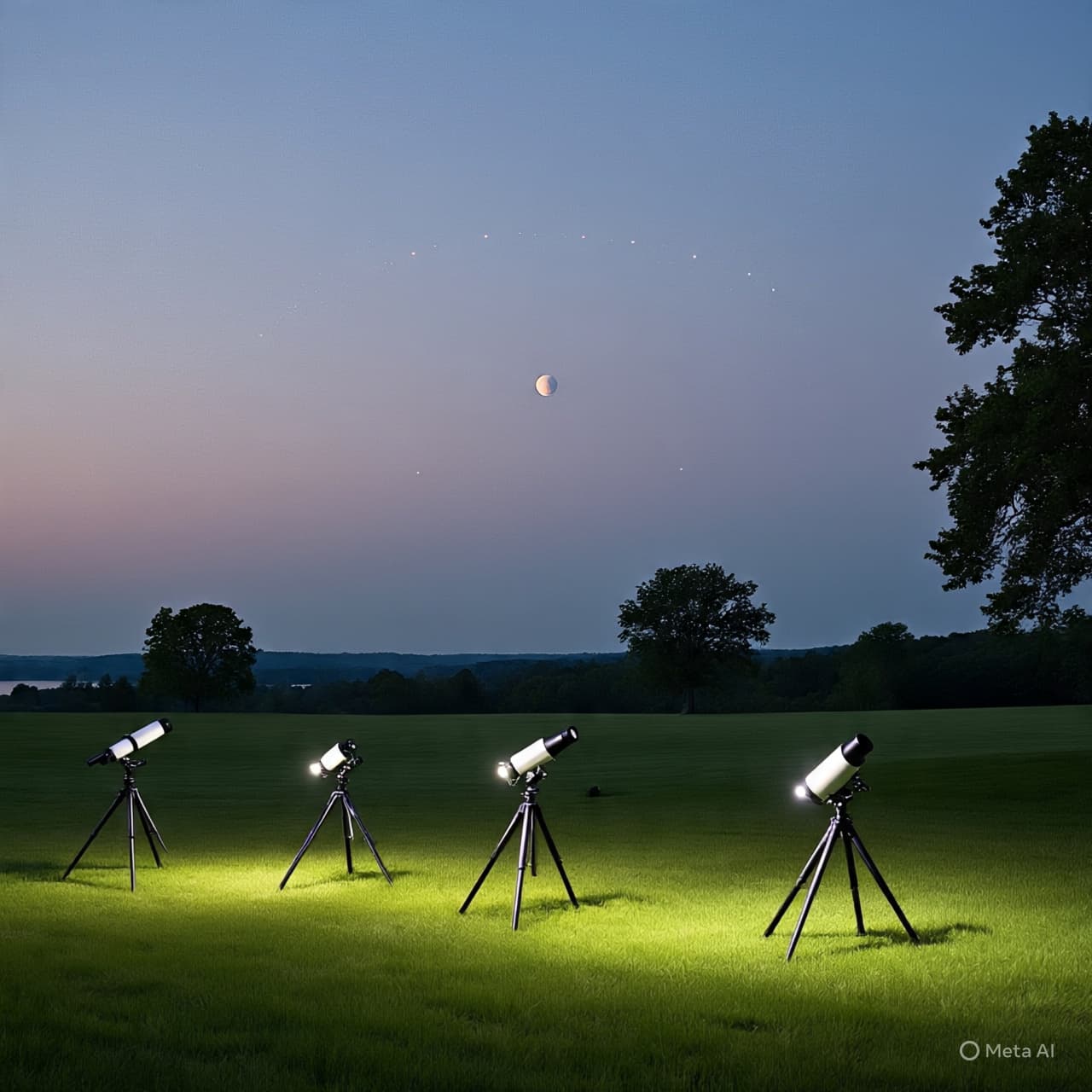
The planets involved — Mercury, Venus, Jupiter, Saturn, Uranus and Neptune — will trace a delicate arc across the western sky shortly after sunset, forming what astronomers and skywatchers often call a “planetary parade.” Four of these worlds — Mercury, Venus, Saturn and Jupiter — are bright enough to be seen with the naked eye if the sky is clear and the horizon unobstructed. Binoculars or a small telescope will enhance the view, especially for dimmer Uranus and Neptune, which hug the edge of twilight’s fading glow.
In the days around February 28, 2026, look toward the western horizon just 30 to 60 minutes after sunset and let your gaze linger. Venus will shine as one of the brightest points in the evening sky, Mercury will appear low and fleeting, and the gas giants — Jupiter and Saturn — will settle higher, carrying their own subtle hues. With patience and clear air, the distant ice giants Uranus and Neptune also will join the procession, though they require optical aid to resolve.
From an astronomical standpoint, this alignment isn’t a literal line of worlds stretching straight through the cosmos, but rather a perspective effect: as Earth orbits the sun, the planets can appear close together along the ecliptic, the path they trace across our sky. These gatherings happen periodically, though six‑planet configurations are uncommon enough to draw interest from both seasoned stargazers and casual sky admirers.
For those in California, where winter skies often offer crisp clarity, the event has been described as both accessible and evocative. In the San Francisco Bay Area, observers might contend with high clouds, but farther south in Los Angeles and San Diego clear conditions are forecasted. In any case, finding a low, unobstructed westward horizon — free from the silhouettes of buildings, trees, or hills — will enhance the chances of seeing the parade unfold.
This planetary procession also resonates with human history’s long relationship with the heavens. Long before telescopes or astrophysical models, people turned their eyes upward at dusk, tracking bright planets and wondering at their motion against the tapestry of stars. In those early moments of recognition, there was no formal terminology — no “alignment,” “conjunction,” or “ecliptic” — yet the experience carried a quiet fascination much like ours now.
And though the planets themselves move in predictable orbits around the sun, the spectacle feels ephemeral from our vantage. The window to observe them together is slender; Mercury and Saturn linger close to the horizon and slip beneath it relatively swiftly, while the others trace slower arcs overhead before evening deepens to night. Over the next several days, the lineup will shift and disperse, teaching once again that even in the heavens, stillness and motion are woven together.
In the nights around the end of February, weather permitting, skywatchers throughout California and beyond will have the opportunity to see this rare planetary parade. By gazing westward after sunset and bringing binoculars or a small telescope, observers can locate Mercury, Venus, Jupiter, Saturn, Uranus and Neptune aligned across the twilight. Such gatherings of multiple planets occur intermittently as part of the solar system’s rhythm, offering a chance to appreciate the dynamic sky above us.
Illustrations were created using AI tools and are not real photographs.
Sources (Media Names Only)
AP News CBS News Reuters Fox Weather Science Times
Published by Banx Network. This article is part of the Banx decentralized media programme, powered by the BXE token on the XRP Ledger.