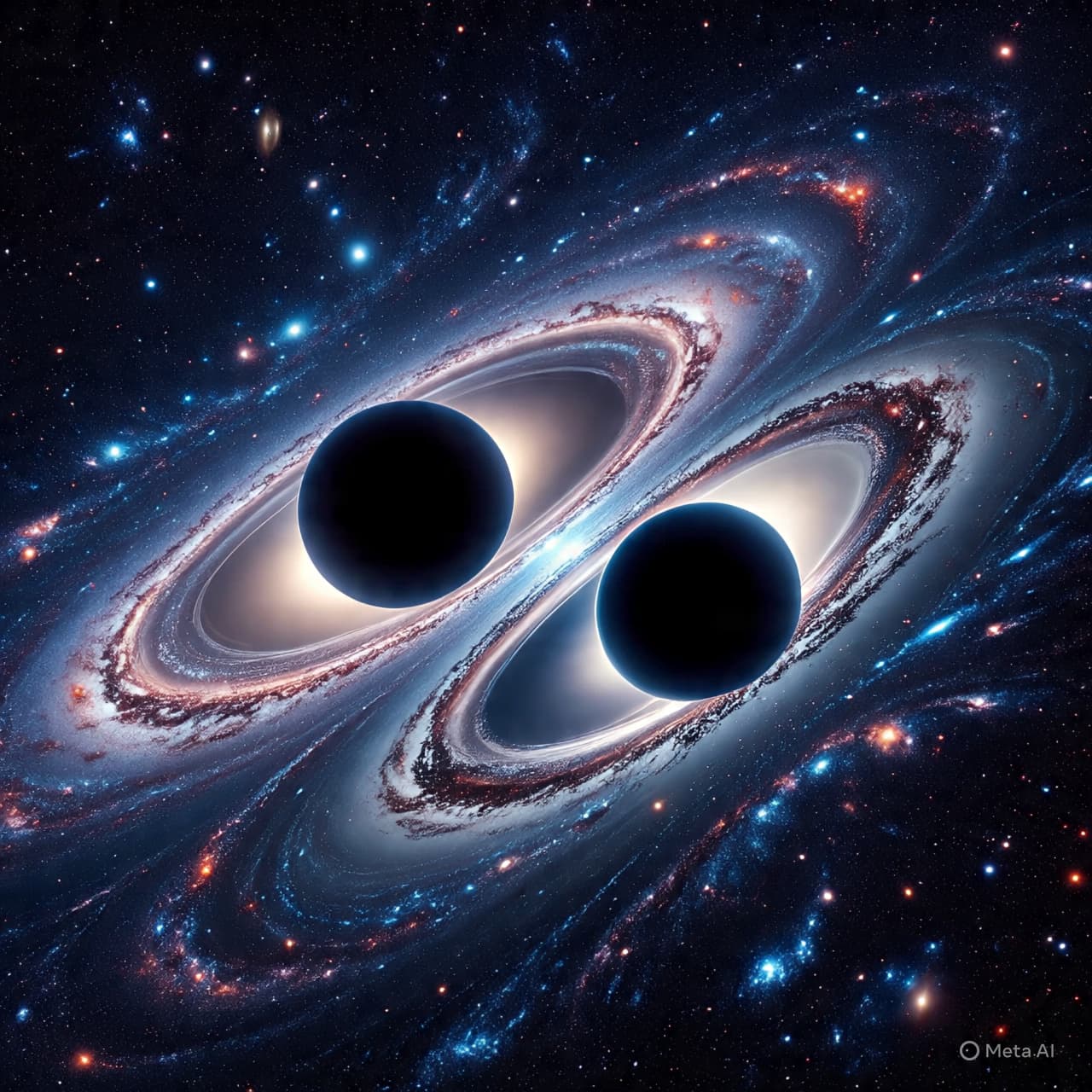
In the vast, swirling centers of galaxies, two supermassive black holes locked in orbit can offer some of the most intriguing signals in the cosmos—but they are notoriously hard to detect until the very final stages of their spiral toward each other. Now, astrophysicists are proposing a new way to spot these elusive pairs well before they merge, by watching how they bend and magnify the light of stars behind them.
When two galaxies collide, their central black holes don’t always merge immediately. Instead, they can form a binary system, orbiting each other at distances that are difficult for current telescopes to resolve. These supermassive black hole binaries are thought to be key drivers of galactic evolution and powerful sources of gravitational waves—the ripples in spacetime predicted by Einstein. But detecting them earlier in their inspiral has been a persistent challenge for astronomers.
The new technique centers on gravitational lensing—the strong bending of light by massive objects. Supermassive black holes act like natural telescopes, curving and magnifying light from stars in their host galaxies. Normally, a single black hole produces dramatic lensing only when a star happens to lie almost perfectly along the line of sight. But when two black holes orbit each other, the pattern of gravitational lensing becomes more complex and more likely to create observable spikes in brightness. These repeating flash-like signatures could act as telltale signs of a binary system.
Researchers from institutions including the Max Planck Institute for Gravitational Physics and the University of Oxford describe this approach in a study published in Physical Review Letters. In their model, the gravitational field of a supermassive black hole binary produces lensing patterns with multiple “caustics”—regions where starlight can be dramatically magnified. As the stars move relative to the binary, the resulting light signal can spike and dip in a way that would be distinctive compared to lensing by a single black hole.
The beauty of this method lies in its potential to identify binary systems years before they emit powerful gravitational waves detectable by future space-based observatories like the LISA mission. Wide-field optical surveys from observatories such as the Vera C. Rubin Observatory and the Nancy Grace Roman Space Telescope will soon map large portions of the sky with unprecedented depth and regular cadence, making it plausible to spot these repeating lensing events.
If successful, this approach could open a new “early warning” channel for supermassive black hole binaries, allowing astronomers to combine optical signals with future gravitational wave detections for multi-messenger astronomy. That means not only hearing the spacetime ripples but also seeing the changing light patterns of stars influenced by these colossal cosmic dancers.
Supermassive black hole binaries have remained in the shadows of astronomy because they are so compact and distant. But by watching how they twist and magnify starlight, physicists are now offering a promising path to bring these hidden giants into view—and to better understand how galaxies grow, merge, and evolve across cosmic time.
AI Image Disclaimer Visuals are created with AI tools and are not real photographs.
Sources Reuters Associated Press BBC News The Guardian Financial Times (turn0search17 news was integrated into article)
Published by Banx Network. This article is part of the Banx decentralized media programme, powered by the BXE token on the XRP Ledger.