For a brief moment, the frontlines of Ukraine seemed to pause under the language of holiday and restraint. The idea of an Easter truce—fragile, conditional, and contested—passed over the war like a thin sheet of spring light, offering a sense of suspension rather than stillness. But as with many pauses in this conflict, it carried within it the expectation of fracture, a quiet counting of hours until movement resumed.
As the truce period expired, both Ukraine and Russia accused each other of violations, each side describing the other’s actions as evidence that the ceasefire was never fully observed. Reports from various sectors of the front suggested continued exchanges of fire during the supposed pause, underscoring the difficulty of enforcing even temporary reductions in hostilities across a deeply fragmented battlefield.
The proposal of an Easter truce itself was not new in form, but it echoed earlier attempts to create brief humanitarian windows in the conflict—moments intended to allow civilians limited reprieve or enable localized evacuation and aid movement. Yet such arrangements have repeatedly struggled to hold across the extensive and shifting lines of engagement that stretch through eastern and southern Ukraine.
In the days surrounding the truce period, military briefings from both sides maintained contrasting narratives. Ukrainian officials described ongoing shelling and drone activity in several regions, while Russian statements emphasized alleged Ukrainian strikes during the same window. Independent verification of battlefield claims remains limited, as access to active combat zones is constrained and reporting often relies on partial or delayed information.
This pattern of mutual accusation has become a familiar rhythm in the war’s communication landscape. Alongside physical frontlines, there exists a parallel front of narrative control, where each side seeks to establish the legitimacy of its conduct and the violations of its opponent. In this space, even temporary pauses become contested terrain, interpreted differently depending on perspective and position.
The expiration of the truce also reflects the broader challenge of establishing sustained pauses in a conflict defined by attrition and mobility. Unlike structured armistices or formal ceasefire agreements, these brief, symbolic halts rely heavily on mutual compliance and real-time coordination—conditions that have proven difficult to maintain amid ongoing offensives and counteroffensives.
For civilians living near the front, such pauses can feel both significant and uncertain. Moments of reduced intensity may allow for movement, repair, or recovery, yet the lack of guarantee means that any calm is provisional. The return of hostilities after the truce reinforces a pattern in which relief arrives not as resolution, but as interruption.
International observers continue to frame these temporary ceasefires as indicators of diplomatic possibility, however limited. Each attempt suggests that communication channels remain open enough to propose pauses, even if not strong enough to sustain them. In this sense, the truce exists less as a solution and more as a measurement of distance between competing realities.
As the Easter period closes and military activity resumes its established cadence, attention shifts once again to the broader trajectory of the war—its endurance, its fatigue, and its unresolved geography. The brief suspension now recedes into record, another instance in a sequence of interrupted pauses that mark the conflict’s passage.
What remains is a landscape where ceasefires are not endpoints, but intervals—brief edits in a narrative that continues without final punctuation.
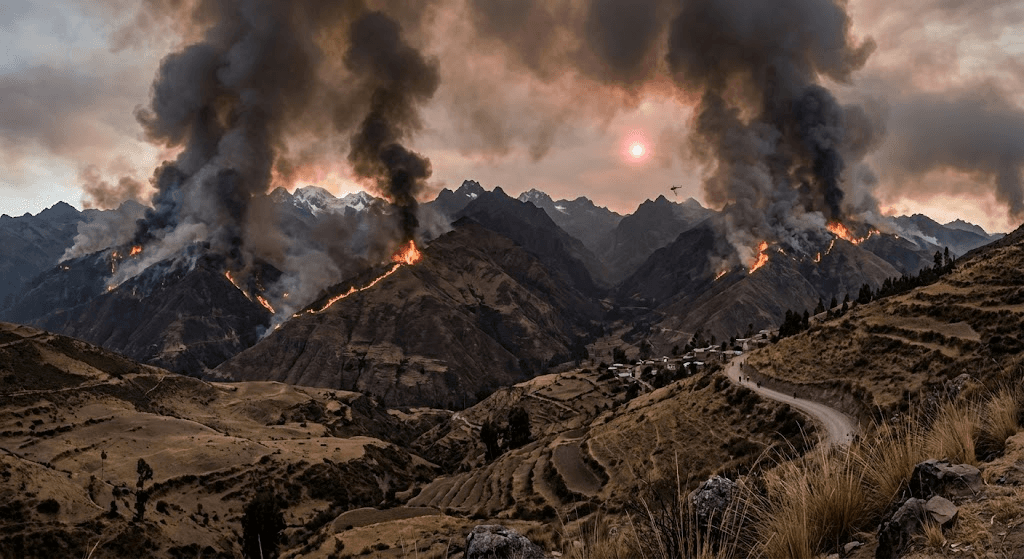
AI Image Disclaimer All visuals are AI-generated conceptual illustrations intended to represent conflict conditions and not real-time battlefield photography.
Sources Reuters, BBC News, Al Jazeera, The Guardian, Associated Press
Published by Banx Network. This article is part of the Banx decentralized media programme, powered by the BXE token on the XRP Ledger.