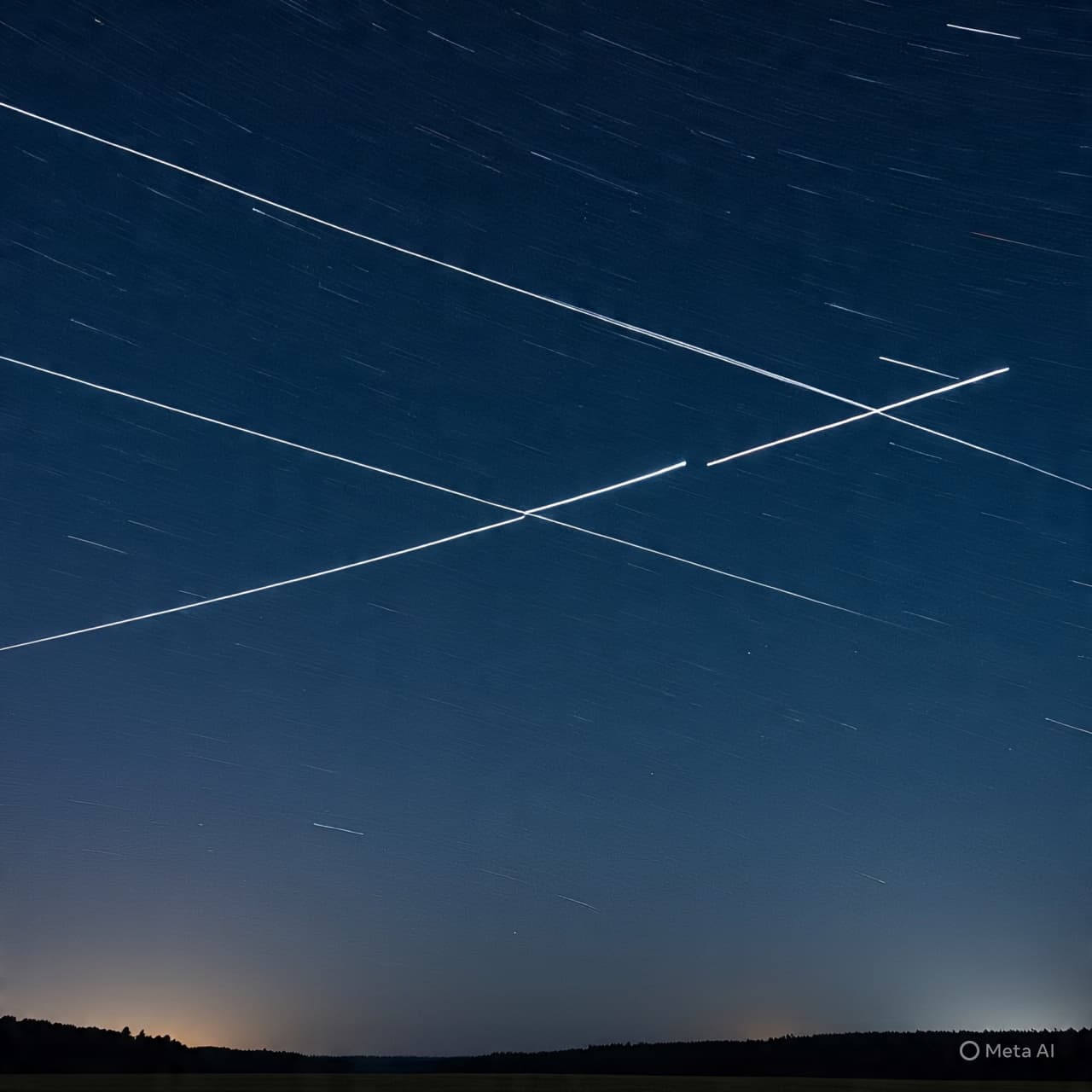
There was a time when the night sky held a kind of certainty. It stretched above in deep, unbroken darkness, its scattered points of light fixed in their quiet positions. To look upward was to encounter distance—unchanged, indifferent, and far removed from the movement of life below.
That distance has begun, slowly and almost imperceptibly, to narrow.
With the expansion of satellite constellations led by SpaceX, the sky has taken on a different texture. What once appeared empty between the stars now carries motion—small, steady points of light crossing the horizon, visible not as anomalies but as part of an increasingly familiar pattern.
The recent milestone of the company’s 10,000th satellite marks a moment within this broader transformation. The network, known as Starlink, has been designed to deliver high-speed internet access to remote and underserved regions, extending connectivity to places where traditional infrastructure has struggled to reach. In this sense, the system represents a significant shift in how communication is distributed, offering a form of access that moves not through cables and towers alone, but through orbit.
For communities in isolated areas, this reach has been tangible. Connections once limited by geography have become more stable, more immediate, allowing for communication, education, and economic activity to flow with fewer barriers. The signal, carried across space, arrives with a kind of quiet efficiency, linking distant points on the Earth through an unseen network above.
Yet alongside this expansion, another change has taken shape—one less easily measured in speed or access. The increasing number of satellites has introduced a persistent presence into the night sky, one that reflects sunlight and alters the visual field observed from the ground. Astronomers and researchers have noted that these reflections can interfere with observations, particularly for sensitive instruments designed to detect faint celestial objects.
The concern extends beyond professional study. For those who look upward not through telescopes but with the unaided eye, the character of the night itself has begun to shift. The sky is no longer solely a record of distant stars and galaxies, but also of human activity, layered into the same field of view.
Efforts have been made to address this balance. Adjustments in satellite design, including coatings and orientation strategies, have aimed to reduce reflectivity. Collaboration between companies and the astronomical community continues, seeking ways to preserve both access to the sky and the integrity of observation.
Still, the tension remains. The same system that brings connection to remote regions also introduces a form of light that cannot easily be removed once in place. It becomes part of the environment, woven into the experience of night.
There is no clear boundary where one effect ends and the other begins. The benefits of global connectivity exist alongside the gradual brightening of the sky, each influencing how the world is experienced in ways both practical and perceptual.
SpaceX has launched thousands of Starlink satellites to provide global internet coverage, surpassing 10,000 units in orbit. The expansion has improved connectivity in remote areas while raising ongoing concerns among astronomers about increased light pollution and its impact on observations.
AI Image Disclaimer
Illustrations were created using AI tools and are not real photographs.
Source Check: The New York Times; BBC; The Guardian; Space.com; Reuters
Published by Banx Network. This article is part of the Banx decentralized media programme, powered by the BXE token on the XRP Ledger.