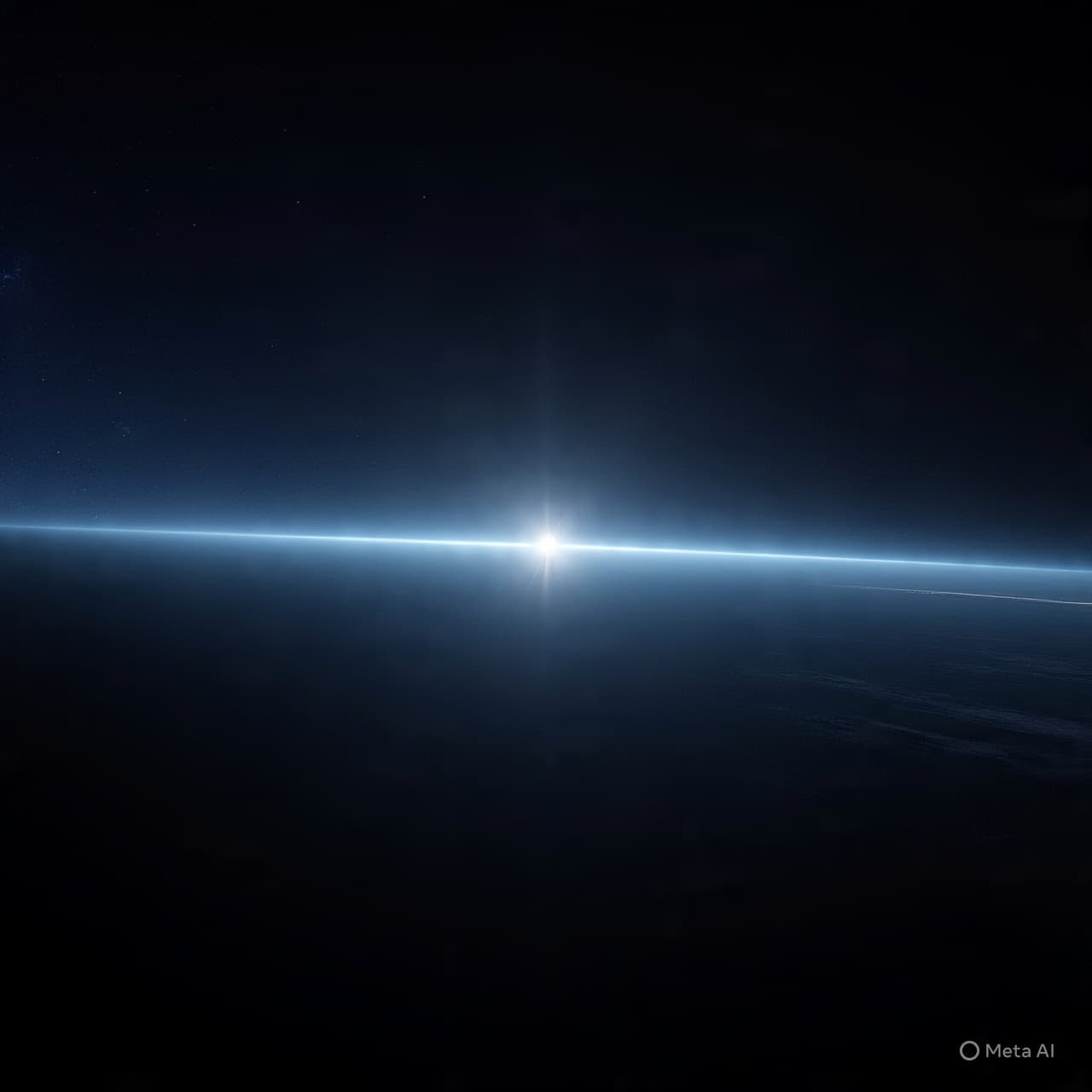
Opening There are moments in science that resemble the hushed pause between waves at the shore — a calm that follows a crest but precedes what comes next. The universe, in all its vastness, has always invited us to look outward, to search for truth in places where light barely reaches and mysteries accumulate like stars at dusk. Recently, a seasoned physicist invoked one such cosmic vista in reflecting on an idea as old as humanity itself: the possibility that a realm we describe as “heaven” might lie at the furthest margins of what we can perceive — beyond the cosmic horizon that defines the limit of observable space.
Body The observable universe — the part of existence from which light has had time to reach us since the Big Bang — forms a kind of boundary in cosmology. Beyond this cosmic horizon, objects recede so swiftly that their light will never arrive here, no matter how long humans observe or wait. In that sense, it’s a frontier not of material substance but of fundamental limitation, woven into the fabric of expanding space itself.
In an essay shared with a mainstream audience, a physicist with training in both physics and astronomy suggested that this unreachable edge, where the universe’s expansion erases the difference between distance and light’s ability to traverse it, could be thought of as akin to ideas of heaven in some ancient traditions. Drawing on historical descriptions and the language of relativity, he proposed that an “upper realm” of timelessness — where light-like entities travel and ordinary measures of time cease — might occupy a zone beyond the visible cosmos.
It’s important to recognize the distinction between this kind of interpretation and traditional scientific claims about observable phenomena. Modern cosmology does indeed describe the cosmic horizon — roughly defined by how far light has traveled in the universe’s lifetime — but it does not posit a physical place or dimension that we can measure or access. Most astronomers outside of specific philosophical or theological frameworks view the horizon not as a “boundary” in a physical sense, but as a limit imposed by the universe’s expansion and the speed of light.
Nevertheless, ideas that bridge cosmological boundaries with deeper existential questions reflect a long tradition of human thought. For centuries, scholars, theologians, poets, and philosophers have looked to the skies in search of meaning — from metaphors of light and distance to speculation about worlds beyond our own. Even as mainstream science deliberately refrains from equating physical theory with spiritual doctrine, such reflections highlight how cosmic inquiry often stirs deeper questions about existence and the unknown.
In this case, the notion of a “heaven at the edge of the observable universe” functions less as a scientific hypothesis supported by testable evidence and more as an interpretation inspired by cosmology and cultural narratives. Whether one reads it as metaphor, theology, or philosophical exploration, it offers a vantage point from which to contemplate both the limits of science and the enduring human quest for meaning.
Closing In straightforward terms, current scientific understanding does not support the idea that a tangible “heaven” exists at the edge of the observable universe. The cosmic horizon is a well-defined concept in modern astronomy, referring to a boundary set by the expanding universe beyond which light cannot reach us. Claims linking this boundary to theological descriptions are speculative and lie outside established scientific consensus. Astronomers emphasize that while the structure of the universe beyond what we can see remains an open question, there is no empirical evidence for physical realms corresponding to spiritual ideas.
A physicist merged cosmological concepts with ancient ideas by suggesting the cosmic horizon — the limit of observable space — could metaphorically align with spiritual notions of heaven.
AI Image Disclaimer
“Illustrations were produced with AI and serve as conceptual depictions.”
Source Check (5 credible media names)
1. Orbital Today 2. Fox News (opinion piece event reported by mainstream) 3. UNILAD 4. International Business Times UK 5. National Geographic (context on the observable universe and science beyond it)
Published by Banx Network. This article is part of the Banx decentralized media programme, powered by the BXE token on the XRP Ledger.