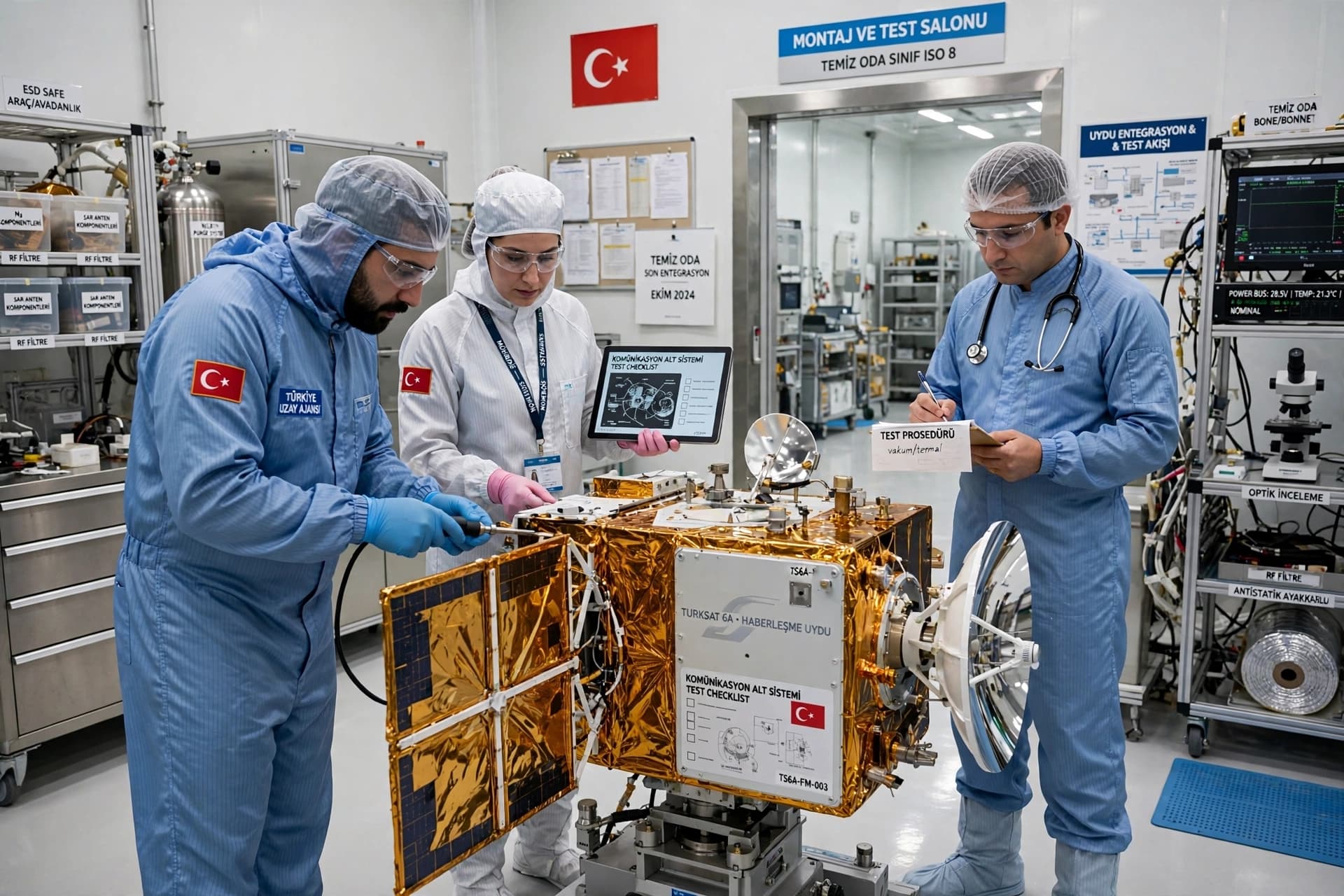
Türkiye is seeking to broaden its role in the international space industry, and Airbus is watching that development closely. The European aerospace company is discussing possible cooperation with Turkish institutions in areas ranging from satellite communications to lunar exploration and human spaceflight.
The discussions include Airbus and Türkiye’s Scientific and Technological Research Council, known as TÜBİTAK. Airbus executive Carlo Mirra said negotiations were continuing in several areas, with lunar exploration identified as one of the fields where cooperation could become more direct.
Satellite technology provides another important connection. Airbus has previously participated in Türkiye’s Türksat satellite programs, giving the two sides an existing industrial relationship that could potentially be expanded into additional projects.
Türkiye has been developing its domestic space capabilities through a national space program and investments in satellite technology. Companies and institutions including Türksat, Turkish Aerospace Industries, ASELSAN and other emerging space businesses have become part of an increasingly broader national ecosystem.
The country is also preparing to host the 77th International Astronautical Congress in Antalya. More than 1,800 abstracts from Turkish institutions had reportedly been submitted for the technical conference, creating an opportunity for local researchers and companies to present their work to an international audience.
For Airbus, cooperation with Türkiye could take several forms. Mirra described possibilities ranging from direct industrial partnerships to agreements involving Türkiye, the European Space Agency, the European Commission or countries associated with Airbus.
The discussion arrives at a time when space technology is expanding beyond traditional government programs. Satellites now support communications, navigation, Earth observation, environmental monitoring and disaster response, while new commercial projects are creating additional demand for spacecraft and related systems.
Lunar exploration adds another layer to that development. As international space programs prepare for more ambitious missions beyond low Earth orbit, cooperation between established aerospace companies and emerging national programs can provide access to engineering experience, technology and international supply chains.
For Türkiye, building stronger connections with established space companies can also help integrate domestic capabilities into the wider international market. The process involves more than launching satellites; it includes developing engineers, manufacturing systems, research institutions and companies able to participate in complex international projects.
No major new contract between Airbus and Türkiye was announced in the reports, so the current discussions should be understood as ongoing cooperation rather than a finalized program. Still, the conversations show how Türkiye’s space ambitions are increasingly being connected with international aerospace networks, from satellite communications on Earth to possible missions farther beyond it.
Image Disclaimer: These illustrations are AI-generated representations of satellite and space technology. They do not depict actual Airbus-Türkiye facilities, spacecraft or confirmed missions.
Sources: Türkiye Today Anadolu Agency Airbus Defence and Space TÜBİTAK
Published by Banx Network. This article is part of the Banx decentralized media programme, powered by the BXE token on the XRP Ledger.