In the hushed expanse of the southernmost continent, where wind‑sculpted ice meets the distant glare of a low winter sun, there will soon be a gentle bending of light and shadow that belong to stories older than any human tale. On February 17, 2026, the moon will drift between Earth and sun in such a way that, for a breath‑brief moment, the sun’s brilliant face will glow like a circle of fire against the cold Antarctic sky. It is a kind of cosmic tango — subtle, spare, and serene — and it will be witnessed only by those few who call this remote land home, or who have ventured down to its silent reaches to watch the sky’s slow choreography.
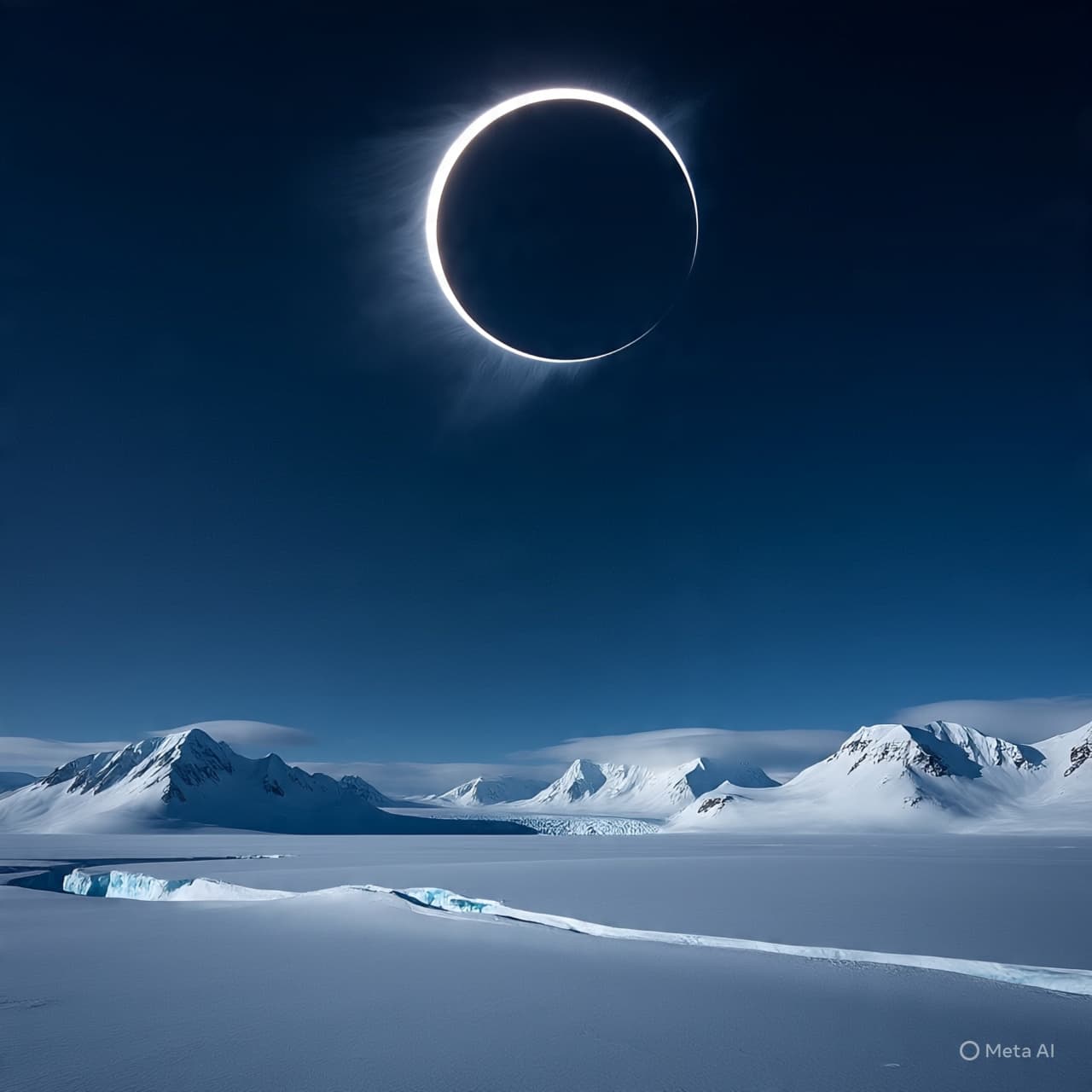
This celestial event, known as an annular solar eclipse, occurs when the moon lies between our world and the sun but, in its orbit, sits a little farther from Earth than usual. Instead of blotting out the sun entirely, the moon appears slightly smaller, leaving a ring of sunlight visible around its dark silhouette — the “ring of fire” that has stirred imagination and awe for centuries. In the frozen heart of Antarctica, where the horizon stretches unbroken, this fiery band will glow briefly above a landscape of white and shadow. On this February day, the path of perfect alignment will sweep across sparsely inhabited ice, touching only the narrow strips of land near isolated research stations, where perhaps a handful of scientists and support staff will witness the moment when day becomes ringed with fire.
The sun’s warm disk will be obscured by as much as 96 percent at the peak of the eclipse, leaving only a luminous outer edge dancing against the silhouette of the moon’s form. For those few inside the path of annularity, the effect — which can last around two minutes — is a quiet marvel, a reminder of the delicate gravitational rhythms that bind Earth, moon, and sun together. Around them, ice and snow reflect the low polar light, and the horizon seems to hold its breath as darkness and brightness merge in a fleeting embrace.
Beyond the narrow ribbon of complete annularity, the eclipse will still make its presence felt across broader reaches of the Southern Hemisphere. Observers in much of Antarctica will see the sun partially eclipsed, its disc softly bitten into by the moon’s passage. Further afield, skywatchers in the southernmost skirts of Africa and South America — from parts of South Africa and Mozambique to the tips of Argentina and Chile — will glimpse a partial eclipse, where the sun appears dimmed by a slow, celestial shadow play. Even there, beneath skies that are darker at midday by only a fraction, the day’s rhythm will feel subtly altered, as though the presence of the moon has quietly dipped its hand into the flow of daylight.
This eclipse arrives during the long southern summer, when Antarctica’s daylight lingers low on the horizon and the sun’s path is a slow arc through the sky. Those fortunate few who will be in place to see the ringed sun may reflect on the rare stillness of such a moment — the convergence of motion and quiet that reminds us how celestial mechanics can choreograph patterns far beyond the pulse of everyday life. It is a display that belongs more to the patience of the heavens than to human urgency, a gentle testament to the rhythms that govern sky and earth alike.
In straightforward terms, astronomers describe the event on February 17, 2026 as an annular solar eclipse, during which the moon will cover much of the sun’s disk but stop shy of totality, creating a thin bright ring. This “ring of fire” phase will be visible only from remote parts of Antarctica, with only a very small number of people — researchers and perhaps a few visitors — present in the annularity zone. Partial phases of the eclipse will be visible across broader parts of the Southern Hemisphere, including southern Africa and the southern tip of South America.
All Visuals are AI‑generated and serve as conceptual representations.
Sources (Media Names Only)
Live Science Space.com EarthSky
Published by Banx Network. This article is part of the Banx decentralized media programme, powered by the BXE token on the XRP Ledger.