There is a soft poetry to scientific discovery — a whisper in the cadence of progress, a gentle unfolding of knowledge like light over frost‑covered ground at dawn. For over a century, physicists have walked the delicate line between the known and the unknown, tuning their instruments and their minds in hopes of glimpsing nature’s subtle harmonies. Among these long quests, the story of superconductivity stands out: a phenomenon that once seemed confined to near‑absolute zero, now slowly climbing toward temperatures that bring us closer to practical, world‑changing applications. In a new chapter of that story, researchers have nudged the frontier upward once again, setting a fresh record for superconductivity under ambient conditions without the strenuous need for extreme pressures.
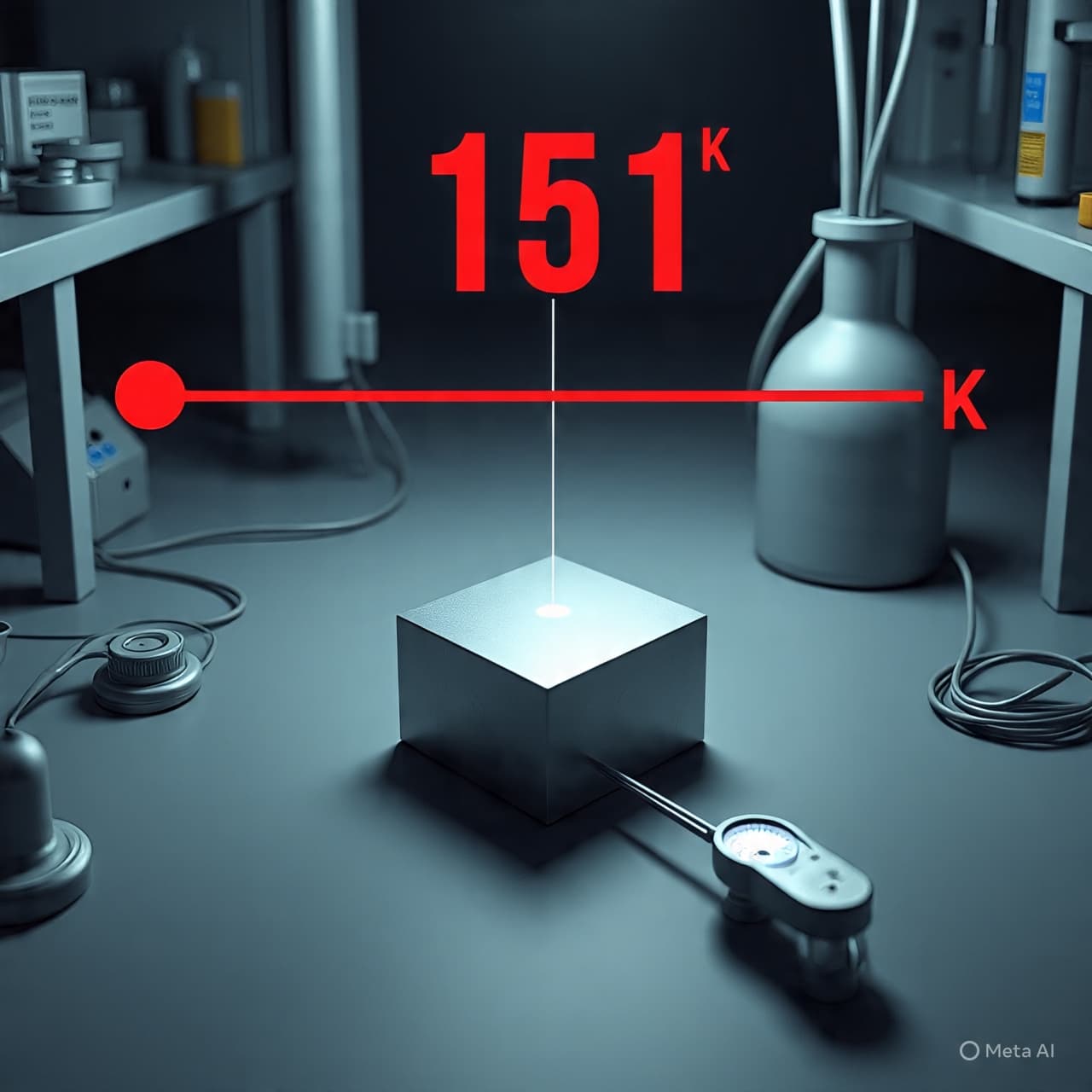
Superconductivity — the remarkable state in which a material conducts electricity with zero resistance — has long captivated scientists and dreamers alike. First glimpsed by Heike Kamerlingh Onnes in 1911 at the frigid edges of physics, it has danced just out of reach for everyday use, constrained by chilling demands or crushing pressures. Historically, materials that superconduct at higher temperatures did so only when squeezed to pressures akin to the Earth’s deep interior, rendering them impractical for most applications. Yet the collaborative work of researchers at the University of Houston’s Texas Center for Superconductivity and their partners has quietly shifted this landscape. By refining a technique known as pressure quenching, they preserved a metastable phase in a ceramic superconductor that maintains superconductivity up to 151 Kelvin — roughly minus 122 degrees Celsius — at ordinary atmospheric pressure.
This new threshold raises the ambient‑pressure critical temperature by nearly 18 Kelvin compared with earlier records, opening a gentle window of possibility between the cold realms of liquid nitrogen and the practical thresholds of cooling technology. What makes this advance particularly resonant is its subtlety: it does not rely on exotic heavy compression but on a carefully guided transformation of material phases that lingers once the pressure is released. In the language of physics, the material’s electrons pair in such a way that they flow without resistance across the lattice — a dance of particles choreographed by both quantum mechanics and human ingenuity.
For context, previous discoveries of high‑temperature superconductivity, particularly in metal hydrides, have required extreme pressures far beyond atmospheric, limiting their immediate utility. Under those conditions, scientists have clocked superconductivity near warmer temperatures, but at the cost of highly specialized gear and impractical constraints. The new result does not yet reach those lofty numbers but moves the record for ambient‑pressure superconductivity ever so slightly closer to temperatures that might one day intersect with everyday engineering.
Like many breakthroughs in physics, this one is a reminder that progress often comes in quiet steps rather than sweeping leaps. Materials scientists and condensed‑matter physicists will continue to explore compositions and processes that could push the bar even higher, aiming for superconductivity that works closer to room temperature without exotic conditions. Until then, each new record adds a stone to a bridge spanning theory and application.
In recent experiments, the successful raising of the critical temperature to 151 K at ambient pressure provides new data that will be studied and built upon by laboratories worldwide, reflecting a broader, collaborative effort in superconductivity research.
AI Image Disclaimer (Rotated Wording) “Visuals are created with AI tools and are not real photographs.”
Sources (Based on News) Phys.org – report on the new ambient‑pressure superconductivity record. Quantum Zeitgeist – University of Houston achievement summary. Physics (APS) – analysis of the ambient‑pressure superconducting phase. Science News – context on superconductivity temperature records. Newswise – details on the collaborative research and techniques.
Published by Banx Network. This article is part of the Banx decentralized media programme, powered by the BXE token on the XRP Ledger.