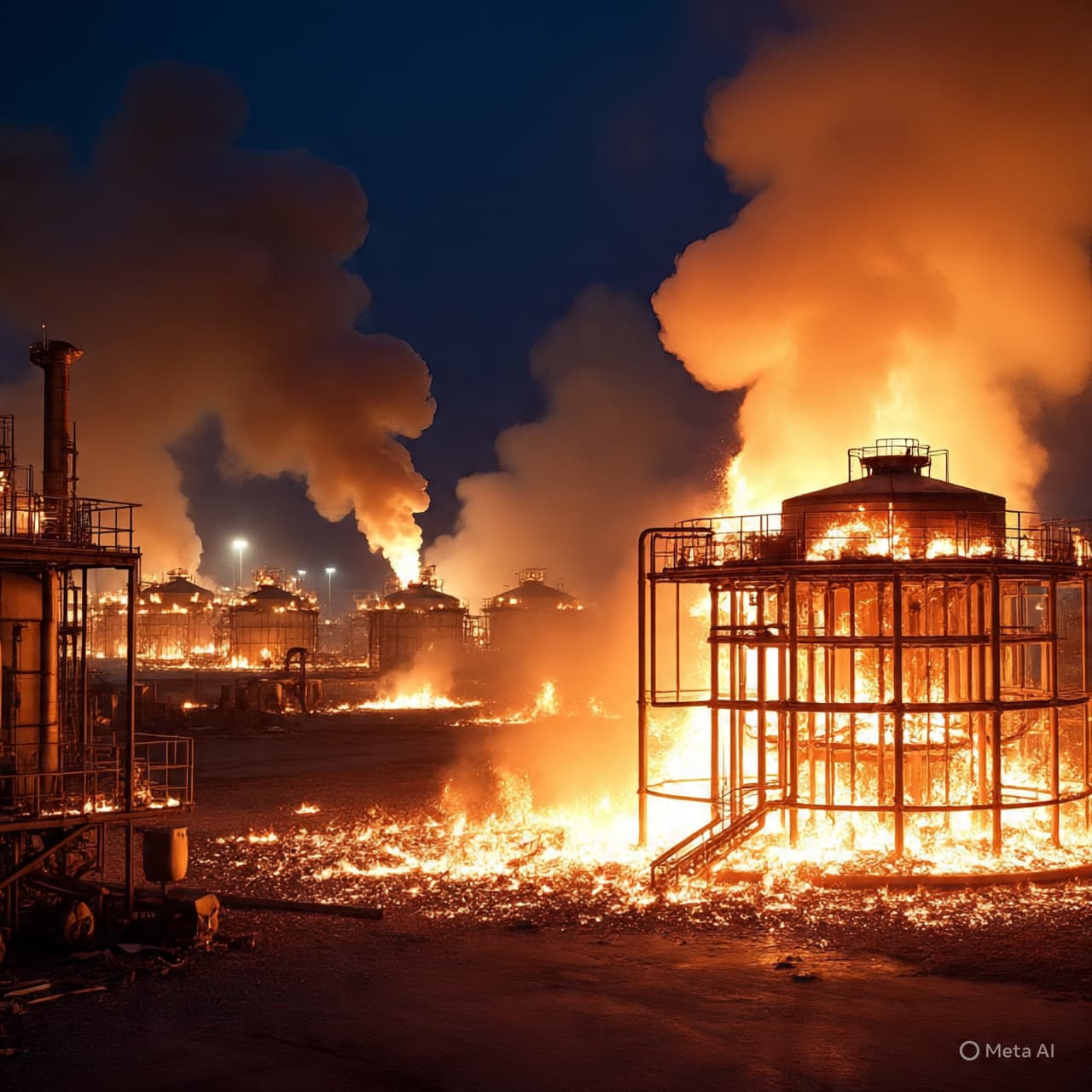
In the industrial outskirts of many Middle Eastern cities, fuel depots rarely attract attention. They stand quietly at the edge of highways and deserts—rows of storage tanks, pipelines, and loading bays where trucks arrive before dawn and depart before the midday heat. These places are not monuments or symbols. They are simply the quiet machinery of everyday life, keeping engines running and lights on.
Yet in times of war, even the most ordinary infrastructure can become a strategic landmark.
Israeli forces announced that they had carried out strikes on fuel supplies associated with the Islamic Revolutionary Guard Corps, the powerful branch of Iran’s military that operates both conventional units and regional proxy networks. According to Israeli military statements, the targets included fuel depots and logistical facilities believed to support the movement of missiles, drones, and other military equipment linked to the Guard’s operations.
The attacks form part of a wider campaign that has unfolded over recent weeks, as Israel attempts to disrupt what it describes as the logistical backbone of Iran’s military capabilities. While missile launch sites and command centers often dominate headlines, supply lines—the steady flow of fuel, parts, and transport—remain the quieter foundations that allow those systems to function.
Fuel, in particular, carries a special importance in modern warfare. Aircraft sorties, drone launches, and long-distance missile deployments all depend on the unseen networks that move energy across a country’s territory. Targeting these supplies, military planners often argue, can slow operations without directly striking populated urban centers.
The facilities reportedly linked to the Revolutionary Guard reflect a broader economic and military structure that has developed in Iran over decades. The IRGC, originally formed after the 1979 revolution, now holds influence across large sections of the country’s security and economic sectors, including construction, shipping, and elements of the energy industry.
In the current conflict between Israel and Iran, that structure has drawn increasing attention.
Israel has described its campaign as an effort to weaken the infrastructure supporting Iran’s missile program and its network of allied armed groups across the Middle East. Iranian officials, meanwhile, have framed the attacks as acts of aggression and have continued to launch retaliatory missile and drone strikes toward Israeli territory.
The exchange has gradually expanded the geography of the war. From missile launch sites and radar stations to airports and supply depots, the map of potential targets grows wider with each passing day. Industrial zones that once operated far from the attention of global audiences now appear in military briefings and satellite imagery.
For civilians living near such infrastructure, the shift can feel sudden. A place that once smelled only of fuel and machinery may, overnight, become part of a much larger story unfolding across the region.
Yet even as the conflict intensifies, analysts note that strikes on logistical networks often signal a strategic phase of warfare—one aimed not only at immediate destruction but at limiting an opponent’s capacity to sustain operations over time.
In that sense, the attack on fuel supplies reveals something about the quiet architecture of modern conflict. Wars are not fought only where missiles launch or aircraft take flight. They are also sustained in the quieter spaces where energy is stored, transported, and transformed into motion.
For now, those spaces—once overlooked pieces of industrial geography—have become another chapter in a war that continues to unfold across the Middle East, one depot and runway at a time.
AI Image Disclaimer Illustrations were created using AI tools and are not real photographs.
Sources Reuters Associated Press BBC News Al Jazeera The Guardian
Published by Banx Network. This article is part of the Banx decentralized media programme, powered by the BXE token on the XRP Ledger.