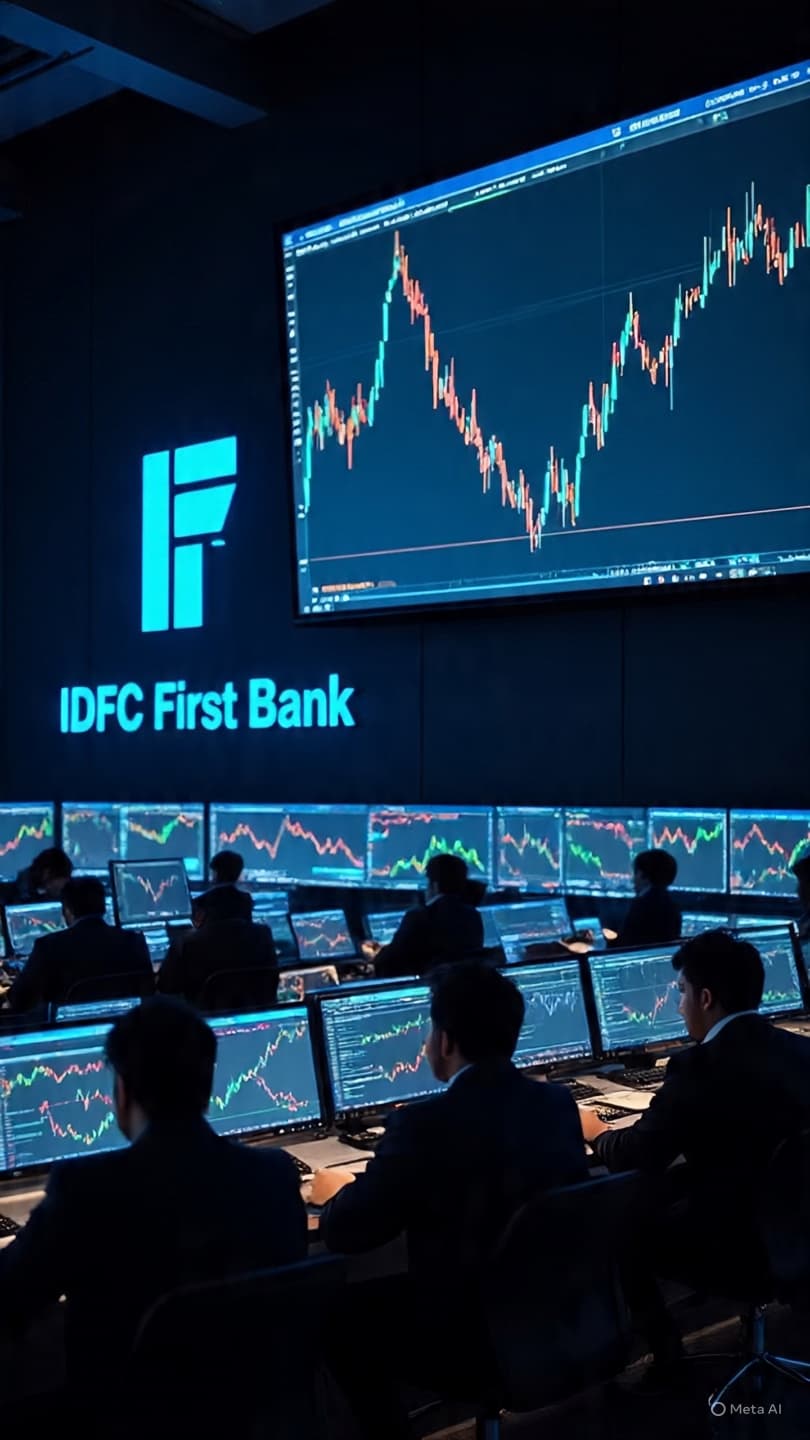
In the ebb and flow of financial markets, share prices often reflect confidence as much as they do numbers. Just as tides respond to unseen currents beneath the surface, investor sentiment can shift swiftly when new information emerges. On Monday, that undercurrent stirred sharply for IDFC First Bank — its shares plunged nearly 20 % after the lender disclosed a significant fraud amounting to roughly ₹590 crore connected to accounts managed at its Chandigarh branch.
The drop marked one of the steepest declines in the bank’s stock in years, with trade halting briefly as the shares hit their lower circuit. The revelation of the suspected fraud — discovered during reconciliation of accounts linked to government entities — raised immediate questions about internal controls and operational oversight.
According to regulatory filings, the irregularities came to light when a department of the Haryana government sought to close accounts and transfer funds. Discrepancies between the amounts the government entity expected and the bank’s records prompted deeper scrutiny, revealing discrepancies that collectively totaled about ₹590 crore.
In response, the bank has taken swift internal action: four employees from the Chandigarh branch have been suspended, a police complaint has been filed, and an independent forensic audit — led by KPMG — is underway. The bank has also informed statutory auditors and relevant regulators as part of ongoing efforts to assess the full scope of the matter.
Market reactions underscored how quickly sentiment can turn in financial circles. The suspected fraud amount not only overshadowed the bank’s quarterly profit but also wiped out a substantial portion of its market capitalization in a single session, as investors reassessed risk and rebalanced portfolios.
Despite the sharp sell-off, IDFC First Bank has maintained that the incident appears confined to a specific set of government-linked accounts and does not currently suggest wider exposure across its customer base. The bank has emphasized its strong capital position and liquidity, noting that the suspected amount — while significant — represents a small fraction of its total deposits and net worth.
Analysts observing the situation have pointed out that while the immediate impact on capital may be manageable, the episode highlights broader questions concerning governance and operational safeguards. For institutional clients, regulators, and investors alike, the focus now turns to how the bank navigates recovery, accountability, and assurance of strengthened controls.
As the week unfolds, the forensic audit and legal proceedings will likely shape not just the bank’s financials but also the narrative surrounding transparency and trust in India’s banking sector. For many onlookers, Monday’s market reaction was a reminder that confidence — like markets themselves — can be fragile, shifting on currents that only reveal themselves with time.
AI Image Disclaimer: Images in this article are AI-generated illustrations, meant for concept only.
---
Sources (Credible Mainstream/Niche): Reuters BBC News The Economic Times Moneycontrol Business Today
Published by Banx Network. This article is part of the Banx decentralized media programme, powered by the BXE token on the XRP Ledger.