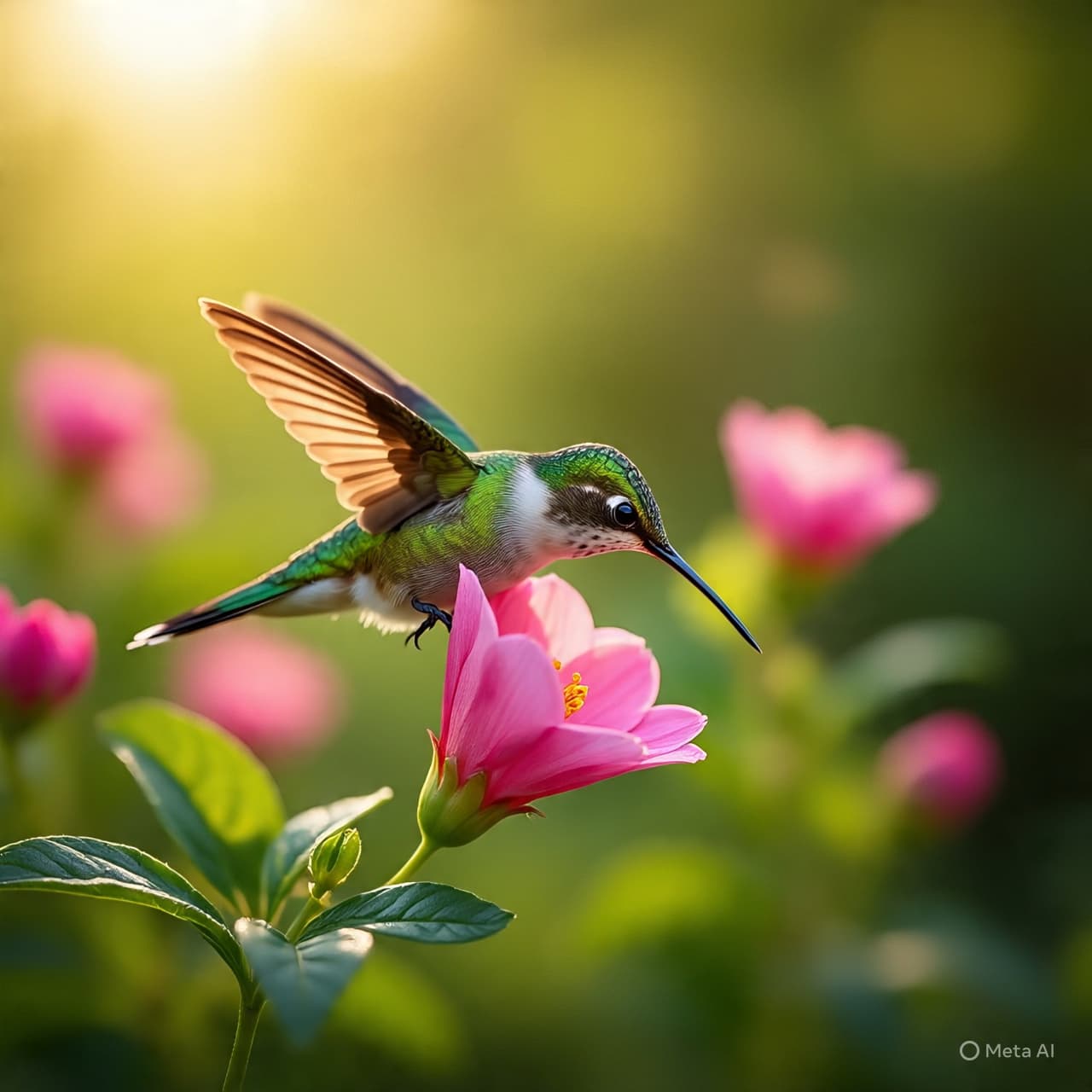
There is a particular kind of motion that seems to belong to the air itself—brief, shimmering, and almost constant. A hummingbird, suspended between flower and sky, moves with a precision that makes stillness feel distant. Its wings blur, its body hovers, and in that small span of time, it draws what it needs from the world around it.
In recent observations, scientists have described how hummingbirds receive what might be considered a daily “buzz” from nectar, a steady intake of energy that sustains their rapid metabolism. The comparison to a single drink per day offers a way of understanding the scale of their intake, though the reality is more continuous than the phrase suggests. Each visit to a flower becomes a small act of renewal, repeated across the course of a day.
The energy within nectar is tied to the plant world, to flowers shaped by time, pollinators, and environment. For hummingbirds, this source of energy is both accessible and essential. Their bodies, adapted for speed and hovering flight, require a constant supply of fuel, one that must be replenished frequently to match the demands of their movement.
At the center of this exchange lies a familiar concept in biology: metabolism. In hummingbirds, metabolism operates at an elevated pace, converting nectar into the energy needed to sustain rapid wingbeats and agile flight. This process unfolds continuously, with little margin for pause.
What appears as a single “drink” is, in practice, a series of small interactions—brief pauses at flowers, each contributing to the day’s total intake. These moments, though fleeting, are essential. They connect the bird to its environment in a cycle of movement and sustenance, one that repeats throughout waking hours.
There is a balance within this rhythm. The energy expended in flight must be met with energy gained from nectar, creating a delicate equilibrium. Too little intake, and the balance shifts; too much, and the system adjusts accordingly. This interplay shapes the behavior of hummingbirds, guiding their routes, their timing, and their interactions with the plants they visit.
The image of a “daily buzz” captures something of this process, suggesting both energy and repetition. Yet it also hints at the continuity of life in motion—an ongoing exchange between organism and environment, sustained through countless small acts rather than a single, defining moment.
In observing this pattern, researchers gain insight into how energy moves through ecosystems, from flower to bird and beyond. It is a reminder that even the smallest creatures participate in larger cycles, their daily routines contributing to the broader flow of life.
Scientists report that hummingbirds consume nectar equivalent to about one drink per day in energy terms, though their intake occurs continuously through frequent feeding. The findings highlight the high metabolic demands of these birds and their reliance on constant energy intake.
AI Image Disclaimer Visuals are AI-generated and serve as conceptual representations.
Sources National Geographic BBC News Science Nature Smithsonian Magazine
Published by Banx Network. This article is part of the Banx decentralized media programme, powered by the BXE token on the XRP Ledger.