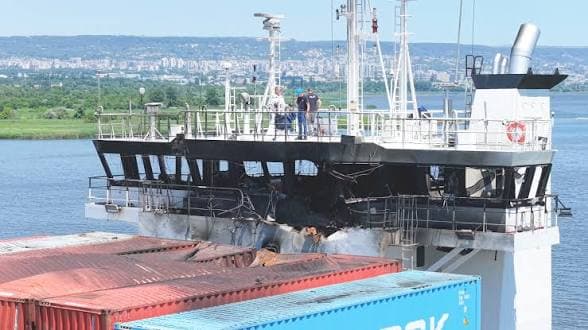
At certain points on the map, the world narrows into something almost fragile—a line of water where distance compresses and movement becomes deliberate. The Strait of Hormuz is one such place, where currents carry not only ships, but the weight of economies and expectations. Tankers pass through its corridor in steady procession, each journey part of a larger, unseen rhythm.
In recent days, that rhythm has been accompanied by sharper language. Donald Trump has said that any closure of the Strait of Hormuz would be met with a forceful response, a statement that adds to a growing atmosphere of caution around one of the world’s most critical shipping routes. The words arrive not in isolation, but within a broader context of regional tension, where the possibility of disruption carries implications far beyond the narrow waters themselves.
The strait serves as a passage for a significant share of global oil supplies, linking producers in the Gulf with markets across continents. Its importance lies not only in volume, but in its position: there are few alternatives that can replicate its efficiency. As a result, even the suggestion of interruption—whether through conflict, blockade, or heightened risk—can ripple quickly through energy markets, influencing prices and planning in distant places.
Statements like these are part of a larger language of deterrence, where emphasis is placed on consequence rather than action. They reflect a recognition of how vital the strait remains, and how sensitive its status can be to shifts in political and military dynamics. The presence of naval forces in the region, including those of the United States Navy, underscores this awareness, forming a backdrop of readiness that is both visible and implicit.
At the same time, the daily movement through the strait continues. Ships navigate carefully, guided by established routes and coordinated systems designed to maintain flow even under strain. For those directly involved in shipping, the calculations are constant—balancing efficiency, safety, and the evolving signals that shape decision-making.
The wider region remains marked by a series of overlapping concerns, where diplomatic exchanges, security incidents, and economic considerations intersect. In this environment, language itself becomes part of the landscape, shaping expectations as much as responding to them. Each statement adds a layer to how the situation is understood, both locally and globally.
For countries dependent on energy imports, the stability of the Strait of Hormuz is more than a regional issue; it is a matter of continuity. Supply chains, pricing structures, and long-term planning all assume a certain degree of reliability in this passage. When that assumption is questioned, even briefly, the effects can extend far beyond the immediate geography.
Yet the strait has long existed within this balance—between openness and vulnerability, between movement and the potential for interruption. Its history includes moments of tension as well as long periods of steady operation, each shaping how it is perceived in the present.
As the conversation unfolds, the facts remain measured: a prominent political figure has stated that any closure of the Strait of Hormuz would prompt a forceful response, reinforcing the significance of the passage and the stakes associated with its security. Around this statement, the broader currents of geopolitics continue to move, carrying both uncertainty and continuity in equal measure.
And in the narrow stretch of water where so much converges, ships continue their passage—quiet, deliberate, and attentive to the balance that allows them to move forward.
AI Image Disclaimer Illustrations were created using AI tools and are not real photographs.
Sources Reuters BBC News Associated Press Bloomberg The Wall Street Journal
Published by Banx Network. This article is part of the Banx decentralized media programme, powered by the BXE token on the XRP Ledger.