
There are moments in politics when history is invoked like a lighthouse—its beam swung across the present in search of resemblance. Names rise from the past not only as memory, but as measure. In recent days, amid renewed tension over military strikes linked to Iran, one such name surfaced again, carried on the cadence of campaign rhetoric and televised interviews.
At a rally and in subsequent remarks, Donald Trump criticized British Prime Minister Keir Starmer, saying he is “no Winston Churchill” in response to the United Kingdom’s position on strikes connected to Iran. The comparison, sharp and deliberate, reached back to the wartime leadership of Churchill, whose legacy remains synonymous with defiance and resolve during global conflict.
The remarks followed coordinated military actions in the region, where Western allies have weighed responses to escalating exchanges involving Iran and its proxies. The British government has defended its posture as measured and aligned with international law, emphasizing consultation with partners and the goal of deterrence rather than expansion. Officials in London have framed their approach as steady and proportionate, rooted in alliance commitments and regional stability.
Trump’s comments reflect a broader transatlantic debate about the scale and tone of Western engagement in the Middle East. While the United States and the United Kingdom remain close security partners, political rhetoric on both sides of the Atlantic has underscored differences in emphasis—between forceful signaling and calibrated restraint, between symbolic language and procedural diplomacy.
Churchill’s name, invoked so often in times of uncertainty, carries a particular weight in Britain. His wartime speeches, delivered under the shadow of aerial bombardment, are woven into the country’s political memory. To measure a modern prime minister against that legacy is less a literal comparison than a gesture toward a certain style of leadership—unyielding, rhetorically vivid, defined by existential stakes.
For Starmer, who took office pledging pragmatic governance and institutional steadiness, the present challenge lies in navigating a volatile geopolitical moment while maintaining domestic consensus. His administration has reiterated support for collective defense arrangements and has stressed coordination through NATO and allied frameworks. British officials have declined to engage directly with Trump’s characterization, instead reaffirming the government’s strategic objectives.
In Washington, Trump’s remarks land within a presidential campaign season already animated by foreign policy contrasts. He has positioned himself as both a critic of prolonged military entanglements and an advocate of assertive deterrence, a balance that continues to shape his commentary on unfolding crises. His comparison to Churchill serves as both historical shorthand and political provocation.
Across Europe and the Middle East, the underlying situation remains fluid. Diplomatic channels operate alongside military preparedness, and leaders calibrate language as carefully as they calibrate force. In such an atmosphere, rhetoric can travel as swiftly as aircraft, shaping perceptions even as policies evolve more slowly behind closed doors.
As the exchange of words settles into the broader current of campaign discourse, the essential facts remain: the United Kingdom stands by its actions in coordination with allies, and Trump stands by his critique of what he views as insufficient resolve. Between them stretches not only the Atlantic, but the enduring question of how history should guide the present.
Churchill once spoke of courage as a quiet virtue before it becomes a public spectacle. Today, his name surfaces again—not in wartime radio broadcasts, but in the echo of modern microphones. The comparison may fade with the news cycle, yet it reveals how the past continues to frame the choices of the present, casting long shadows over leaders navigating uncertain ground.
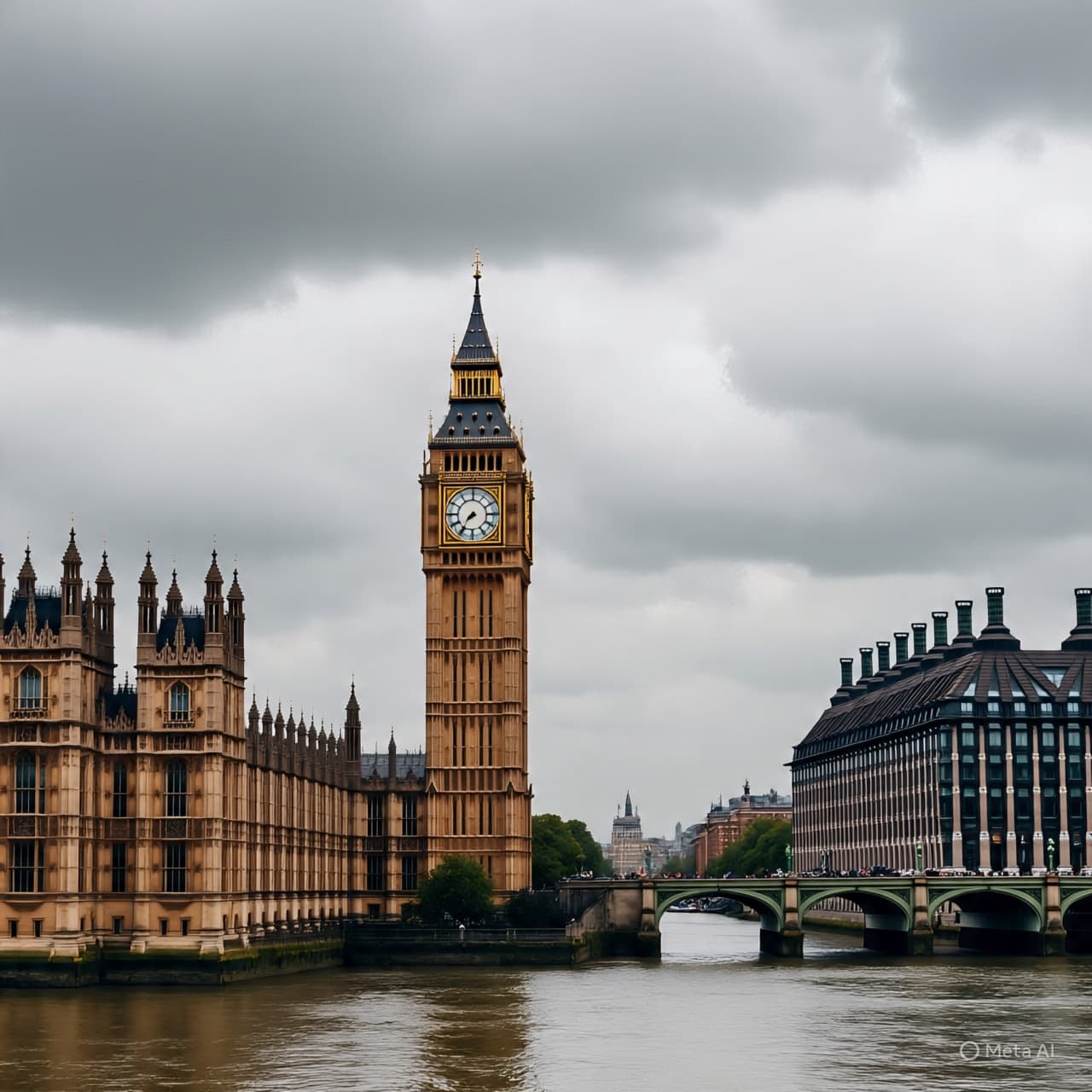
AI Image Disclaimer Visuals are AI-generated and serve as conceptual representations.
Sources BBC News Reuters Associated Press The Guardian Sky News
Published by Banx Network. This article is part of the Banx decentralized media programme, powered by the BXE token on the XRP Ledger.


