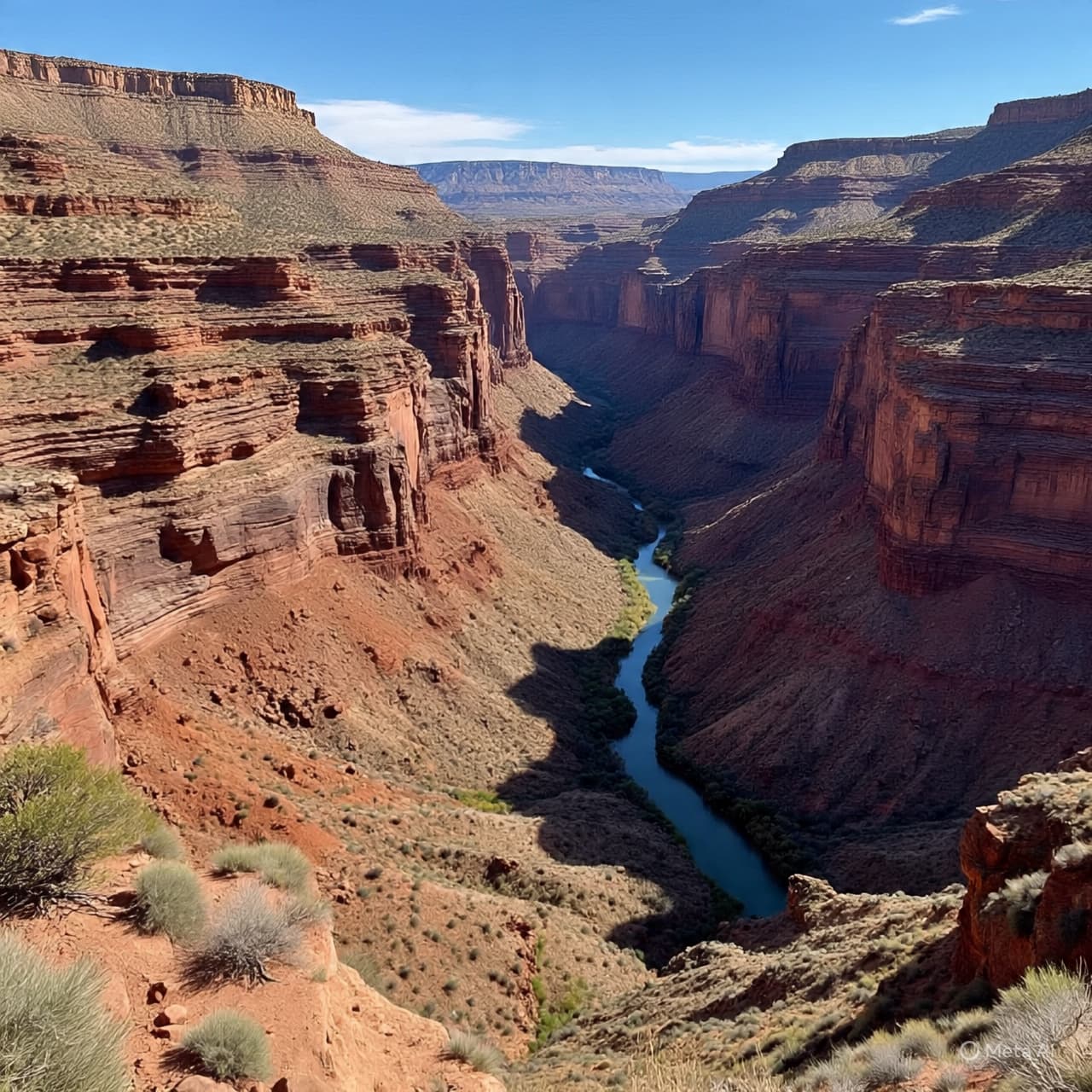
In many places across the planet, a traveler can stand before a cliff face where the story of Earth appears to pause.
Layers of stone rise in quiet order, one resting upon another like pages in an immense archive. Sandstone, limestone, shale—each formed in a different world of rivers, seas, and climates long vanished. Yet sometimes the sequence breaks. Between two layers, the expected pages are missing.
Geologists call this interruption the Great Unconformity. It appears in rock formations across continents, from the depths of the Grand Canyon to exposures scattered across North America and beyond. In these places, a remarkable stretch of time—often nearly a billion years—seems to have disappeared from the geological record.
For generations, the question lingered like an unfinished sentence in Earth’s history. Where did those missing years go?
A growing body of research now points toward a moment early in the planet’s tectonic evolution, when the movement of continents and the reshaping of the crust may have stripped vast layers of rock from the surface. The process, according to recent studies, may have unfolded during the late Precambrian era, when Earth’s tectonic systems were becoming more active and continental crust was reorganizing on a planetary scale.
In simple terms, the Great Unconformity represents a dramatic episode of erosion. Ancient rocks formed billions of years ago were exposed at the surface and gradually worn away by wind, water, and ice. Later, much younger sediments were deposited directly on top of the eroded landscape, leaving an enormous span of geological time absent between the two layers.
But understanding what triggered such widespread erosion has been far more complex.
Some scientists have long proposed that global glaciations—episodes when much of Earth may have been covered by ice—scraped away huge sections of continental rock. These ancient ice ages, often referred to as “Snowball Earth” events, occurred roughly 700 million years ago and could have removed significant amounts of crust through glacial erosion.
The new research suggests that tectonic activity may have set the stage even earlier. As continents collided, separated, and reorganized, the processes that shape mountains and ocean basins also exposed large portions of ancient crust to the elements. Uplifted terrains would have become vulnerable to erosion, slowly removing layers of rock that had accumulated over vast stretches of time.
In this view, tectonics and climate may have worked together. The rising of continents created landscapes that could be stripped by ice and weathering, while later sedimentation preserved the surfaces that remained.
The result is the geological puzzle visible today: a sharp boundary where ancient crystalline rocks meet far younger sedimentary layers, with hundreds of millions of years of Earth’s history seemingly erased.
Yet the absence itself carries information. By studying the chemistry and age of rocks around the unconformity, scientists can reconstruct the sequence of events that led to the disappearance of those layers. Each measurement adds a small piece to a much larger timeline.
For geologists, such gaps are not empty spaces but clues. They reveal moments when the planet changed course—when mountains rose, continents shifted, and entire landscapes were worn away before new ones formed.
The study reports that early tectonic processes likely contributed significantly to the formation of the Great Unconformity, linking the widespread geological gap to large-scale crustal movement and erosion during Earth’s early tectonic evolution.
AI Image Disclaimer
Illustrations were generated using AI systems and are intended as visual interpretations rather than documentary photographs.
Source Check
Credible coverage and/or primary reporting exist from: Nature Geoscience ScienceDaily Phys.org Scientific American The Conversation
Published by Banx Network. This article is part of the Banx decentralized media programme, powered by the BXE token on the XRP Ledger.