There are moments in astronomy when distance feels less abstract — when something born far beyond our solar boundary drifts close enough to be seen not as theory, but as presence. In the quiet corridors between Mars and Jupiter, where sunlight thins and shadows stretch long, a faint traveler glows against the dark.
The object is known as 3I/ATLAS, only the third confirmed interstellar visitor ever recorded passing through our solar system. Its name is procedural, almost clinical, yet its path feels anything but. It does not belong to the family of comets shaped in our Sun’s distant Oort Cloud. Its origins lie elsewhere — in another stellar system, under another sky.
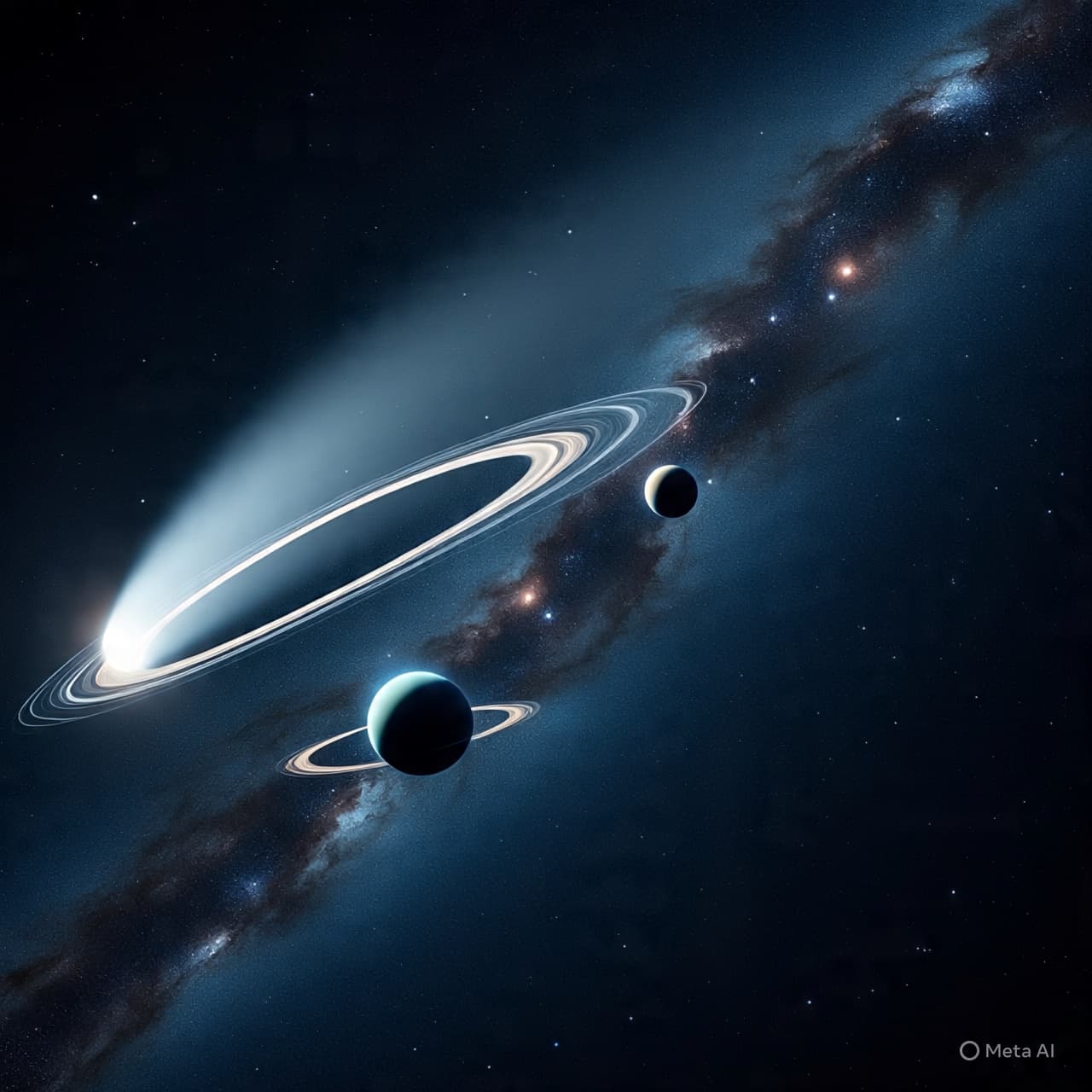
In new imagery highlighted as a recent space photograph of the day, 3I/ATLAS appears as a delicate blur: a small nucleus wrapped in a soft coma, its dust tail stretching outward like breath caught in cold air. The image was captured not by a telescope on Earth, but by the Jupiter Icy Moons Explorer — the European Space Agency’s spacecraft better known as JUICE — currently traveling toward Jupiter. As it journeys to study icy moons, the spacecraft briefly turned its instruments toward this passing stranger.
The glow visible in the frame is sunlight reflecting off dust and gas released from the comet’s surface as it warmed during its approach to the inner solar system. Like comets native to our Sun, 3I/ATLAS developed a coma and tail when solar radiation began to loosen volatile materials from its frozen body. Yet its trajectory tells a different story. Its hyperbolic path — too fast and too steep to be gravitationally bound — confirms that it will not remain. The Sun may bend its course, but it cannot claim it.
Since its discovery by the ATLAS survey system, astronomers have tracked the comet carefully. Observatories on Earth and in orbit have analyzed the composition of its coma, searching for clues about the environment in which it formed. Early observations indicate the presence of dust and organic compounds similar in some respects to those found in solar system comets. The familiarity is striking, though its birthplace lies among distant stars.
There is something quietly humbling in that resemblance. Material forged in another system responds to our Sun in ways we recognize. Ice sublimates. Dust scatters light. A tail forms and lengthens. Across vast cosmic distances, the physics remains constant, even if the story behind the object is not.
The image from JUICE does not dramatize the encounter. It presents it plainly: a faint, luminous form against blackness. No dramatic flare, no sudden burst — only steady motion through space measured in kilometers per second and years of travel. It is, in essence, a momentary intersection of paths: a spacecraft bound for Jupiter and a comet bound for interstellar return.
3I/ATLAS has already passed its closest approach to the Sun and is now traveling outward once more. Astronomers report that it poses no threat to Earth. Its brightness will gradually diminish as it recedes, its tail thinning until it becomes indistinguishable from the background of stars.
In time, it will slip beyond the reach of our telescopes, continuing along a trajectory shaped briefly by our Sun’s gravity before reentering the vast quiet between stellar systems. Observations of the comet are ongoing, with researchers continuing to analyze data gathered by ground-based observatories and spacecraft instruments.
For now, the latest image stands as documentation rather than spectacle — a record of light reflected from ice that formed around another star, crossing our field of view for a fleeting season.
AI Image Disclaimer
Visuals are AI-generated and serve as conceptual representations.
Source Check:
Space.com European Space Agency NASA Live Science Sky & Telescope
Published by Banx Network. This article is part of the Banx decentralized media programme, powered by the BXE token on the XRP Ledger.