There are questions in a nation’s life that linger quietly for generations, like an old law written in careful ink yet read anew by every era. They do not demand attention all at once, but instead wait—patiently—for the moment when history circles back and asks whether their meaning has shifted, or whether it has simply been waiting to be understood differently.
In the United States, the principle of birthright citizenship has long stood as one such enduring idea. Rooted in the 14th Amendment, it carries with it the promise that being born on American soil is, in itself, an entry into the nation’s civic identity. Now, that principle finds itself once again under careful examination, as the Supreme Court prepares to weigh a legal challenge tied to the policy ambitions of Donald Trump and his broader second-term agenda.
The case, as it takes shape, is less about a single policy shift and more about the interpretation of a foundational clause. At its center lies the question of whether the longstanding understanding of citizenship—granted by birth within the country—can be redefined through executive authority or legislative recalibration. Supporters of the challenge suggest that the current interpretation extends beyond what was originally intended, while critics view the effort as a departure from a deeply embedded constitutional guarantee.
As the issue moves toward judicial review, the role of the Supreme Court becomes both pivotal and delicate. The Court is not simply being asked to rule on a contemporary political proposal, but to revisit the contours of a constitutional promise that has shaped generations. In doing so, it must navigate not only legal precedent but also the broader implications of altering a principle so closely tied to national identity.
For Donald Trump, the case represents a continuation of themes that have defined his political narrative—particularly around immigration and the boundaries of citizenship. Framed within the context of a potential second term, the effort signals an intention to revisit and, perhaps, reshape longstanding policies. Yet, as with many such endeavors, the path forward is neither simple nor assured, especially when it intersects with constitutional interpretation.
Public discourse surrounding the issue has grown increasingly attentive, though not always uniform in its tone. Some voices approach the matter as a necessary legal clarification, while others express concern about the broader societal impact of revisiting birthright citizenship. The conversation, much like the law itself, unfolds in layers—legal, historical, and deeply human.
There is also a quieter dimension to the debate, one that considers how the meaning of citizenship evolves over time. Laws may remain fixed in text, but their interpretation often reflects the values and concerns of the moment. In this sense, the Court’s forthcoming deliberation may be seen not only as a legal decision but as a reflection of how the nation understands itself in the present day.
As proceedings move forward, the outcome remains uncertain. The Supreme Court’s decision will likely carry significance beyond the immediate case, influencing future discussions about immigration, identity, and the scope of executive authority. Yet, for now, the matter rests in a space of anticipation, where legal argument and national reflection meet.
In the end, the Court is expected to hear arguments and issue its ruling in due course. Whatever the decision, it will mark another chapter in the ongoing interpretation of the Constitution, approached through established judicial process and measured deliberation.
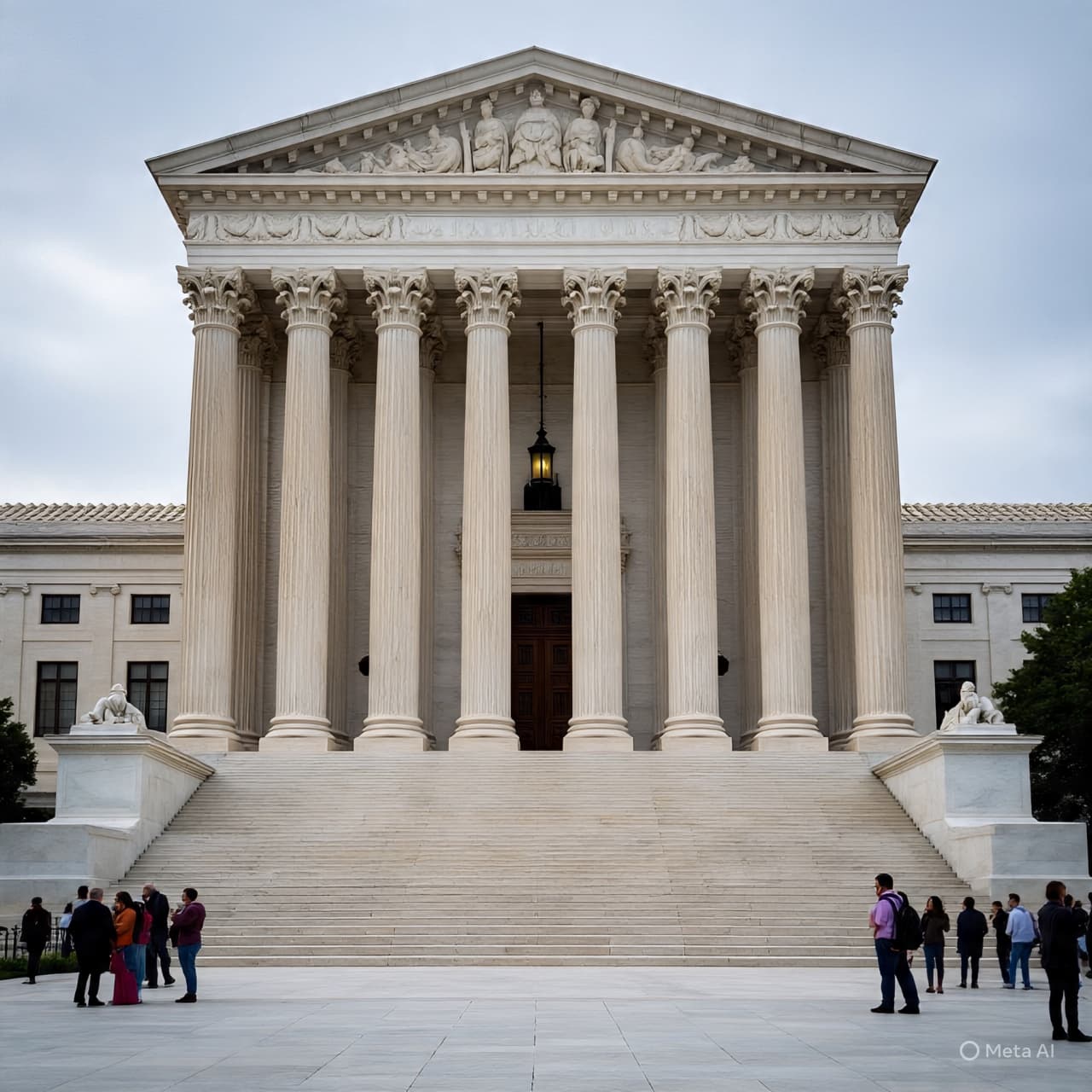
AI Image Disclaimer Graphics are AI-generated and intended for representation, not reality.
Source Check (Credible Media Scan)
The New York Times CNN Reuters BBC News The Washington Post
Published by Banx Network. This article is part of the Banx decentralized media programme, powered by the BXE token on the XRP Ledger.