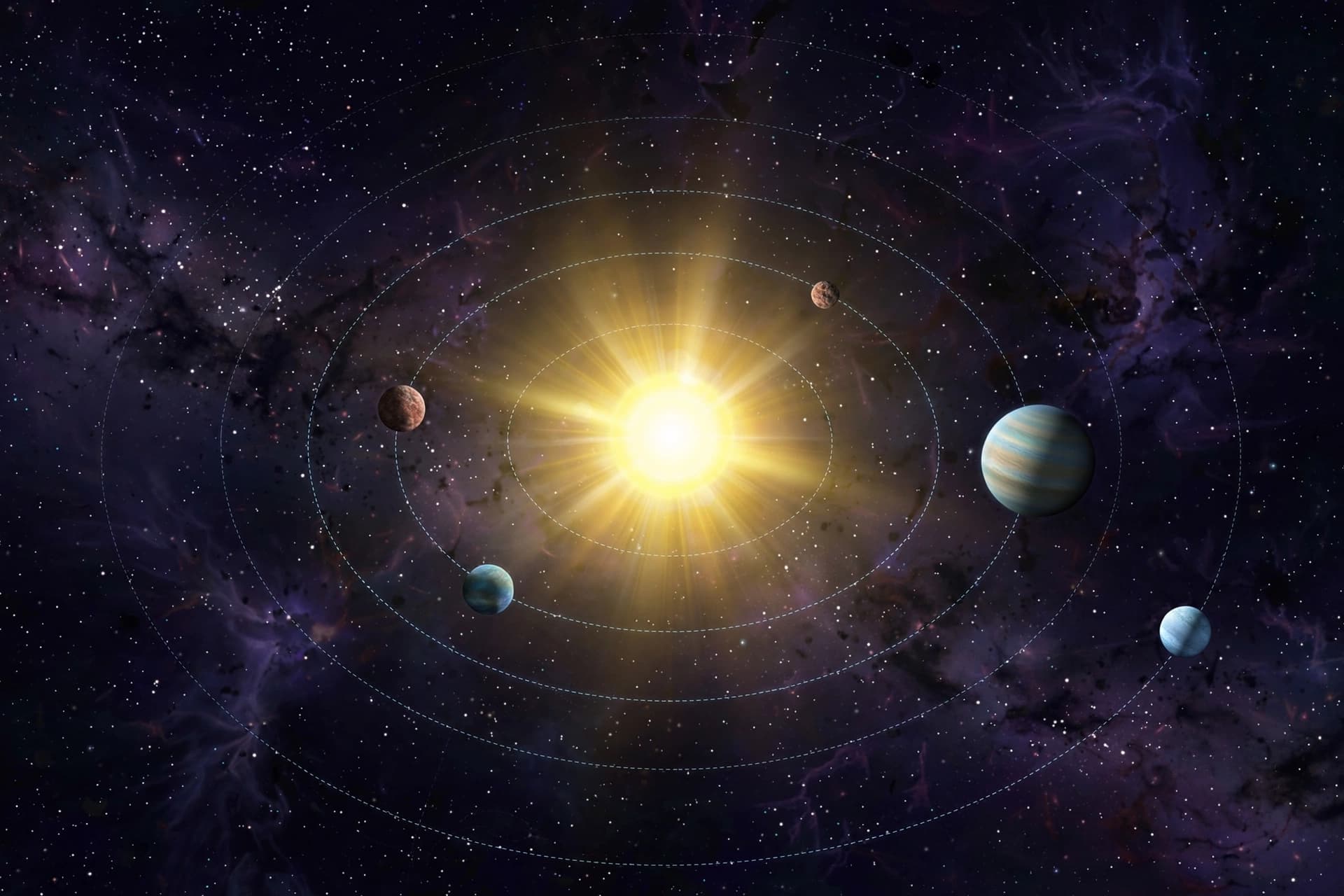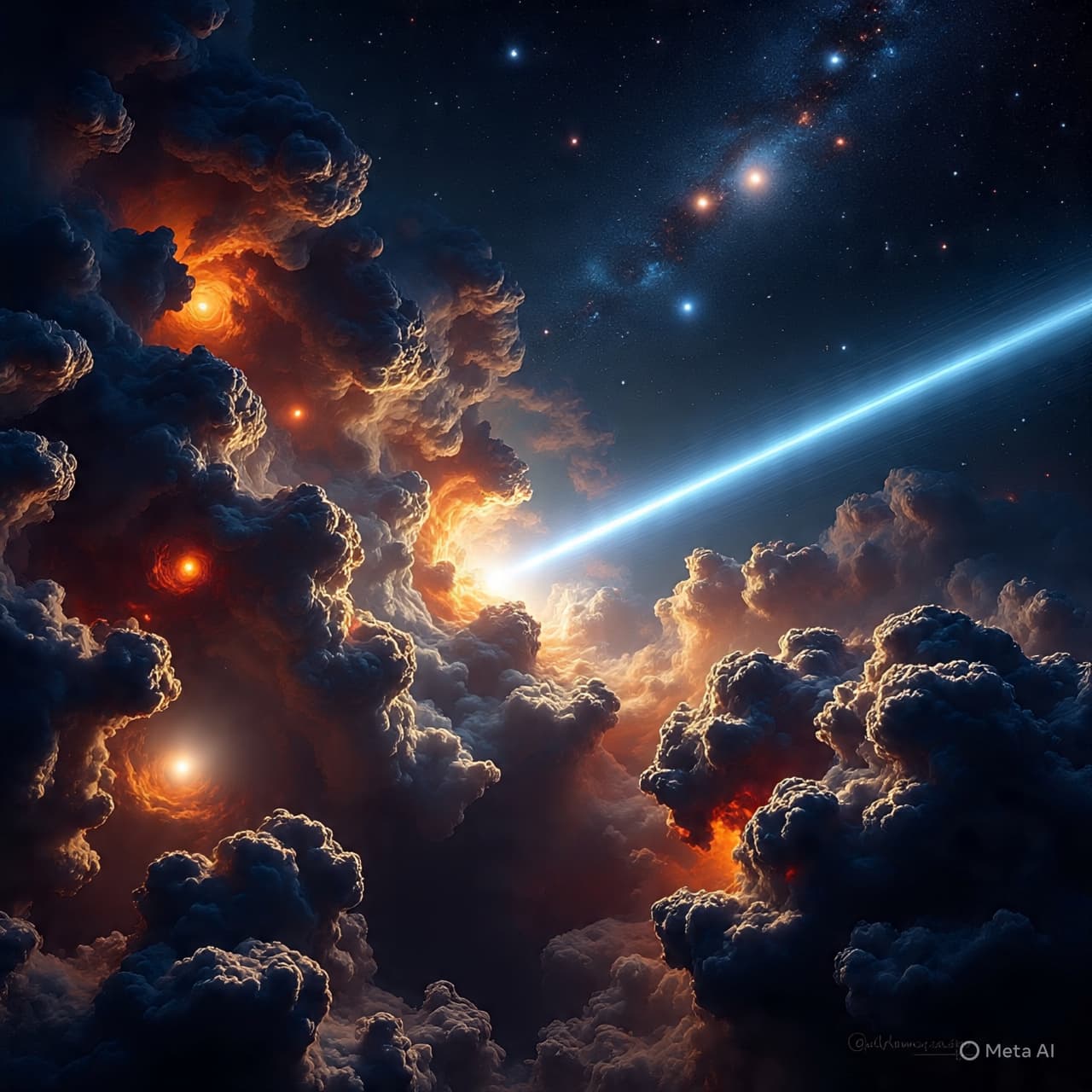
In the quietest stretches of the cosmos, where light travels for millennia before meeting an eye, there are signals that hum rather than shine. They do not blaze like supernovas or streak like comets. Instead, they whisper in microwaves — precise, amplified, improbably bright. It is there, in one such distant region of space, that astronomers have recently observed a colossal natural microwave laser, blasting its focused energy across the interstellar dark.
The phenomenon is known as a “maser” — short for microwave amplification by stimulated emission of radiation — a cosmic cousin to the laser, but operating at microwave frequencies. Unlike the tidy beams produced in laboratories, these astrophysical masers arise under rare and delicate conditions: dense clouds of gas, energized by nearby stars or violent stellar events, align their molecules in such a way that radiation is amplified rather than scattered.
The newly observed maser, detected using powerful radio telescopes, stands out for both its size and intensity. Scientists describe it as one of the most luminous microwave emissions of its kind ever recorded, spanning a region far larger than our solar system. The signal originates in a distant star-forming environment, where newborn stars heat surrounding gas clouds, triggering the precise chain reaction required for maser emission.
Such emissions are not entirely unknown. Water, hydroxyl, and methanol molecules are among the most common ingredients in these cosmic amplifiers. But what makes this discovery notable is scale: the energy output suggests extraordinary physical conditions, possibly linked to massive stellar birth or turbulent interactions in a galactic core.
Radio astronomers track these signals not only for their novelty, but for what they reveal about the environments that produce them. Maser emissions act like signposts in space, marking regions of intense star formation or the surroundings of supermassive black holes. Because the radiation is coherent and bright, it can travel vast distances without fading into background noise, offering scientists a clear probe into otherwise obscured regions.
The detection was made possible through sensitive radio arrays capable of distinguishing faint microwave frequencies from cosmic static. Observatories working in coordination were able to map the structure and velocity of the gas cloud generating the beam. Subtle shifts in frequency, caused by the Doppler effect, help researchers measure motion within these stellar nurseries — how gas swirls, collapses, and sometimes erupts outward.
While the phrase “microwave laser blasting into space” may evoke drama, the reality is both quieter and more intricate. There is no weapon-like burst, no sudden flash visible to the naked eye. Instead, it is a sustained and highly ordered amplification of radiation, shaped by physical laws that govern atoms and molecules everywhere in the universe.
Discoveries like this remind scientists that space is not empty but active — filled with chemistry, motion, and structure. In the vastness between stars, matter organizes itself into patterns that can focus energy across unimaginable distances. The maser’s beam, though invisible to human eyes, travels steadily onward, a narrow thread of microwaves cutting through cold vacuum.
For researchers, the next steps involve deeper observation: refining distance estimates, modeling the environment more precisely, and comparing this maser to others cataloged across the Milky Way and beyond. Each detection adds to a growing map of energetic processes shaping galaxies.
In the end, what seems at first like an exotic anomaly becomes part of a broader cosmic rhythm. In the darkness, molecules align. Energy amplifies. A signal emerges and journeys outward, indifferent to who might one day listen. And on Earth, in observatories tuned to the faintest frequencies, astronomers translate that whisper into understanding.
Published by Banx Network. This article is part of the Banx decentralized media programme, powered by the BXE token on the XRP Ledger.