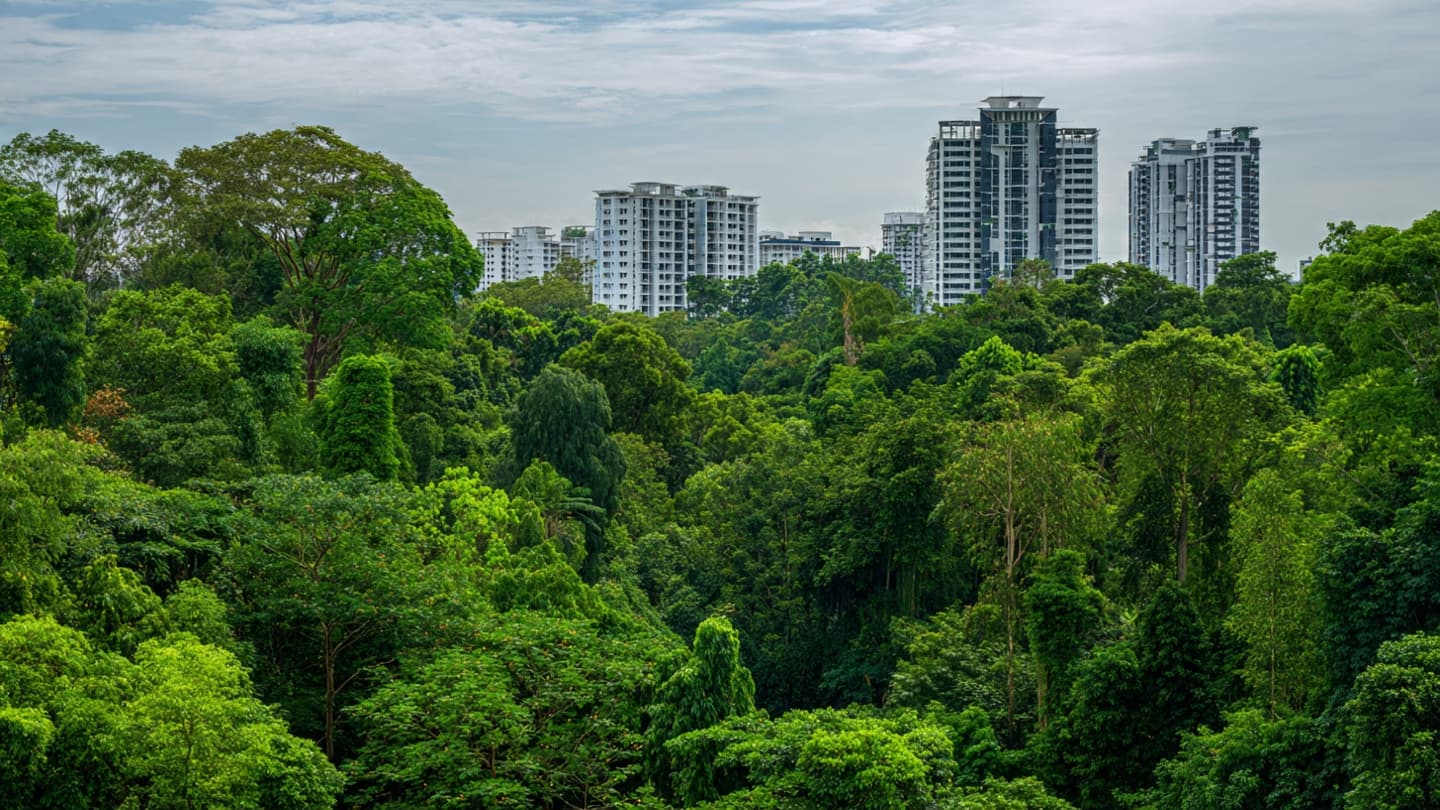
At the edge of Singapore's built landscape, the forest can feel like another country. Concrete towers disappear behind trees, roads become quieter, and the temperature beneath the canopy changes almost immediately. Yet these remaining green spaces exist within one of the world's most carefully planned urban environments.
Maju Forest, a 23-hectare secondary forest in western Singapore, has become part of a wider debate over how the city should use limited land. Government plans to clear about two-thirds of the forest for high-density public housing have generated public concern over biodiversity and the loss of green space.
The issue reflects a practical reality of Singapore's geography. The country has limited land but a large population and continuing demand for housing. High-density development has therefore become an essential part of its urban planning model.
At the same time, Singapore has cultivated an international reputation for incorporating nature into the city. Trees line roads, parks sit among residential districts and green corridors connect parts of the urban landscape. The remaining forests represent a different form of nature—less designed, more spontaneous and harder to reproduce.
Secondary forests such as Maju may contain plants, insects, birds and other organisms that have adapted to changing urban conditions. Their ecological value can therefore extend beyond the visual experience of trees. Forests can also provide shade, retain rainwater and contribute to local temperature regulation.
Those functions have become more relevant as cities around the world experience hotter conditions. Urban trees can reduce heat exposure around buildings and public spaces, although the effectiveness depends on the scale and arrangement of vegetation.
The housing question remains equally concrete. Singapore's public housing system provides homes for a large proportion of the population, and new developments require land. A forest that appears quiet and undeveloped on a map may therefore be part of a much larger calculation involving future residents and urban infrastructure.
The discussion around Maju Forest has attracted environmental groups and residents who want greater consideration of the area's ecological characteristics. The government has indicated that the development plans can evolve as environmental information is assessed.
That process illustrates how urban planning increasingly involves competing forms of value. Housing provides shelter and community, while forests provide ecological functions and spaces that may be difficult to replace once removed.
There is no simple measurement that places one above the other. The challenge is particularly visible in Singapore because almost every parcel of land carries several possible futures. A single piece of ground can be imagined as a housing estate, a park, a transport corridor or a habitat.
Maju Forest therefore represents more than one development proposal. It is a small window into the broader question facing dense cities everywhere: as populations grow and climates change, how much natural landscape can remain within the urban fabric, and how should those remaining spaces be valued?
SEO-friendly Slug singapore-maju-forest-housing-biodiversity-urban-planning
Hashtags #Singapore #Environment #Biodiversity #UrbanPlanning #Housing #ClimateChange #Sustainability
Sources Reuters National Parks Board Singapore Government of Singapore
Published by Banx Network. This article is part of the Banx decentralized media programme, powered by the BXE token on the XRP Ledger.