
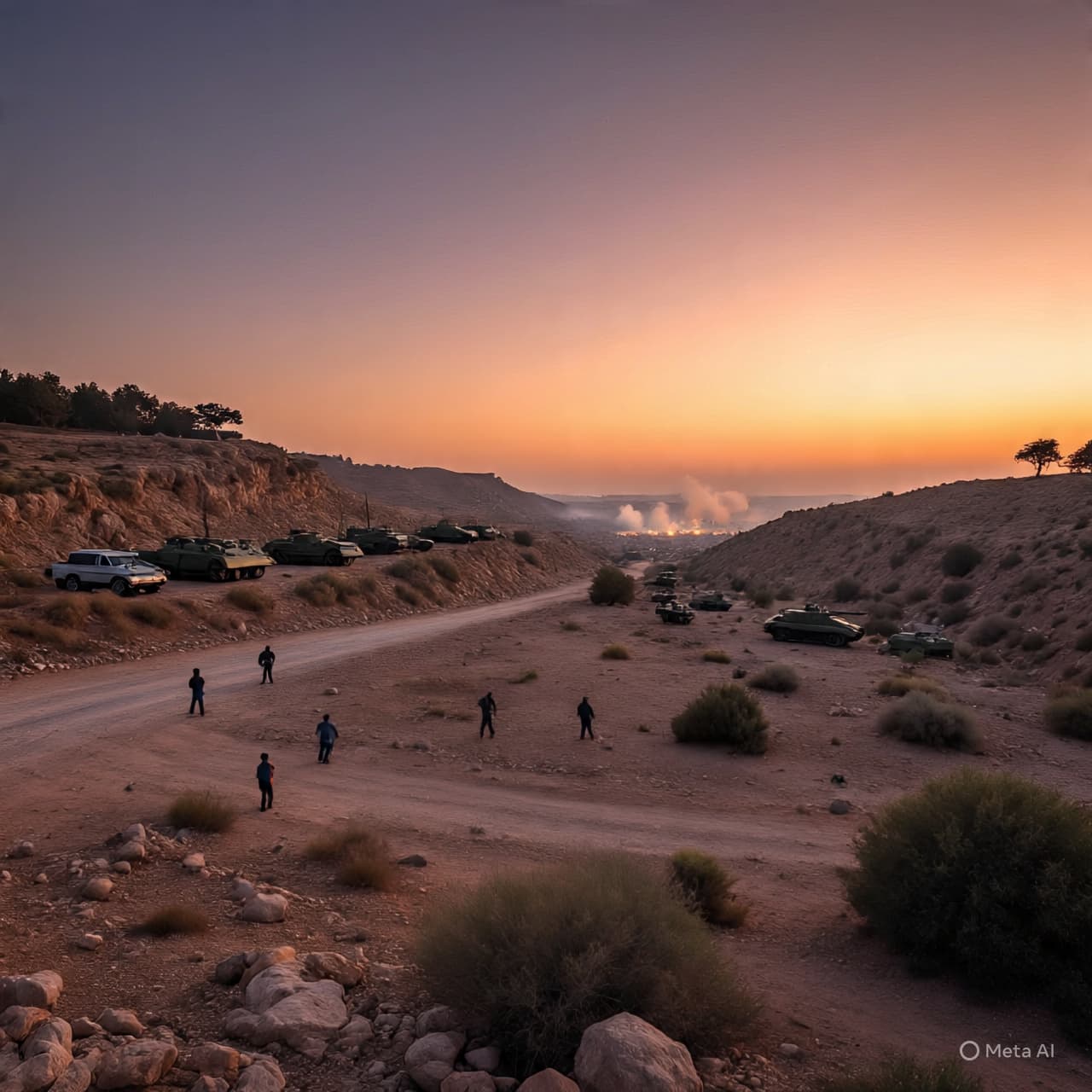
Key Highlights
- Renewed conflict:Israel and Hezbollah exchange fire amid rising tensions.
- Diplomatic efforts:U.S. prepares for critical talks with Iran.
- Regional implications:Ongoing hostilities complicate peace negotiations.
The Middle East is once again engulfed in turmoil, with the Israel-Hezbollah conflict reigniting as high-stakes diplomatic talks between the United States and Iran loom on the horizon. Recent airstrikes and rocket exchanges along the Israel-Lebanon border have intensified, marking a precarious moment in a region long characterized by fragile peace. Israeli forces have targeted what they describe as Hezbollah positions, while the militant group has retaliated with cross-border attacks, creating a cycle of violence that complicates ongoing diplomatic efforts.
As the U.S. prepares for negotiations with Iran, aimed at exploring pathways toward de-escalation and regional stability, the backdrop of escalating hostilities introduces a layer of complexity that cannot be ignored. The timing of these military actions raises critical questions about the feasibility of diplomacy in an environment rife with conflict. Can meaningful discussions about peace and stability occur while violence unfolds just beyond the negotiating table?
Israeli officials assert that their military operations are defensive, aimed at neutralizing threats along their northern border. Conversely, Hezbollah maintains that its actions are retaliatory, framing the conflict as a response to Israeli aggression. This mutual perception of victimhood perpetuates a cycle of violence, where both sides view themselves as reacting rather than instigating hostilities.
Iran, while not directly involved in the current exchanges, remains a pivotal player in this complex geopolitical landscape. Its support for Hezbollah complicates the U.S.-Iran talks, as any escalation involving the militant group inevitably casts a shadow over the negotiations. The Iranian government appears to be adopting a measured stance, observing the situation closely while maintaining its strategic interests in the region.
The interplay between military actions and diplomatic efforts creates a delicate balance. Diplomats typically rely on clarity—clear terms, commitments, and boundaries. However, the current environment offers little of this clarity, presenting overlapping realities where agreements in one arena may be undermined by actions in another. The potential for miscommunication or miscalculation looms large, threatening to derail diplomatic progress.
Neighboring countries and global powers are closely monitoring the situation, weighing the risks of spillover effects on regional stability, energy routes, and humanitarian conditions. Each localized development carries the potential for broader implications, making the stakes even higher for all involved.
Despite the ongoing exchanges, there appears to be a mutual restraint from both Israel and Hezbollah, as neither side seems eager for a full-scale confrontation. The military actions, while serious, have thus far adhered to a pattern of signaling rather than outright escalation. This fragile restraint may be one of the few factors preventing the situation from spiraling further out of control.
As the U.S. moves forward with its talks with Iran, the outcome will depend not only on what is discussed at the negotiating table but also on how the realities on the ground influence those discussions. Diplomacy cannot exist in a vacuum; it is constantly shaped by the very conflicts it seeks to resolve.
In the coming days, both dialogue and conflict are likely to unfold side by side. Whether they will converge toward a resolution or diverge into deeper discord remains uncertain. For now, the region stands at a crossroads where every action and every pause carries significant weight.
Published by Banx Network. This article is part of the Banx decentralized media programme, powered by the BXE token on the XRP Ledger.



