Artificial intelligence is moving through Europe at a complicated speed. Companies are trying to catch up with American and Chinese competitors while governments and researchers debate how quickly increasingly powerful systems should be developed.
French startup Mistral has emerged as one of the European companies pushing against calls for a broad slowdown in AI development. Reuters reported that Mistral and other European technology firms questioned proposals from U.S. AI companies seeking to reduce the pace of frontier-model development.
The debate intensified after Anthropic CEO Dario Amodei called for major AI developers to slow the rate at which their models become more capable. He also proposed greater independent evaluation of advanced AI systems.
Mistral's position reflects a different concern: Europe remains behind the United States and China in developing frontier AI systems. From that perspective, slowing development could affect European companies at a moment when they are still building the infrastructure, capital, talent, and models needed to compete internationally.
Clement Delangue, CEO of French-American AI company Hugging Face, similarly argued that Europe needs to accelerate its technological development while supporting independent evaluation and safety measures. Reuters reported his position as part of the wider European debate.
The disagreement does not necessarily represent a simple division between safety and innovation. European AI companies have also supported stronger testing and oversight. The central question is how those safeguards should be implemented without making it substantially harder for smaller or newer companies to compete.
That question matters particularly in Europe because the region has fewer companies developing frontier AI models than the United States. Dependence on foreign systems can affect everything from cloud infrastructure and software development to education, business services, and scientific research.
Mistral has therefore become part of a broader European effort to develop AI capabilities closer to home. Its models are intended to compete in an industry where American companies have accumulated enormous amounts of computing power and investment.
At the same time, safety concerns remain part of the international conversation. Reuters reported that several leading AI companies were considering or supporting independent evaluation mechanisms as questions increased about the behavior and capabilities of advanced systems.
For Europe, the discussion is consequently moving along two tracks at once. The region wants stronger safeguards around increasingly powerful AI while also seeking enough technological capacity to avoid becoming permanently dependent on systems developed elsewhere.
France's Mistral sits directly inside that tension. Its argument is not simply about developing technology faster; it is also about Europe's ability to build its own position in an industry that is increasingly shaping computing, research, business, and everyday digital life.
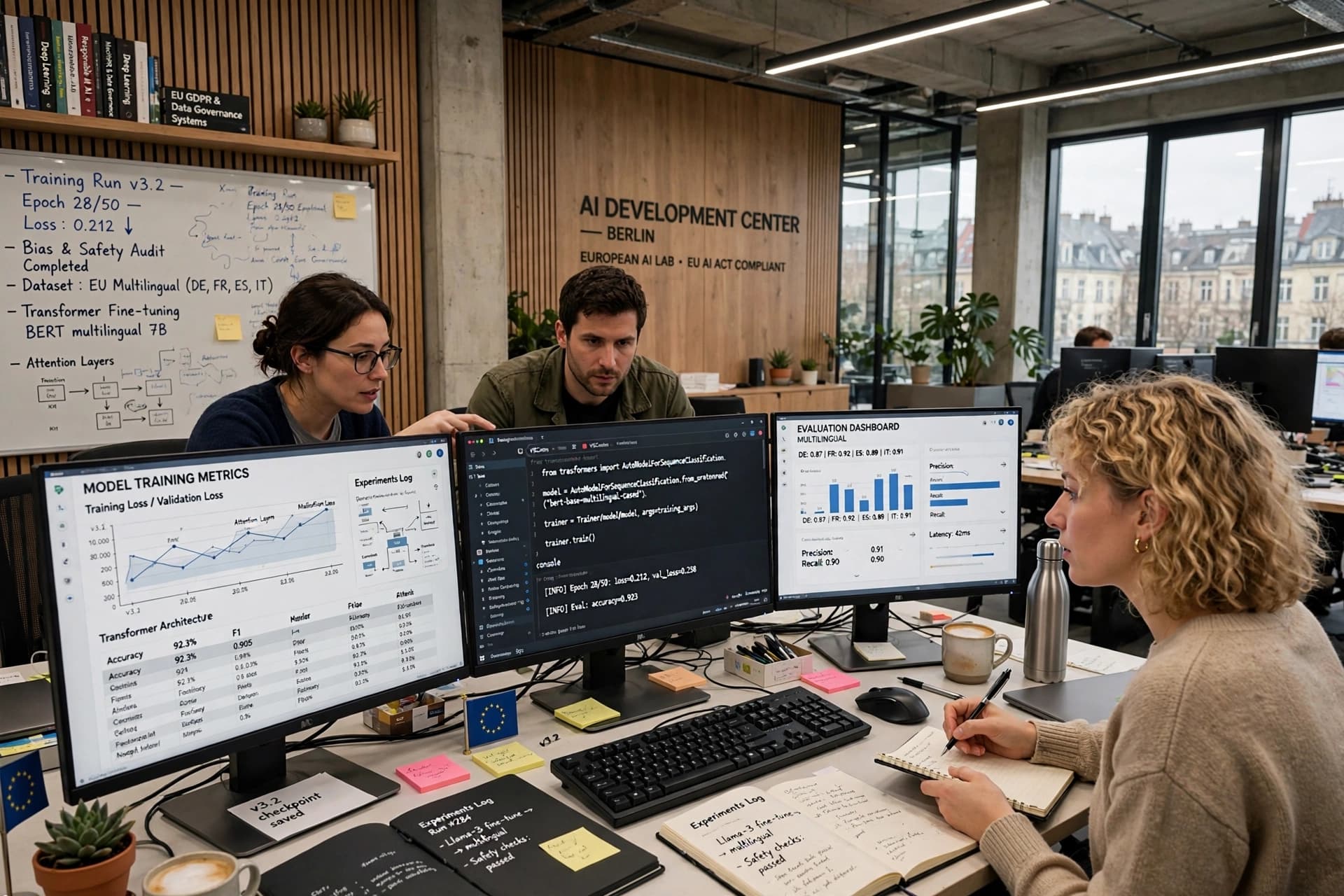
AI Image Disclaimer These illustrations were generated with AI for conceptual purposes and do not depict actual Mistral facilities, employees, or development environments.
Published by Banx Network. This article is part of the Banx decentralized media programme, powered by the BXE token on the XRP Ledger.