There are periods in scientific work that are defined not by discovery, but by anticipation. A pause settles in—not empty, but filled with preparation, as if the next movement has already begun to gather, just beyond reach. In laboratories and across networks of collaboration, ideas remain in motion even when official directions have yet to arrive.
Within the field of astrophysics, such a moment now surrounds the NASA Research Opportunities in Space and Earth Sciences program, commonly known as ROSES. Each cycle of this program outlines pathways for research, inviting proposals that range from observational studies to the most abstract forms of theoretical work.
The element known as D.4, focused on Theoretical and Computational Astrophysics Networks, has long represented a particular kind of inquiry—one that does not rely on telescopes alone, but on models, simulations, and the careful construction of systems that exist first in mathematics before they are observed in the sky.
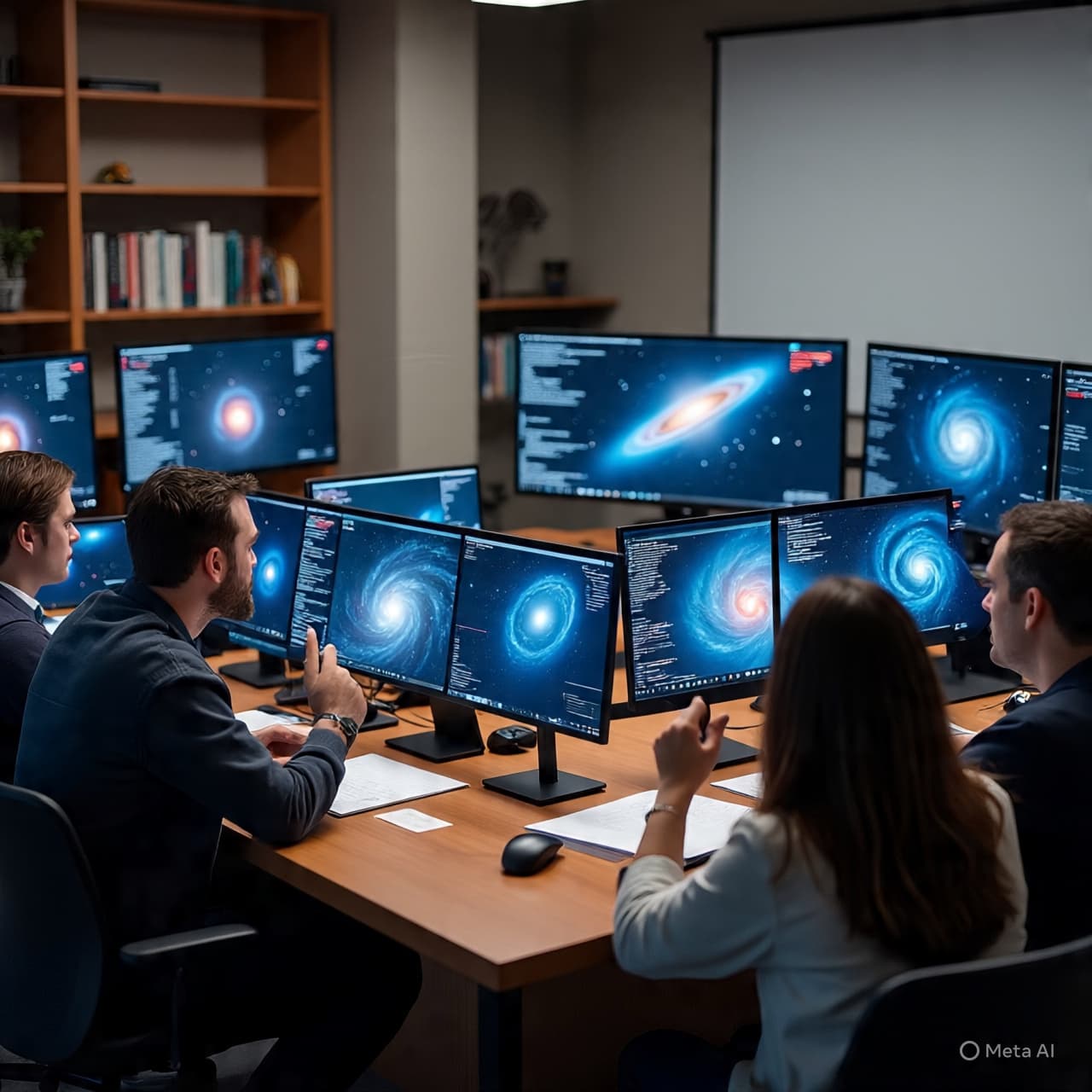
These networks bring together researchers across institutions, linking expertise in physics, computation, and cosmology. Their work often unfolds in shared frameworks, where large-scale simulations attempt to reproduce the behavior of galaxies, dark matter, and the broader structure of the universe. It is a field defined as much by collaboration as by calculation.
The recent update to ROSES-25 D.4, marked as “to be determined,” introduces a note of uncertainty into this otherwise structured process. Details regarding timelines, scope, or specific directions remain pending, leaving researchers in a state that is neither fully paused nor fully advancing.
Such intervals are not unfamiliar. Funding cycles and program announcements often move at a pace that differs from the work they support. Yet for those engaged in theoretical and computational astrophysics, where projects can span years and depend on coordinated effort, the absence of clarity carries its own weight.
Still, the underlying work continues. Models are refined, data sets are expanded, and collaborations persist across institutions and continents. The questions themselves—how galaxies form, how cosmic structures evolve, how unseen forces shape the observable universe—do not wait for administrative timelines.
There is a quiet resilience in this. The field advances not only through formal calls and structured programs, but through the steady accumulation of insight, the gradual testing of ideas that extend far beyond any single funding cycle.
In this way, the current moment becomes part of a longer rhythm. The pause is not an end, but a transition—an interval in which direction will eventually emerge, and with it, new opportunities for exploration.
NASA’s ROSES-25 D.4 program element, focused on Theoretical and Computational Astrophysics Networks, is currently listed with details to be determined. Further updates regarding proposal timelines and program scope are expected to be announced through official NASA channels.
AI Image Disclaimer
Illustrations were created using AI tools and are not real photographs.
Source Check: NASA; NSPIRES; SpaceRef; American Astronomical Society; Phys.org
Published by Banx Network. This article is part of the Banx decentralized media programme, powered by the BXE token on the XRP Ledger.