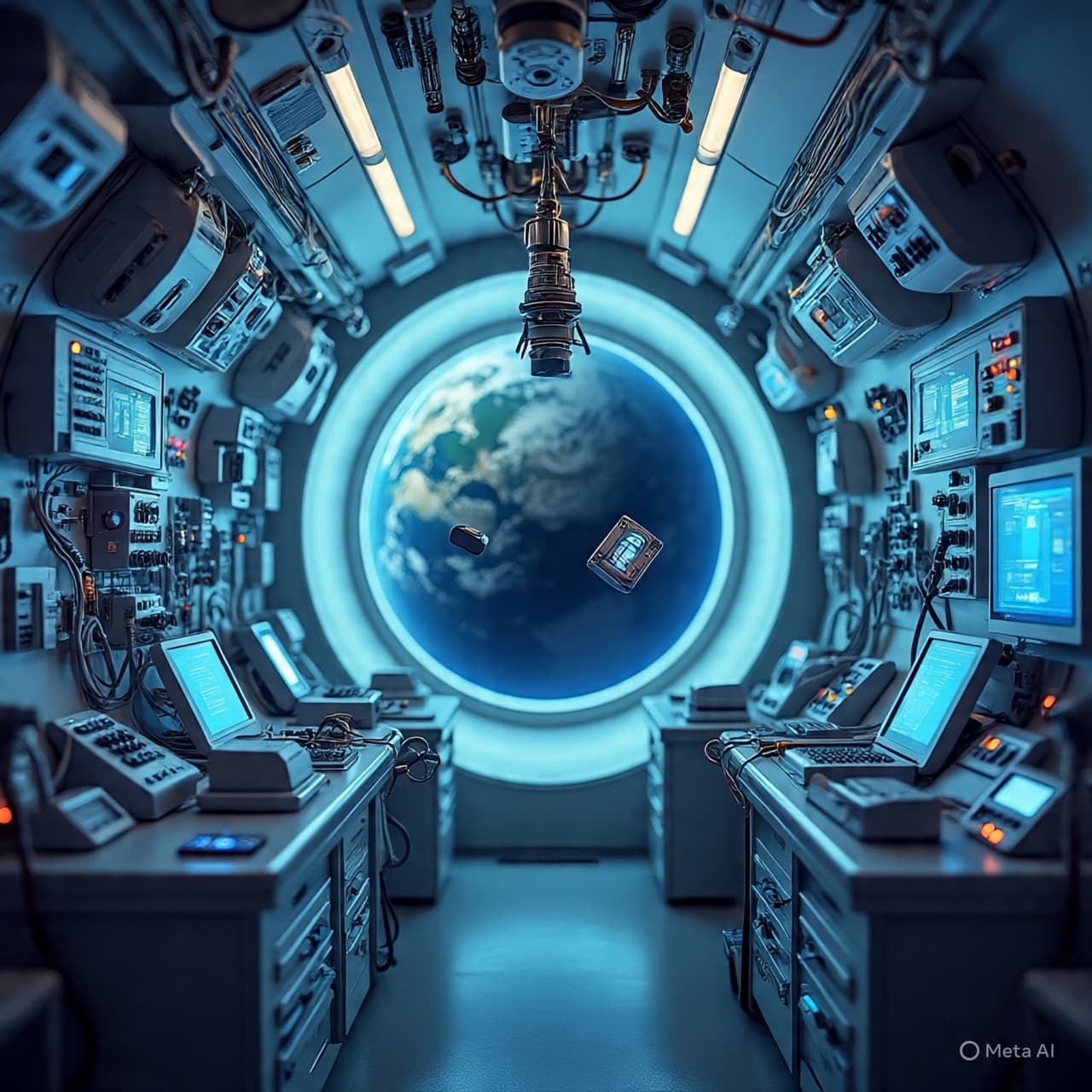
At dawn on an orbiting station, the sun arcs along a horizon that never quite settles. It moves in circles, day after circular day, and in its light the machinery hums, gently and without rest. Here, in this place of constant motion, a question stirs that seems at once intimate and impossibly distant: could a new human life begin here, unfurling against the backdrop of silent stars?
On Earth, human reproduction unfolds within a cradle of gravity, atmospheric shelter, and generational rhythms that have shaped our bodies for millennia. In space, that cradle loses its familiar curves. Without the steady tug of gravity, cells swim in fluid that behaves differently; hormones may ebb and flow in unfamiliar cadences; and within the bodies of those who float in orbit, tissues and organs adapt in ways scientists are only beginning to chart.
Radiation, too, threads through these considerations like an unseen tide. Outside the protective cocoon of Earth’s magnetic field, high-energy particles stream unchecked, capable of altering the delicate machinery of DNA in ways that pose risks to both gametes and developing embryos. It is this silent influx — one could call it cosmic weather — that haunts the discussion of space-born life, suggesting that conception and gestation in orbit or on distant worlds would confront forces far beyond those encountered in a terrestrial nursery.
Laboratory studies from mice to lab cultures offer glimpses of possibility and caution. In some experiments, early stages of mammalian embryo development have taken place in microgravity, hinting that the first steps of life might unfold beyond Earth’s surface. In others, problems in later stages, or in gamete quality itself, suggest a path strewn with obstacles. These scientific reflections are neither definitive nor complete, but they remind us that the process of making a baby — a process taken for granted across generations — is a tapestry woven from many threads that space may unravel or rearrange.
Yet, amid the uncertainties, researchers and ethicists alike are asking new questions about human presence beyond Earth. What would it mean to welcome life where our bodies constantly adapt to conditions they never evolved to meet? How might societies shape policies around reproduction in environments that are as beautiful as they are hostile? And perhaps most quietly, what does it signify about our species that we yearn to extend the circle of life into the unknown?
For now, no human has conceived or given birth off our home planet. The science remains in its early chapters, written with careful curiosity and tempered by caution. Still, as spacecraft become longer–duration homes for explorers and as talk of lunar and Martian habitats edges closer to reality, the question of whether — and how — humans might bear children away from Earth occupies both minds and labs. In the quiet hum of a station in low orbit, illuminated by a light that never fully rises or sets, this future remains a work in progress, shaped by inquiry more than certainty.
All Visuals are AI‑generated and serve as conceptual representations.
Sources (Media Names Only)
Nature The Times of India Euronews ScienceFocus Jalopnik
Published by Banx Network. This article is part of the Banx decentralized media programme, powered by the BXE token on the XRP Ledger.