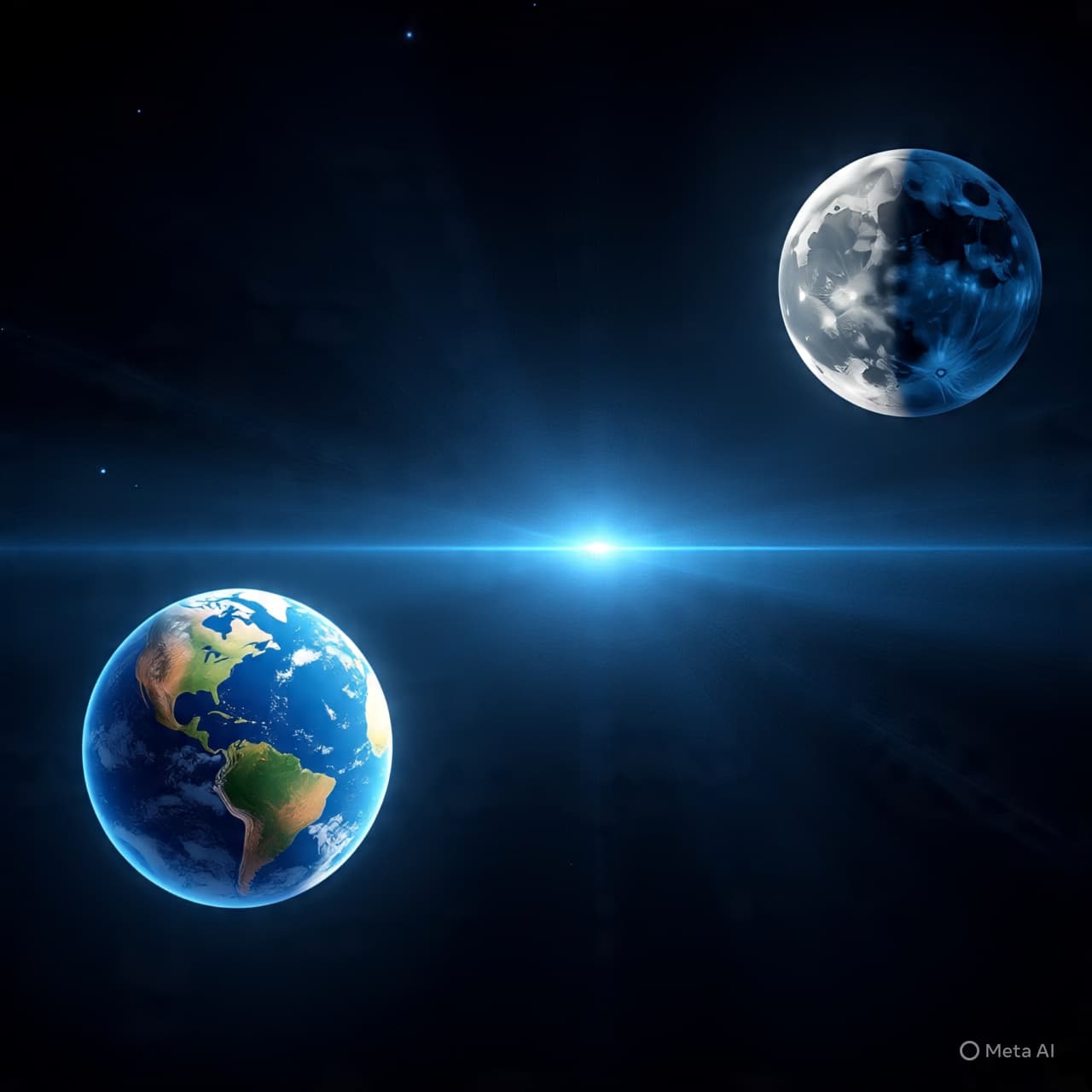
Space is often described as empty, a vast expanse where little exists between celestial bodies. Yet, as instruments grow more sensitive, that emptiness begins to reveal subtle structures—patterns formed not by matter we can see, but by particles we can barely detect. Between Earth and the Moon, one such structure has come into view.
Scientists have identified what they describe as a “cosmic-ray cavity,” a region where high-energy particles appear to be less dense than expected. Cosmic rays, which constantly bombard Earth from all directions, usually fill space with a steady presence. But in this particular region, their distribution changes.
The discovery suggests that the space between Earth and the Moon is not uniform. Instead, it may be shaped by interactions between magnetic fields, solar wind, and planetary influences. These forces can create pockets where particles are deflected or redirected, leaving behind a kind of void.
Detecting this cavity required precise instruments capable of measuring tiny variations in particle density. Satellites and space probes collected data over time, allowing researchers to map the region with increasing accuracy. The result is a picture of space that is far more structured than previously assumed.
One possible explanation involves Earth’s magnetosphere—the protective magnetic field that shields the planet from solar radiation. As this field interacts with the Moon and the solar wind, it may create zones where cosmic rays are partially excluded. The cavity, then, is not empty but shaped by invisible forces.
This finding has implications beyond simple observation. Understanding how cosmic rays move through space is essential for space travel, particularly for missions that venture beyond Earth’s protective field. Regions with lower particle density could offer safer pathways for spacecraft and astronauts.
At the same time, the discovery raises new questions. How stable is this cavity? Does it shift with solar activity? And what does it reveal about similar structures elsewhere in the solar system? Each answer leads to further inquiry, expanding the boundaries of exploration.
There is something quietly unsettling about the idea. A space we thought we understood turns out to hold hidden contours, shaped by forces we cannot see. It is a reminder that even in the most familiar regions of space, mystery persists.
In the broader view, this discovery does not redefine space but refines it. The universe is not emptier or fuller than we imagined—it is simply more nuanced. And between Earth and its closest neighbor, that nuance is now coming into focus.
AI Image Disclaimer Illustrations were produced with AI and serve as conceptual depictions.
Source Check NASA Space.com Nature Astronomy ScienceDaily European Space Agency
Published by Banx Network. This article is part of the Banx decentralized media programme, powered by the BXE token on the XRP Ledger.