
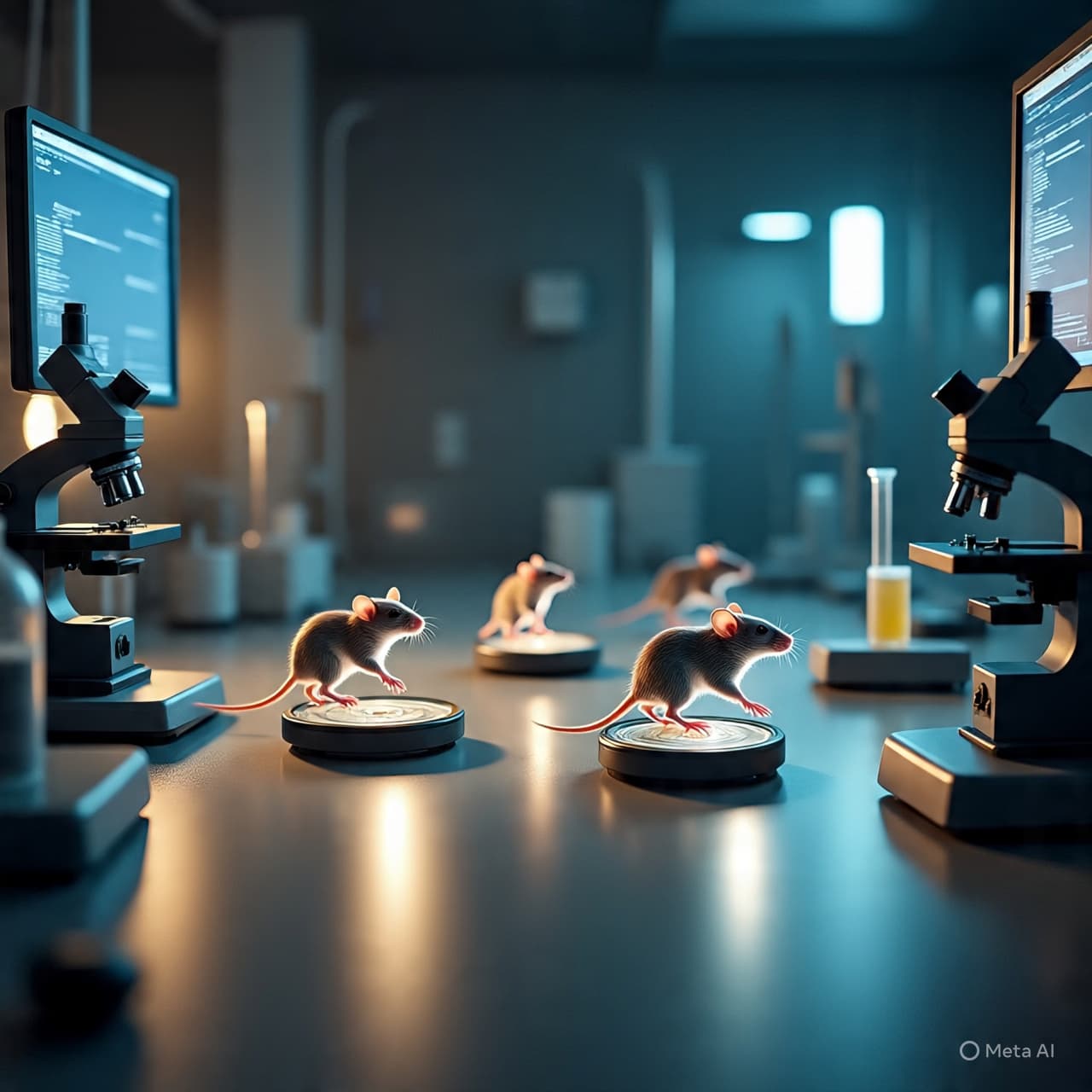
There is something quietly humbling about imagining life on Mars. Not the dramatic red storms or the distant horizon, but the simple, human act of staying strong—of keeping one’s body anchored when gravity itself loosens its grip. In that imagined stillness, where every step feels lighter yet more uncertain, scientists have turned to an unlikely companion: mice. Small, unassuming, yet carrying within them the echoes of our own biology, they have become storytellers of a future not yet lived.
In laboratories far from the Martian dust, researchers have been observing how muscles respond when gravity fades into something gentler. Space, as it turns out, is not kind to the human body. Muscles shrink, bones lose density, and the quiet machinery that keeps us upright begins to forget its purpose. For astronauts bound for long journeys—perhaps even to Mars—this is not a distant concern but an immediate challenge, one that demands both ingenuity and patience.
It is here that mice enter the narrative, not as mere subjects, but as bridges between worlds. Scientists have studied how these animals respond to reduced gravity conditions, mimicking what astronauts might experience during extended missions. What they discovered is both subtle and promising: certain types of resistance-based activity, combined with biological responses at the cellular level, may help preserve muscle strength far more effectively than previously thought.
The research suggests that muscles do not simply weaken in space; they adapt, sometimes too quickly, to a new normal of less resistance. But when guided—through targeted exercise or even molecular interventions—they can be reminded of their original purpose. In mice, this has meant maintaining muscle mass and function despite conditions that would typically lead to rapid decline. For humans, the implication unfolds gently but clearly: future astronauts might rely on more refined, efficient exercise systems, possibly paired with treatments that support muscle resilience at the microscopic level.
What makes this discovery particularly compelling is not just the science, but the shift in perspective it offers. Rather than fighting against space, researchers are learning how to work with the body’s natural tendencies, nudging it toward balance even in unfamiliar environments. The image of bulky gym equipment in spacecraft may give way to more elegant solutions—compact devices, smarter routines, and perhaps even therapies that operate beneath the skin, quietly reinforcing the body’s strength.
Yet, as with all early discoveries, this is a beginning rather than a conclusion. Translating results from mice to humans requires careful steps, and the complexities of long-term space travel remain vast. Still, there is a sense of progress that feels less like a leap and more like a steady unfolding, as if each small insight brings Mars a little closer—not just as a destination, but as a place where human life can endure with dignity and health.
In the end, the story of mice in laboratories is not so distant from the story of astronauts among the stars. Both are navigating environments that challenge what it means to be grounded. And in that shared uncertainty, science offers a quiet assurance: that even far from Earth, the human body may yet find ways to remain strong, adaptable, and, in its own way, at home.
AI Image Disclaimer Visuals are created with AI tools and are not real photographs.
Sources BBC CNN Nature NASA The Guardian
Published by Banx Network. This article is part of the Banx decentralized media programme, powered by the BXE token on the XRP Ledger.



