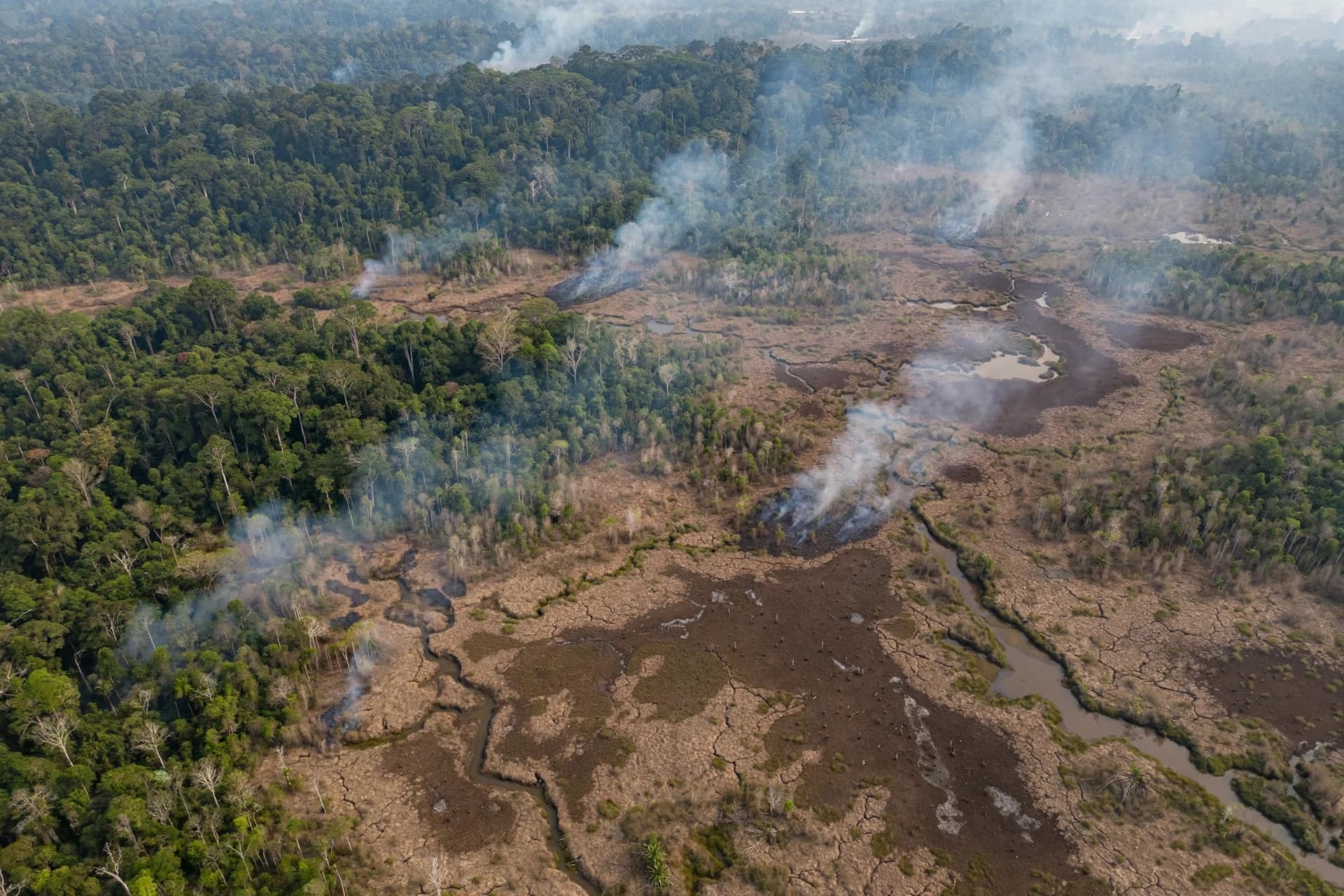
The September sky over parts of Indonesia has carried a different kind of silence this year. In several areas, the usual rhythm of rain has been replaced by heat, dry vegetation and smoke drifting across landscapes that are familiar with seasonal fire, but not always with fire of this scale.
Reuters reported that Indonesia’s wildfire situation has intensified during 2026 as a strong El Niño pattern contributes to unusually hot and dry conditions. Kalimantan, particularly, has become one of the areas where the effects are most visible, with fires spreading through forests and peatlands while communities remain exposed to smoke.
The scale of the fires has also appeared in satellite observations. Data reported by Reuters from the European Union’s Copernicus climate monitoring service showed Indonesian wildfire carbon dioxide emissions reaching extremely high levels in early September. The figures placed Indonesia among the largest sources of wildfire-related emissions globally during that period.
Behind those numbers are landscapes that respond differently when the rain disappears. Peatlands can hold fire beneath the surface, allowing flames and heat to remain difficult to detect and extinguish. A fire that appears to have weakened on the surface may therefore continue underground, creating another layer of difficulty for firefighters and local communities.
The human dimension is equally visible. In West Kalimantan, volunteer groups have been helping communities identify hotspots, respond to smaller fires and encourage safer land-clearing practices. Reuters reported that more than 140 women volunteers known as The Power of Mama have been working across several villages, reflecting how fire prevention has increasingly become a community effort.
For residents, however, the problem is not measured only in hectares or emissions. Smoke changes the ordinary rhythm of a day. Outdoor activities become more difficult, visibility can decline, and families must pay greater attention to the quality of the air they breathe. The landscape itself can begin to feel unfamiliar when a distant horizon disappears behind haze.
Government agencies have also deployed measures including water bombing and cloud seeding in an effort to contain the fires and encourage rainfall. Yet the effectiveness of those measures depends partly on weather conditions that remain beyond direct control. When dry conditions persist, even a successful response to one fire does not necessarily prevent another from emerging elsewhere.
The current season also carries a longer memory. Indonesia experienced a major fire crisis in 2015, when extensive burning generated severe environmental and public-health consequences. The country has since strengthened prevention efforts and peatland management, but the 2026 season demonstrates how quickly extreme weather can place those systems under pressure.
As the dry season continues, attention is increasingly turning toward the return of sustained rainfall. For communities living near forests and peatlands, rain is more than a weather event. It is a pause in the cycle of heat, smoke and uncertainty.
And somewhere between the fading dry season and the first heavier clouds, Indonesia is once again being reminded that forests, weather and human activity are closely connected. The fires may eventually disappear from the horizon, but the questions they leave behind—about land, climate and preparedness—remain much longer.
IMAGE DISCLAIMER
The illustrations are conceptual visualizations created for editorial presentation. They are not documentary photographs and should not be interpreted as direct photographic evidence of the reported events.
SOURCES
Reuters — Indonesia wildfire coverage, September 2026
European Union Copernicus Climate Change Service
Reuters — Reporting on Indonesian wildfire emissions and El Niño conditions, September 2026
Published by Banx Network. This article is part of the Banx decentralized media programme, powered by the BXE token on the XRP Ledger.