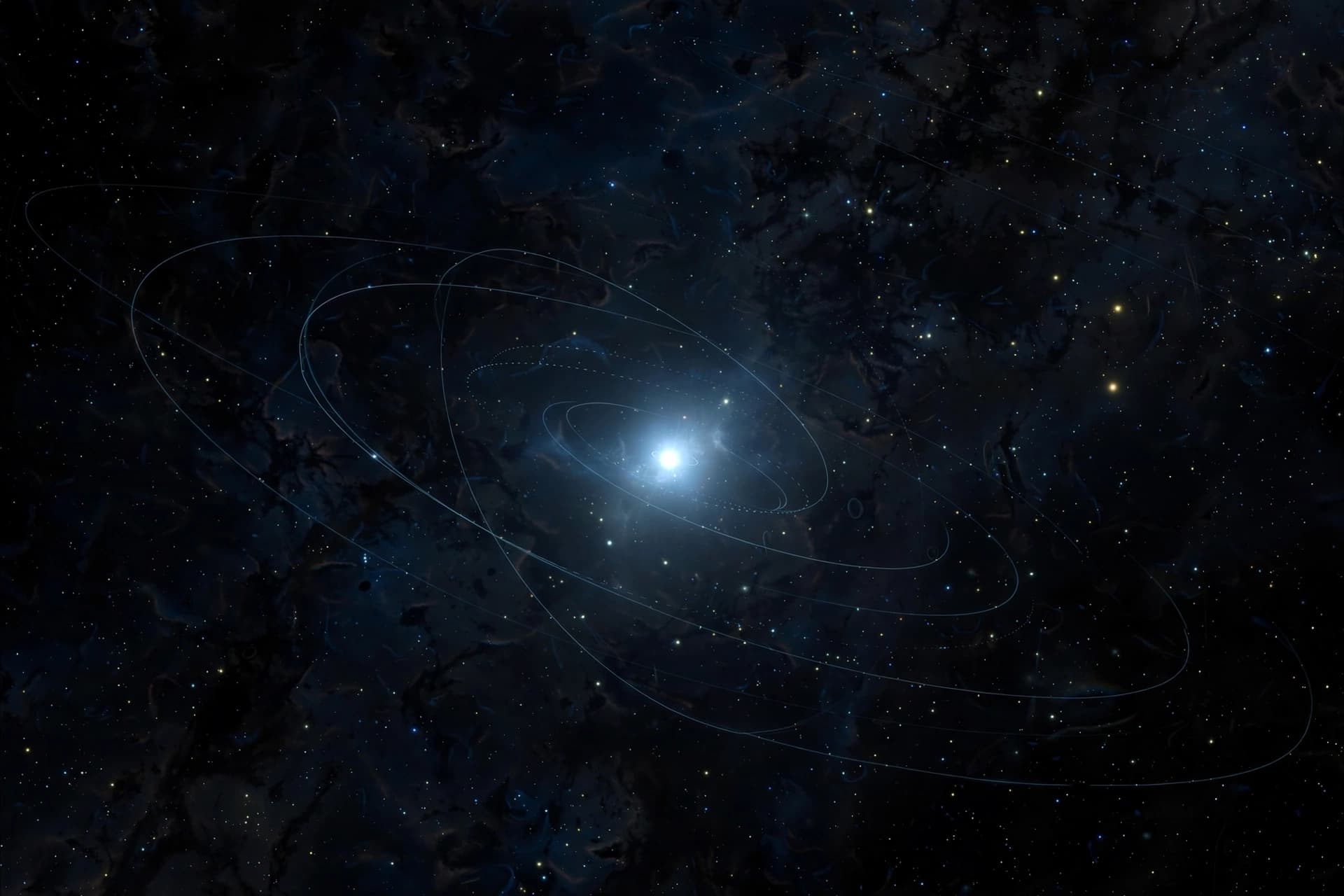
There are nights when the sky feels less like a ceiling and more like an opening—when the distance between what is seen and what is imagined begins to thin. In those quiet hours, the idea of other worlds does not arrive as spectacle, but as a slow unfolding, a reminder that beyond the familiar pull of gravity, there are atmospheres we have never felt and fields we have never touched.
It is into this quiet, expanding distance that a researcher at the University of Kansas now steps, carrying with her both the weight of curiosity and the rare recognition that accompanies it.
Hayley Beltz, a postdoctoral researcher in physics and astronomy, has been awarded the highly competitive NASA Hubble Fellowship Program, becoming the first scientist from the university to receive the honor in its history.
The fellowship, one of the most sought-after distinctions in astrophysics, supports a small cohort of early-career researchers each year, offering them the time and resources to pursue questions that stretch across the universe itself.
For Beltz, those questions orbit around exoplanets—worlds that exist beyond our solar system, often many light-years away. Her work focuses on something even less visible than these distant planets: their magnetic fields, the unseen forces that shape atmospheres, protect surfaces, and perhaps quietly determine whether life, as we understand it, might endure.
There is a certain paradox in studying what cannot be touched. The data arrives as light, collected by instruments such as the Hubble Space Telescope, traveling across vast stretches of space before settling into equations and models on Earth. From these fragments, Beltz builds simulations—mathematical atmospheres where heat, motion, and magnetism interact in ways that might explain how distant planets breathe, shift, and evolve.
Her research aims to deepen understanding of how planetary magnetic fields influence atmospheric behavior, a factor considered essential in shaping environments that could support life. As she has noted, learning about these distant systems also reflects back on Earth itself, offering insight into the range of planetary formation and the fragile balance that sustains life here.
The fellowship will provide up to three years of support, enabling her to expand this work—developing new models, mentoring students, and contributing to a broader scientific dialogue that spans institutions and continents.
Around her, the rhythms of the university continue: classrooms fill, semesters turn, and the sky above Kansas remains unchanged to the casual observer. Yet somewhere within that stillness, new interpretations of distant worlds are being shaped—quietly, patiently, in the language of data and light.
The NASA Hubble Fellowship Program selects approximately two dozen early-career researchers each year to support independent research in astrophysics. Beltz’s award will fund her exoplanet studies at the University of Kansas for the next three years.
AI Image Disclaimer
Illustrations were created using AI tools and are not real photographs.
Source Check: Lawrence Journal-World; Lawrence Times; KU News; Yahoo News
Published by Banx Network. This article is part of the Banx decentralized media programme, powered by the BXE token on the XRP Ledger.