Night over Moscow carries a different kind of silence now—one that listens as much as it rests. The city’s lights remain steady, reflected in glass and river, but above them, the air has become a space of vigilance. What once felt distant now passes overhead, unseen yet deeply registered, altering the rhythm of evenings that used to fade quietly into morning.
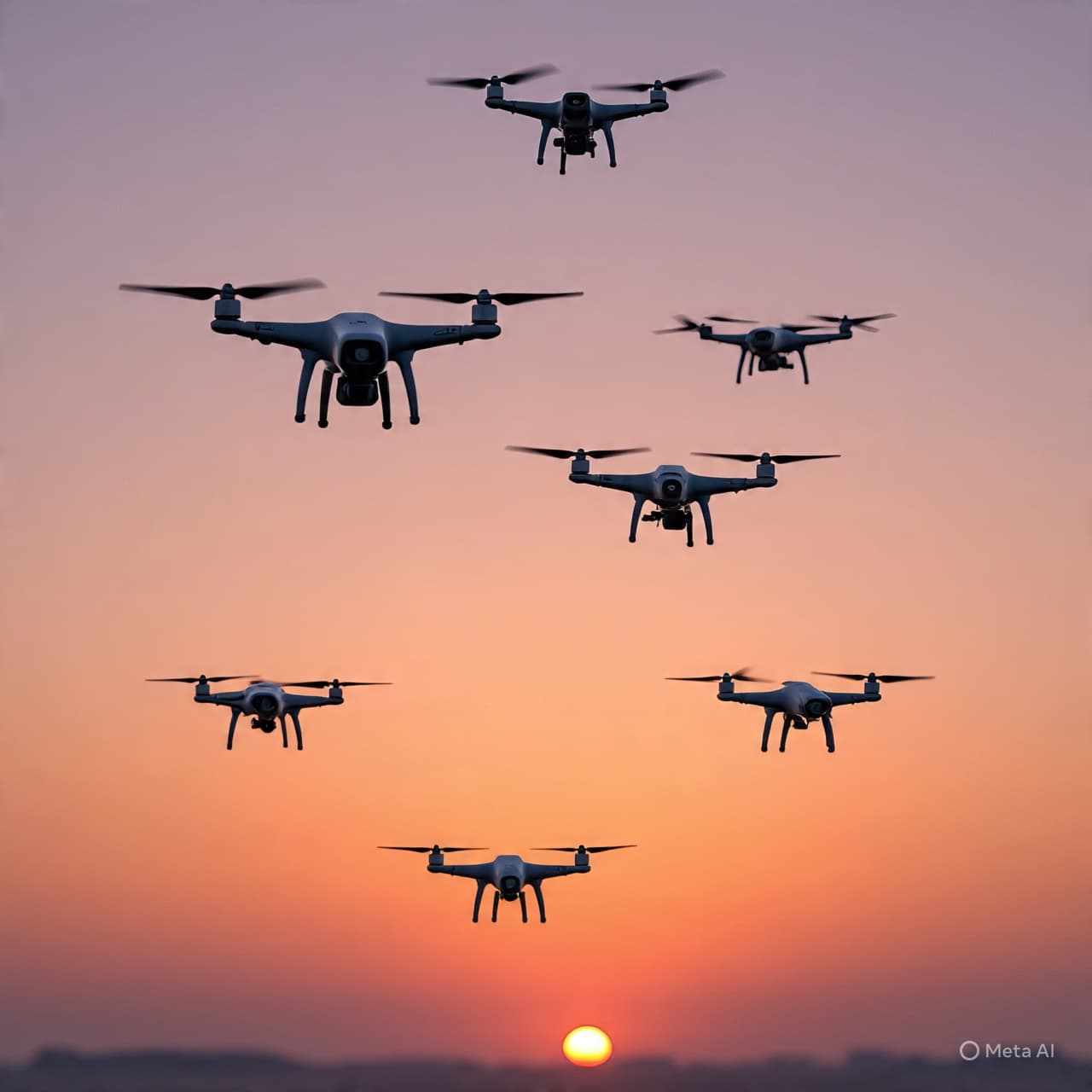
In recent days, that unseen movement has intensified. Russian authorities report that nearly 400 drones launched from Ukraine were intercepted across multiple regions, marking one of the largest waves of aerial activity since the conflict began. The numbers arrive in official briefings, precise and measured, yet they carry with them a sense of scale that is difficult to fully grasp—a sky increasingly populated by trajectories of intent.
The exchanges between Russia and Ukraine have, over time, shifted in form as much as in frequency. Where once the front lines were imagined primarily along the ground, they now extend upward, into airspace that connects cities, infrastructure, and distant points with a speed that compresses geography itself. Drones, small and often difficult to detect, have become instruments of both reach and response, their presence reshaping how distance is understood in conflict.
Officials in Moscow have described the interceptions as largely successful, emphasizing the role of air defense systems in preventing broader damage. Yet even in interception, there is disruption. Airports pause and resume, flights are delayed, and fragments of debris remind those below that the exchange, though distant in origin, is immediate in consequence. The ordinary patterns of urban life adjust, subtly but persistently, to accommodate this new dimension.
Across the border, Ukrainian officials continue to frame such operations as part of a broader effort to counterbalance Russian military pressure, particularly in areas where ground fighting remains intense. The aerial domain, in this sense, becomes not only a tactical extension but also a space of signaling—each launch and interception carrying implications beyond its immediate target.
The scale of recent activity suggests an escalation not necessarily in declaration, but in intensity. Waves of drones, moving in coordinated patterns, reflect both technological adaptation and strategic recalibration. Defense systems respond in kind, creating a cycle that unfolds above cities and fields alike, largely unseen yet widely felt.
For those living beneath these trajectories, the experience is one of layered awareness. Daily routines continue—commuters moving through stations, lights flickering on in apartment windows—but they do so under a sky that has become part of the story in a new way. The distance between conflict and civilian space feels narrower, not through proximity alone, but through repetition.
As reports continue to emerge, the central facts remain stark. Russia says it has shot down nearly 400 Ukrainian drones in a recent surge of aerial attacks, while Ukraine maintains its campaign as part of a broader strategic effort. Between these positions lies a conflict that increasingly occupies the air itself—expanding, adapting, and reshaping the contours of how it is both fought and experienced.
AI Image Disclaimer These visuals are AI-generated and intended for illustrative purposes only.
Sources Reuters BBC News The New York Times Al Jazeera Associated Press
Published by Banx Network. This article is part of the Banx decentralized media programme, powered by the BXE token on the XRP Ledger.