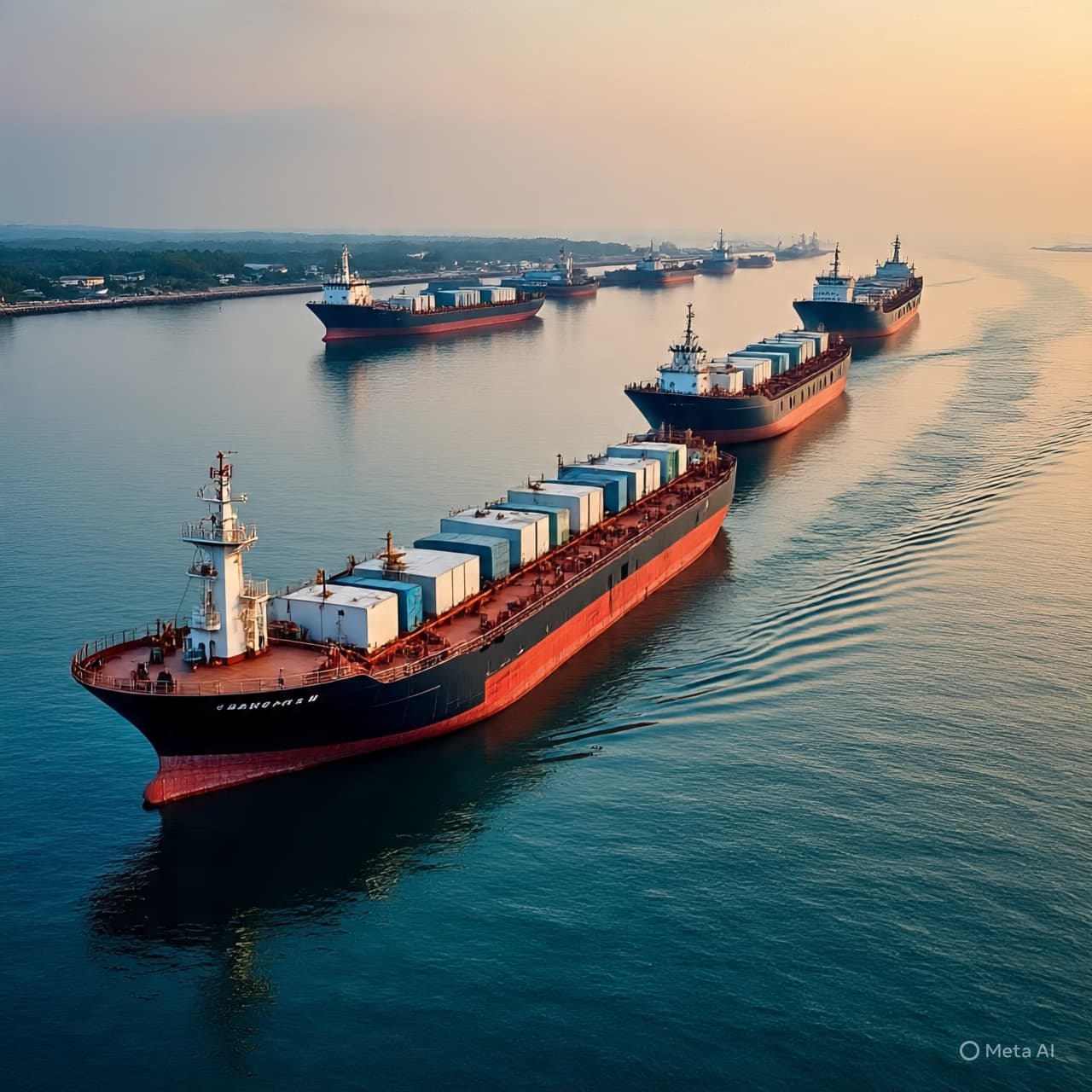
Morning breaks gently over the waters between the Arabian Peninsula and the Iranian coast, where tankers usually move in slow, deliberate lines, like beads sliding across a polished string. The sea here has long carried more than ships. It carries expectation — of fuel reaching ports, of containers arriving on time, of markets waking to continuity rather than interruption.
Yet even a narrow passage can feel vast when tension gathers at its edges.
The recent escalation between the United States and Iran has drawn global attention back to the Strait of Hormuz, a slender corridor linking the Persian Gulf to the open sea. It is a maritime artery through which roughly one-fifth of the world’s oil supply and significant volumes of liquefied natural gas typically pass. On ordinary days, it is a place of choreography — vessels guided by maritime lanes, insurers underwriting risk, port operators anticipating arrival times with quiet precision.
In recent days, that choreography has faltered.
Following U.S. and Israeli strikes on Iranian targets and subsequent retaliation across the Gulf, shipping companies began slowing or suspending transit through the strait. Some vessels have turned back. Others wait in holding patterns offshore. Maritime insurers have reassessed war-risk coverage, in some cases suspending it altogether, leaving shipowners to weigh not only safety but financial exposure.
The disruption has not required a formal closure to be felt. Even partial constraints in passage have rippled outward. Industry executives report that a notable share of the global container fleet — vessels that carry everything from automotive parts to household goods — has been delayed or rerouted. Alternative routes, including longer passages around Africa, extend voyages by days or weeks. Freight rates respond accordingly, rising in quiet increments that accumulate across supply chains.
Energy markets, sensitive to any tremor in this corridor, have reacted with volatility. Oil prices have fluctuated as traders calculate risk premiums into each barrel expected to leave Gulf terminals. Import-dependent economies watch closely. Manufacturers review inventories. Retailers measure timelines against shipping calendars that now appear less certain.
The strait’s geography has always lent it significance. At its narrowest point, shipping lanes compress into a channel only a few miles wide in each direction. To the north lies Iran; to the south, Oman and the United Arab Emirates. Its vulnerability is less about distance than about proximity — how closely commerce moves to geopolitics.
For the global cargo industry, the present strain is both immediate and psychological. Ships delayed today may still arrive tomorrow. But contracts, insurance frameworks, and freight futures are built on predictability. When that predictability wavers, costs multiply in subtle layers: higher premiums, fuel surcharges, longer charter times.
Diplomatic efforts are underway as international actors call for restraint and the safeguarding of maritime navigation. Naval forces in the region have heightened patrols, and shipping advisories continue to evolve as risk assessments are updated. Industry groups emphasize that while trade has not ceased entirely, the system is operating under visible tension.
In direct terms, escalating hostilities between the United States and Iran have significantly disrupted traffic through the Strait of Hormuz, delaying vessels, raising insurance and freight costs, and increasing volatility in global energy and cargo markets. The situation remains fluid as governments and maritime authorities assess security conditions and seek to prevent further interruption to one of the world’s most critical shipping lanes.
AI Image Disclaimer
Illustrations were created using AI tools and are not real photographs.
Sources (Media Names Only)
Reuters Associated Press The Guardian Financial Times Bloomberg
Published by Banx Network. This article is part of the Banx decentralized media programme, powered by the BXE token on the XRP Ledger.