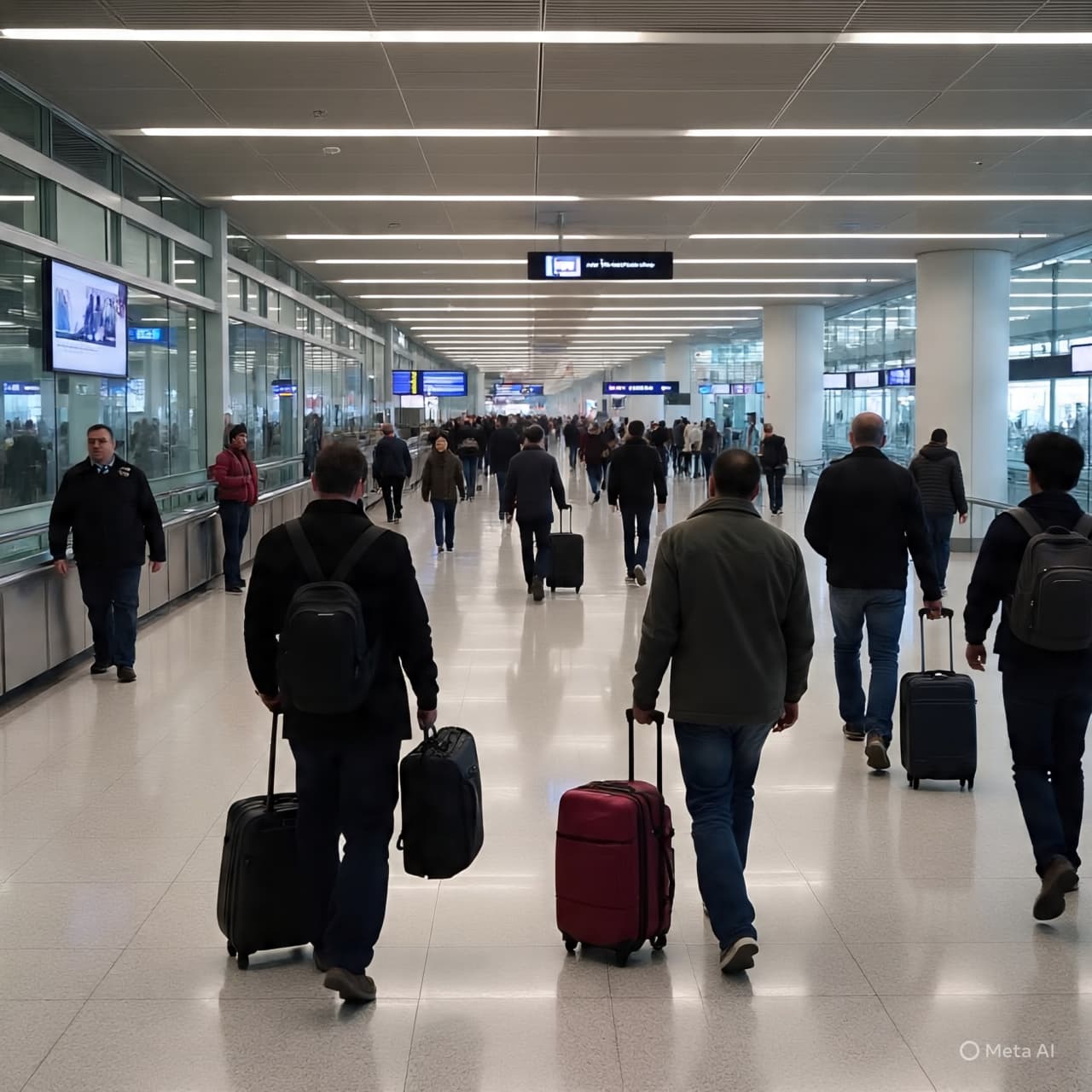
Airports have always belonged to a peculiar kind of time. Not quite anchored, not entirely in motion—just a long corridor of anticipation where footsteps echo and departure boards flicker like distant constellations. People move through them with quiet intention, holding documents, holding destinations, holding the belief that the journey will proceed as planned.
And yet, sometimes, the movement pauses.
At San Francisco International Airport, amid the steady rhythm of travelers preparing to leave one place for another, a moment unfolded that seemed to gather stillness around it. What is usually a seamless passage—from entrance to gate, from gate to sky—was interrupted by an encounter that held its ground, quietly but firmly.
Reports indicate that officers from the Transportation Security Administration alerted agents from U.S. Immigration and Customs Enforcement ahead of the detention of a woman and her young child inside the airport. The arrest took place before they could board a domestic flight, shifting what might have been an ordinary departure into something far more contained, more immediate.
The two individuals were identified as having prior removal orders issued years earlier. Their presence within the terminal, already a space defined by scrutiny and verification, became the point at which separate systems of oversight converged. By the following day, they had been transferred out of state, and shortly thereafter, deported. The sequence moved with a certain efficiency, as though mirroring the operational precision that defines modern travel itself.
Still, what lingers is not the speed, but the setting.
Airports are environments of quiet control. Every bag passes through a scanner, every identity is briefly examined, every traveler moves within a system designed to observe without appearing to intrude. In recent weeks, however, that balance has felt subtly altered. Federal decisions to deploy immigration agents within airport spaces—officially to assist with logistical pressures—have introduced a presence that is both visible and difficult to define.
Within such spaces, roles seem to overlap. Assistance and enforcement exist side by side, sometimes indistinguishable in the moment they appear. For most travelers, the distinction may remain distant, absorbed into the background hum of announcements and footsteps. But for others, it becomes immediate, shaping the course of a journey before it has the chance to begin.
The terminal, after all, is not only a place of departure. It is also a place where identities are confirmed, where records surface, where past decisions can quietly meet the present.
Officials have stated that the arrest was carried out based on existing legal orders and was not part of a broader operational sweep. Local airport authorities were reportedly not notified in advance, and the incident did not disrupt overall airport operations. Flights departed, announcements continued, and the larger rhythm of travel remained intact.
And yet, within that rhythm, a single pause can echo.
Travelers continued to move through the terminal, carrying with them the quiet expectation of forward motion. Planes lifted into the sky, tracing their familiar paths across distances that seemed, for most, uninterrupted.
But somewhere between the check-in counter and the boarding gate, there remains a subtle awareness—almost imperceptible, yet present—that even in places built for movement, there are moments when the journey turns inward, and the path ahead briefly closes.
Illustrations were created using AI tools and are not real photographs.
Sources San Francisco Chronicle Washington Post Condé Nast Traveler The Guardian Wired
Published by Banx Network. This article is part of the Banx decentralized media programme, powered by the BXE token on the XRP Ledger.