
Key Highlights
- Incident:TSA and ICE agents detained a woman and child at San Francisco International Airport.
- Background:The individuals had prior removal orders, leading to their swift deportation.
- Impact:The presence of immigration enforcement at airports raises concerns about traveler experiences.
In the unique environment of airports, time often feels suspended. Travelers navigate through a maze of anticipation, where every footstep and flickering departure board contributes to a collective journey. Yet, within this orchestrated chaos, moments can arise that disrupt the flow, revealing the complexities of authority and movement.
At San Francisco International Airport, a recent incident exemplified this disruption. Reports surfaced that officers from the Transportation Security Administration (TSA) coordinated with agents from U.S. Immigration and Customs Enforcement (ICE) to detain a woman and her young child just before they were set to board a domestic flight. This event transformed what would have been a routine departure into a significant moment of tension and scrutiny.
The individuals involved were identified as having prior removal orders, which had been issued years earlier. Their presence in the airport, a space typically characterized by the anticipation of travel, became a focal point for the convergence of different oversight systems. Following their detention, they were swiftly transferred out of state and subsequently deported, reflecting the operational efficiency that often defines airport procedures.
Airports are designed to maintain a delicate balance between security and the seamless flow of passengers. Every bag is scanned, every identity checked, and every traveler monitored within a framework that aims to ensure safety without overt intrusion. However, recent federal decisions to deploy immigration agents within these spaces have introduced a new layer of visibility and complexity. This presence, while officially justified as a response to logistical pressures, raises questions about the implications for travelers.
In this context, the roles of assistance and enforcement can become blurred. For many passengers, the presence of ICE agents may fade into the background noise of announcements and bustling crowds. Yet for others, particularly those who may be vulnerable to scrutiny, the impact is immediate and profound, shaping their travel experience before it even begins.
Officials have clarified that the arrest was executed based on existing legal orders and was not part of a broader operational sweep. Local airport authorities were reportedly not informed in advance, and the incident did not disrupt overall airport operations. Flights continued to depart, and the rhythm of travel persisted, yet the echoes of that single pause lingered in the air.
As travelers moved through the terminal, they carried with them the expectation of forward motion. Planes ascended into the sky, charting their familiar courses across the horizon. However, the awareness of potential interruptions—of the intersection between movement and authority—remained a subtle undercurrent in the airport atmosphere. In spaces designed for transit, moments of inward reflection can emerge, reminding us that even in the most dynamic environments, the journey can be unexpectedly altered.
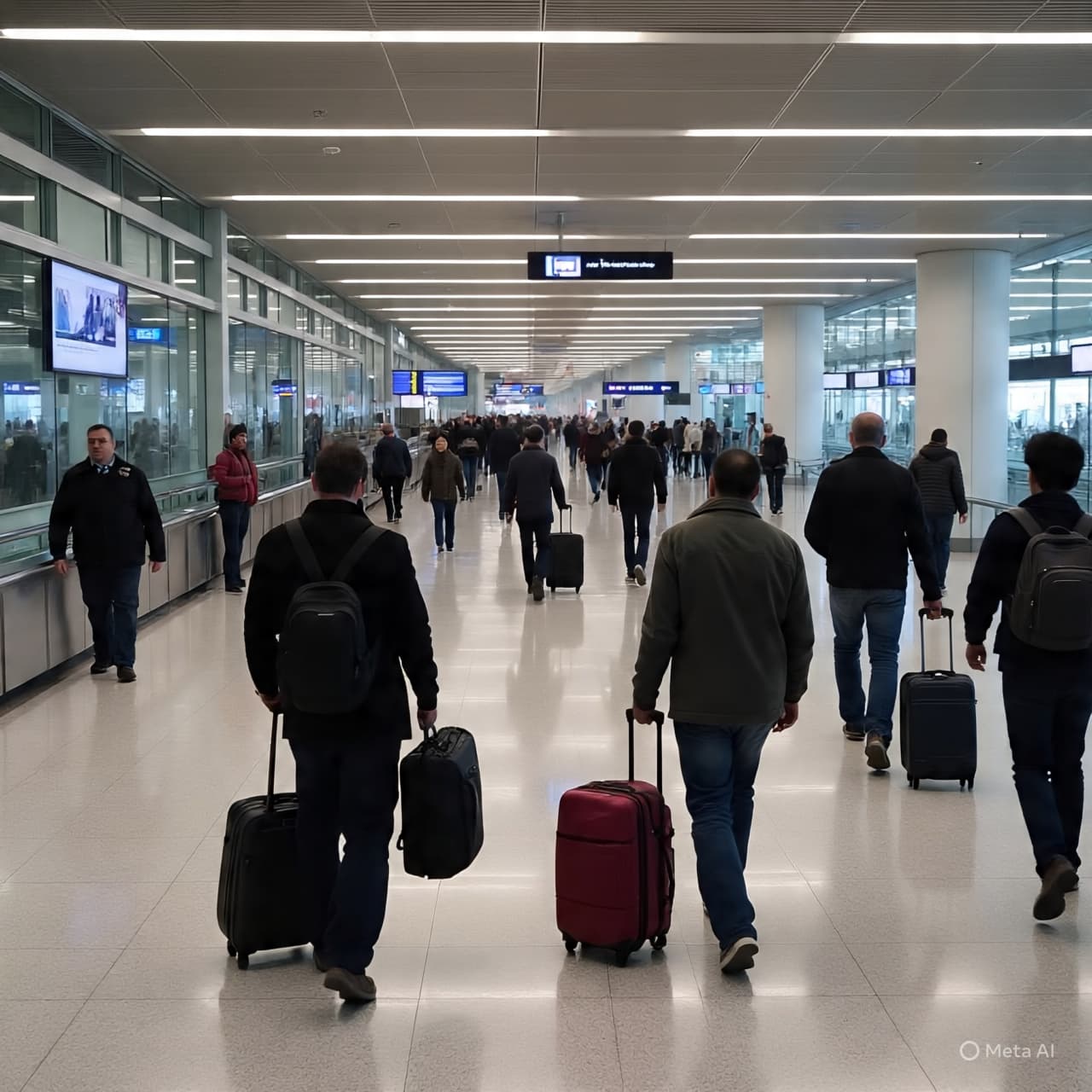
Illustrations were created using AI tools and are not real photographs.
Published by Banx Network. This article is part of the Banx decentralized media programme, powered by the BXE token on the XRP Ledger.



