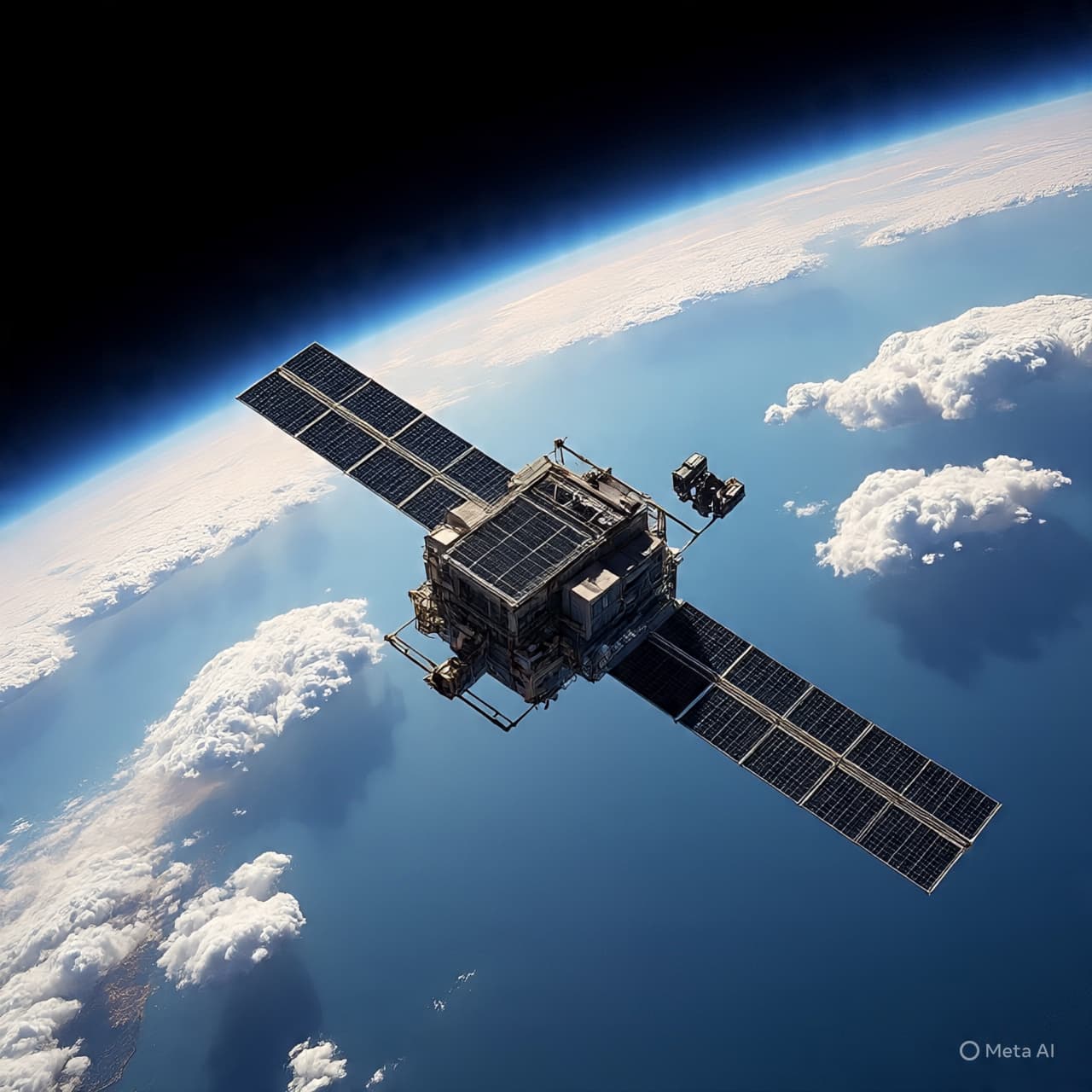
Morning light slips quietly across the curved horizon of Earth, turning oceans into silver and continents into shadowed relief. Above that shifting canvas, the International Space Station continues its measured orbit — a laboratory in perpetual motion, circling the planet every ninety minutes while life inside follows a rhythm all its own.
This week, that rhythm includes preparation and continuity at once. A SpaceX Dragon spacecraft has been packed for a scheduled Thursday departure, its cargo stowed and systems checked as part of the station’s regular cycle of crew rotation and resupply. Yet even as departure procedures advance, research aboard the orbiting outpost continues without pause.
Inside the station’s modules, astronauts move carefully through their final tasks: securing experiment samples, transferring equipment, reviewing checklists. Dragon, docked and pressurized, stands ready to undock and begin its descent sequence that will ultimately bring crew and scientific materials back to Earth. The departure marks another step in NASA’s partnership with SpaceX under the Commercial Crew Program, a framework that has reshaped how astronauts travel to and from low Earth orbit.
But departure does not mean downtime.
Crew members remaining aboard the station have continued human research investigations spanning physiology, cognitive performance, and long-duration spaceflight adaptation. Studies examining muscle tone, bone density, and fluid distribution remain central to understanding how the human body adjusts to microgravity. Other projects focus on immune system responses and cardiovascular changes — data considered essential for planning future missions to the Moon and, eventually, Mars.
The Dragon spacecraft itself carries more than people. It transports experiment results — biological samples, hardware components, and data storage devices — back to Earth laboratories for detailed analysis. Each return capsule becomes a bridge between orbital observation and terrestrial science, closing loops that began hundreds of kilometers above the surface.
Beyond biomedical research, station crews have also maintained technology demonstrations and Earth observation projects. From monitoring climate patterns to testing advanced materials, the laboratory’s work continues in overlapping cycles, independent of individual arrivals and departures. The station’s design anticipates this continuity; science aboard it is not episodic but ongoing.
As Thursday approaches, mission control teams on the ground coordinate closely with astronauts in orbit. Weather conditions, orbital mechanics, and recovery logistics must align precisely. The choreography is technical and procedural, refined over years of missions that have made commercial crew transport a regular feature of modern spaceflight.
The broader significance lies in routine itself. What once required rare and highly publicized launches has become a steady cadence. Crews rotate, experiments proceed, capsules dock and depart — all while the station maintains its quiet vigil over Earth.
When Dragon undocks, it will drift briefly before firing thrusters to lower its orbit. Hours later, parachutes will bloom above the ocean, and recovery vessels will retrieve the capsule and its occupants. Back on Earth, researchers will open containers holding samples shaped by microgravity, translating orbital data into insights that may inform medicine and exploration alike.
For now, the station continues to circle, indifferent to individual milestones. In its modules, laptops glow, experiments hum, and Earth passes below in endless variation. Packing a spacecraft and pursuing science are not separate acts here; they are intertwined movements within a larger choreography — one that sustains humanity’s presence in orbit, one departure and one discovery at a time.
Published by Banx Network. This article is part of the Banx decentralized media programme, powered by the BXE token on the XRP Ledger.