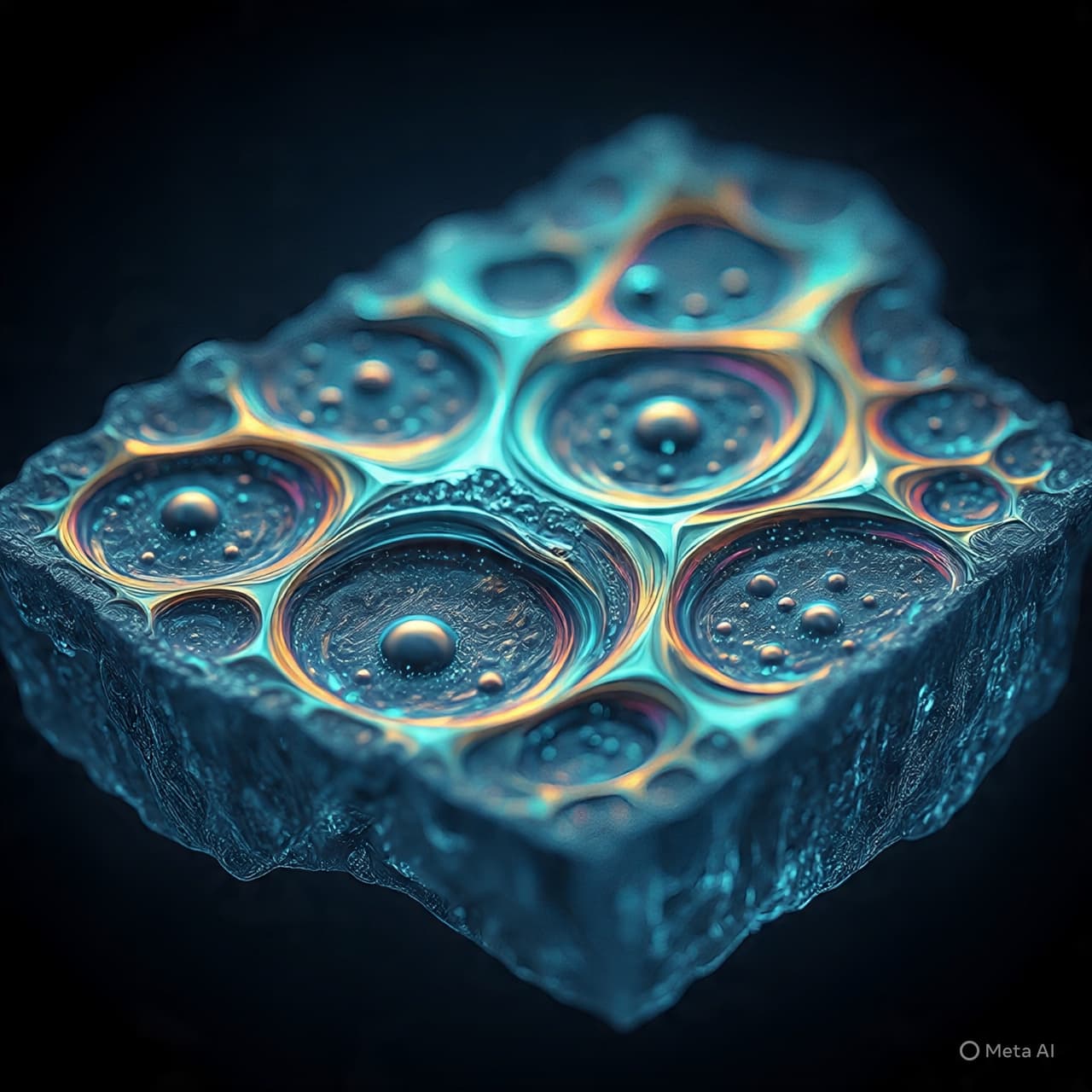
There is a moment, difficult to see and easier to imagine, where solidity is not yet certain. A place along the surface of ice where structure loosens, where order softens just enough to allow motion to return. It is neither fully frozen nor fully fluid, but something in between—a threshold where change becomes possible.
Scientists have long been aware of this boundary, often described through the lens of the quasi-liquid layer. It exists as a delicate film on ice and ice-like materials, forming even at temperatures below the point we typically associate with melting. Within this layer, molecules are less rigidly held, able to shift and rearrange in ways that solid structures alone would resist.
Recent research has begun to illuminate how this nearly invisible layer does more than simply exist—it governs how ice itself grows. Rather than forming through a single, uniform process, ice appears to rely on this softened boundary to mediate its expansion. The quasi-liquid layer becomes a kind of intermediary, guiding how molecules attach, detach, and reorganize as the crystal develops.
In ice-like materials—substances that share structural similarities with ice but extend into other domains of chemistry and materials science—this mechanism takes on broader significance. Growth is no longer just a matter of accumulation, but of negotiation at the surface. The presence, thickness, and behavior of this layer can determine whether a structure forms smoothly or irregularly, slowly or rapidly.
Temperature, naturally, plays a central role. As conditions shift closer to melting, the quasi-liquid layer thickens, allowing greater mobility at the surface. Farther below that threshold, it thins, tightening the constraints on molecular movement. Yet it rarely disappears entirely. Even in deep cold, a trace of this softened boundary remains, quietly influencing the way crystals evolve.
What emerges from this understanding is a more nuanced view of ice—not as a static, rigid substance, but as a system in subtle motion. The distinction between solid and liquid, often treated as absolute, reveals itself instead as a gradient, a continuum shaped by environment and scale. The quasi-liquid layer occupies this gradient, translating temperature and energy into structure.
Beyond natural ice, the implications extend outward. In fields ranging from climate science to materials engineering, controlling how surfaces behave at this boundary could influence everything from frost formation to the design of advanced crystalline materials. The same principles that guide a snowflake’s growth may, in time, inform how we build and manipulate matter at the microscopic level.
The image that remains is a quiet one: a surface that appears still, yet carries within it a constant, gentle rearrangement. Ice, in this sense, is not only a record of cold, but of transition—an ongoing balance between holding form and allowing change.
Researchers have found that a thin quasi-liquid layer on ice surfaces plays a key role in controlling how ice and ice-like materials grow. This layer allows molecular movement even below freezing, influencing crystal structure and growth rates across a range of temperatures.
AI Image Disclaimer
These images are AI-generated for illustrative purposes and do not depict real experimental visuals.
Sources
Nature Science Physical Review Letters Nature Materials Proceedings of the National Academy of Sciences
Published by Banx Network. This article is part of the Banx decentralized media programme, powered by the BXE token on the XRP Ledger.