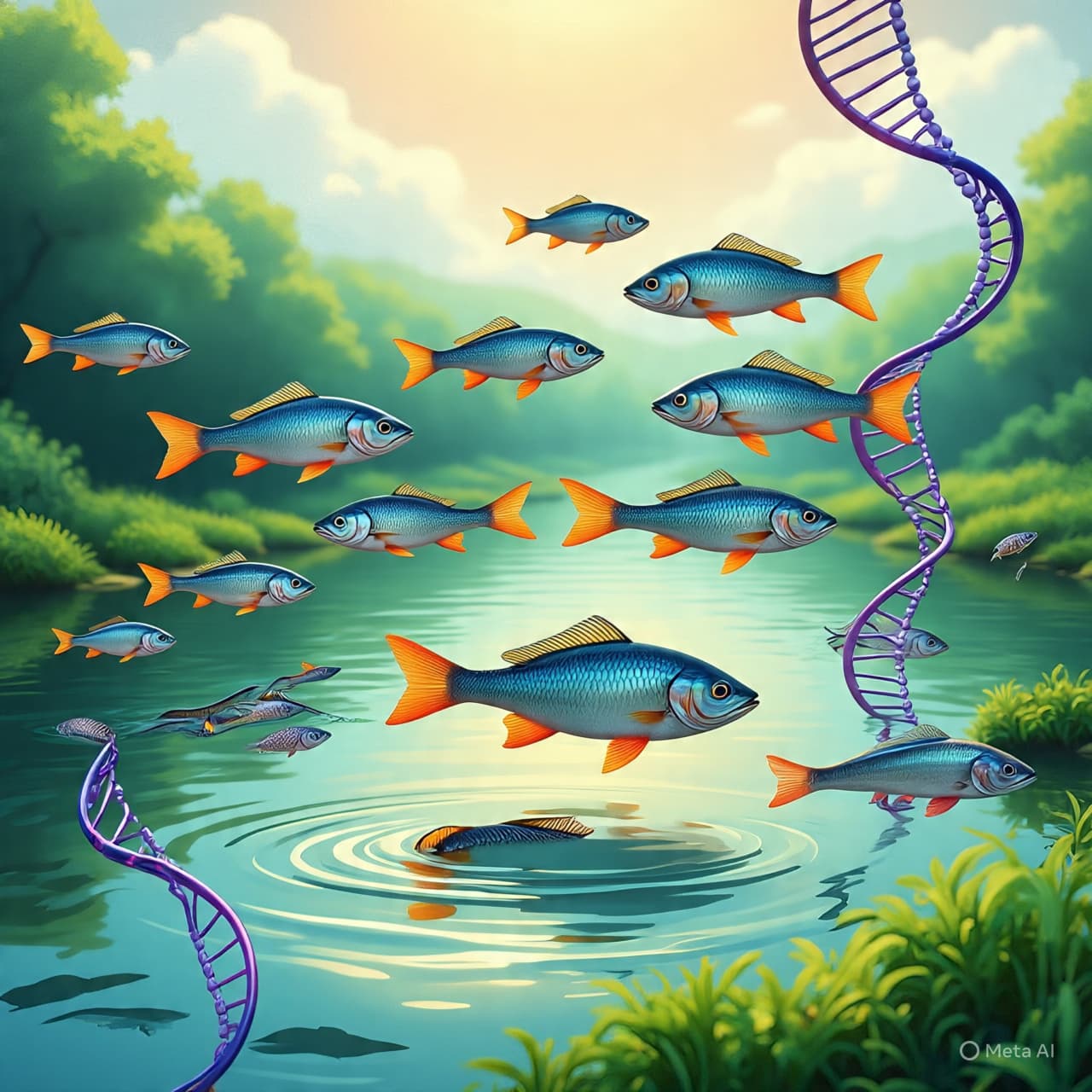
In quiet freshwater streams, where the current moves slowly through reeds and shadowed banks, small fish move through the water in careful patterns. Their lives unfold with a rhythm that seems familiar to biology: feeding, growing, reproducing, and passing genes forward into the future.
Yet among these fish exists a species whose story unfolds differently. Instead of reproduction through mating, it produces offspring that are nearly perfect genetic copies of the mother. Generation after generation, the lineage continues through cloning.
For many years, scientists viewed such systems as evolutionary cul-de-sacs. Without the mixing of genes that occurs during sexual reproduction, populations were thought to accumulate harmful mutations and lose the genetic flexibility needed for adaptation. Variation, after all, is the quiet engine of natural selection.
But biology often holds exceptions to its own expectations.
Recent research has revealed that in a clonal fish species, a process known as gene conversion may provide a subtle path for evolution to continue. Though the fish reproduce without the usual exchange of genes between parents, their genomes still contain mechanisms capable of reshaping genetic information within individual chromosomes.
Gene conversion occurs when one DNA sequence is replaced by a copy of a similar sequence nearby. Instead of exchanging segments between paired chromosomes, the process effectively “corrects” one sequence using another as a template. The result is a quiet rewriting of genetic information—one that can remove harmful mutations or spread beneficial ones through the genome.
In the clonal fish studied by researchers, this process appears to play a surprising role. By selectively replacing mutated segments with intact versions, gene conversion may help maintain functional genes across generations, preventing the gradual deterioration predicted for strictly clonal lineages.
Even more intriguingly, the mechanism can interact with natural selection itself. When beneficial mutations arise, gene conversion can increase their presence within the genome by copying them across homologous regions. Over time, advantageous genetic changes may spread despite the absence of sexual recombination.
The discovery reshapes a long-standing assumption in evolutionary biology. Clonal organisms were once thought to exist largely outside the ordinary dynamics of adaptation. Without recombination, they seemed locked into static genetic patterns.
Yet the genome, like many biological systems, contains hidden layers of flexibility. Processes such as gene conversion create opportunities for genetic refinement, even in species that reproduce by copying themselves.
The fish themselves continue their lives much as before—moving through freshwater habitats, feeding among plants, and producing offspring that resemble them almost exactly. But within their cells, small acts of genetic editing are taking place, preserving variation in ways that were once overlooked.
The study reports that gene conversion events within the genome of a clonal fish species can remove deleterious mutations and amplify beneficial variants, allowing natural selection to remain active despite the absence of sexual reproduction.
AI Image Disclaimer
Visuals are AI-generated and serve as conceptual representations.
Source Check
Credible coverage and/or primary reporting exist from: Nature Ecology & Evolution ScienceDaily Phys.org Scientis New Scientist The Scientist
Published by Banx Network. This article is part of the Banx decentralized media programme, powered by the BXE token on the XRP Ledger.